Why Robot Vacuums Move in Random Patterns
Ever watched your robot vacuum zigzag across the room and wondered if it’s lost? Those seemingly random movements are actually a calculated cleaning strategy. In this guide, we’ll break down exactly why robot vacuums move the way they do, the technology behind their patterns, and how you can help them clean more effectively in your home.
You set your robot vacuum loose on your living room floor, and within minutes it’s bouncing off your coffee table, spiraling around a chair leg, and heading straight for the one corner you already vacuumed twice. It looks chaotic — almost comically inefficient. But here’s the thing: there’s real science behind every twist and turn.
Understanding why your robot vacuum moves the way it does isn’t just satisfying curiosity. It can help you set up your home for better cleaning, choose the right model for your needs, and troubleshoot when something isn’t working properly. Let’s dive into the fascinating world of robot vacuum navigation.
📑 Table of Contents
- How Robot Vacuum Navigation Actually Works
- Why Random Patterns Are More Effective Than You Think
- Different Navigation Systems and Their Patterns
- Factors That Make Your Robot Vacuum’s Pattern Look More Random
- How to Help Your Robot Vacuum Clean More Efficiently
- Troubleshooting: When Random Movement Isn’t Normal
- The Future of Robot Vacuum Navigation
- Conclusion
How Robot Vacuum Navigation Actually Works
Before we get into the “why,” it helps to understand the “how.” Robot vacuums don’t have eyes or a brain the way we do. Instead, they rely on a combination of sensors, algorithms, and sometimes cameras or lasers to figure out where they are and where they need to go.
The Basic Sensor Suite
Most robot vacuums, even budget-friendly models, come equipped with several types of sensors:
- Bump sensors: Physical sensors that detect when the vacuum makes contact with an object, triggering a reversal and redirection.
- Cliff sensors: Infrared sensors on the underside that detect drop-offs like stairs to prevent falls.
- Wall sensors: Side-facing infrared sensors that help the vacuum follow walls and edges.
- Optical encoders: Track wheel rotation to estimate distance traveled and direction.
- Gyroscopes: Help the vacuum maintain orientation and track its turning angles.
These sensors feed data into the vacuum’s onboard processor, which uses algorithms to decide the next move. The sophistication of those algorithms is what separates a $150 robot vacuum from a $1,000 one.
Random Bounce Navigation
The simplest and most common navigation method in entry-level robot vacuums is called random bounce navigation (sometimes called “bump and go”). Here’s how it works:
- The vacuum drives forward in a straight line.
- When it hits an obstacle, it reverses slightly, turns at a random angle, and drives forward again.
- This process repeats continuously throughout the cleaning cycle.
It sounds inefficient, right? But here’s the surprising part: randomized movement is mathematically effective. Think of it like this — if you dropped a handful of marbles on a floor, they’d eventually spread out and cover most of the surface. The same principle applies to a robot vacuum over time.
Why Random Patterns Are More Effective Than You Think
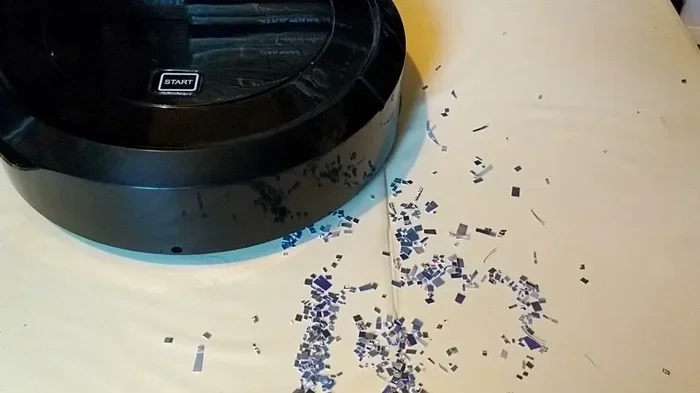
Visual guide about how to robot vacuum random movement
Image source: i.ytimg.com
It’s natural to look at a robot vacuum bouncing around and think, “This thing has no idea what it’s doing.” But research in robotics and probability theory tells a different story.
The Mathematics of Random Coverage
In robotics, this concept is related to something called a random walk or Brownian motion. A landmark study published in the field of computational geometry demonstrated that a randomly moving agent will eventually visit every accessible area of a bounded space — given enough time.
In practical terms, this means:
- A robot vacuum using random bounce navigation will eventually cover nearly every square inch of your floor.
- Over multiple cleaning sessions, the cumulative coverage approaches 95% or higher.
- The randomness actually prevents the vacuum from getting stuck in repetitive loops that miss certain areas.
Why Not Just Use a Straight-Line Pattern?
You might wonder: why not just program the vacuum to move in neat, straight lines like a lawn mower? The answer comes down to cost and complexity.
To follow a systematic pattern, a robot vacuum needs to:
- Know its exact position at all times (requires cameras, LiDAR, or advanced mapping sensors).
- Create and store a map of your home (requires significant processing power and memory).
- Plan an optimal route through that map (requires sophisticated pathfinding algorithms).
All of that technology adds cost. For manufacturers targeting the budget and mid-range markets, random navigation offers a reliable, low-cost solution that still gets the job done. If you’re curious about how to get the most out of these devices regardless of their navigation style, check out our guide on how to use a robot vacuum for practical tips.
Different Navigation Systems and Their Patterns
Visual guide about how to robot vacuum random movement
Image source: applianceteacher.com
Not all robot vacuums are created equal. The navigation system your vacuum uses has a huge impact on how it moves and how well it cleans.
Tier 1: Random Bounce (Budget Models)
Brands: iLife, Eufy RoboVac (basic models), iRobot Roomba 600 series
Pattern: Completely random. The vacuum drives until it hits something, then bounces off at a random angle. There’s no memory of where it’s been.
Pros: Affordable, simple, no setup required.
Cons: Can miss spots, may clean the same area multiple times, longer cleaning times needed for full coverage.
Tier 2: Smart Random / Algorithm-Enhanced (Mid-Range Models)
Brands: iRobot Roomba i3/i4, Eufy RoboVac G30, Roborock Q5
Pattern: These models use a hybrid approach. They still incorporate randomness but layer in algorithms that detect high-traffic areas, adjust speed based on surface type, and use gyroscopes to maintain better orientation. Some can even remember which areas they’ve cleaned in a single session.
Pros: Better coverage than pure random, still relatively affordable, improved efficiency.
Cons: No room mapping, can’t target specific rooms or zones.
Tier 3: Camera-Based Navigation (Upper Mid-Range)
Brands: iRobot Roomba j7/j9, Roborock S7/S8
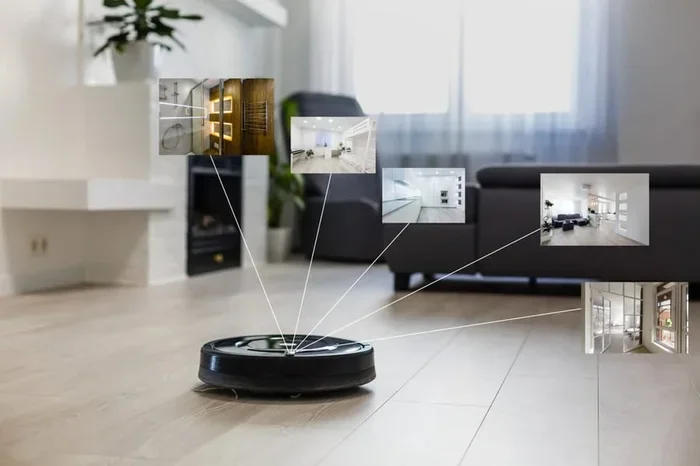
Pattern: These vacuums use cameras to recognize landmarks in your home — like the TV stand, kitchen island, or front door — and build a map over time. They clean in systematic, back-and-forth rows once the map is established.
Pros: Efficient row-by-row cleaning, can target specific rooms, obstacle avoidance.
Cons: Requires good lighting, cameras can be confused by very dark or reflective surfaces.
Tier 4: LiDAR Navigation (Premium Models)
Brands: Roborock S8 Pro Ultra, Dreame L20 Ultra, Ecovacs Deebot X2
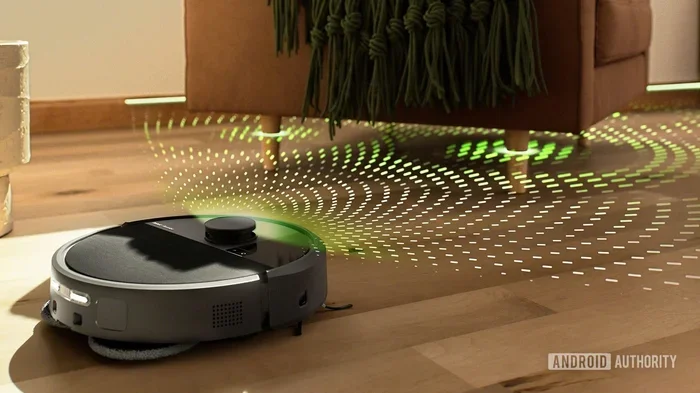
Pattern: LiDAR (Light Detection and Ranging) uses a spinning laser to create a precise 360-degree map of your home in real time. The vacuum then calculates the most efficient path and cleans in neat, systematic rows.
Pros: Most accurate mapping, works in complete darkness, allows for no-go zones and room-specific cleaning.
Cons: Most expensive option, the spinning LiDAR unit adds height (may not fit under low furniture).
Factors That Make Your Robot Vacuum’s Pattern Look More Random
Visual guide about how to robot vacuum random movement
Image source: androidauthority.com
Even robot vacuums with advanced navigation can sometimes seem erratic. Several environmental factors can disrupt even the most sophisticated cleaning patterns.
Furniture and Obstacles
Your home is an obstacle course. Chair legs, table bases, pet bowls, shoes, and power cords all force your vacuum to change direction. A room with lots of furniture will naturally produce a more chaotic-looking path than an open floor plan.
Tip: Before running your vacuum, do a quick sweep of the floor. Pick up small objects, tuck away cords, and push chairs in. This simple step can dramatically improve cleaning efficiency and reduce the “random” appearance of the path.
Floor Type Transitions
Moving from hardwood to a thick area rug, or from tile to a threshold strip, can confuse sensors and cause sudden direction changes. Some models slow down or speed up on different surfaces, which can make the pattern look inconsistent.
If you have mostly hard floors, you might want to check out our top picks for tile floors to find a model optimized for your surface type.
Low Battery Behavior
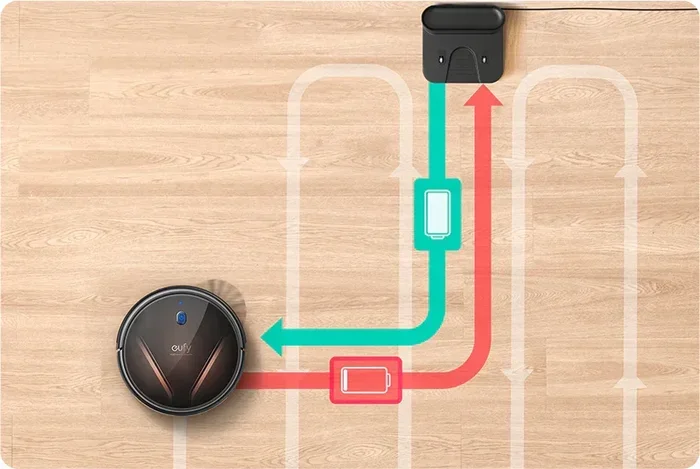
When your robot vacuum’s battery gets low, many models switch to a “homing” mode where they try to find their charging dock. This search pattern can look especially random, as the vacuum may spiral outward or follow walls in an attempt to locate the dock’s infrared signal.
Dirty or Obstructed Sensors
This is one of the most common reasons a robot vacuum starts behaving erratically. Dust-covered cliff sensors can trigger false drop-off warnings, causing the vacuum to reverse unnecessarily. A dirty bumper sensor might not register contact with objects, leading to harder-than-normal bumps and unpredictable redirections.
Regular maintenance is key. Learn how to clean robot vacuum sensors to keep your device navigating smoothly.
How to Help Your Robot Vacuum Clean More Efficiently
Regardless of which navigation system your robot vacuum uses, there are several things you can do to improve its performance and reduce wasted movement.
1. Prepare the Floor Before Each Run
Spend 60 seconds picking up small items — socks, toys, charging cables, and pet accessories. This single habit can reduce random redirections by up to 40% and significantly improve coverage.
2. Use Virtual Walls and No-Go Zones
Most modern robot vacuums support virtual barriers, either through physical magnetic strips or through app-based no-go zones. Use these to block off areas where your vacuum frequently gets stuck, like under a low couch or around a pet feeding station.
3. Run It More Often
Here’s a counterintuitive truth: running your robot vacuum daily for 30 minutes is more effective than running it once a week for three hours. Frequent, shorter runs allow the vacuum to cover different areas each time, and the cumulative effect of random navigation means more complete coverage over time.
4. Maintain the Sensors and Brushes
Clean the cliff sensors, bumper sensors, and brush roll at least once a week. A well-maintained vacuum navigates more accurately and avoids the erratic behavior caused by sensor malfunctions.
5. Optimize Your Charging Dock Placement
Place the charging dock against a wall in an open area, with at least 3 feet of clearance on both sides and 5 feet in front. This makes it easier for the vacuum to dock efficiently and reduces the random searching behavior that drains battery life.
Troubleshooting: When Random Movement Isn’t Normal
While some randomness is expected, certain behaviors indicate a problem. Here’s what to watch for:
Spinning in Circles
If your vacuum spins in tight circles without moving forward, one of its drive wheels may be stuck, jammed with hair or debris, or the wheel sensor may be malfunctioning. Flip the vacuum over and inspect both wheels for obstructions.
Repeatedly Hitting the Same Wall
This usually indicates a dirty or faulty cliff sensor. The vacuum thinks it’s approaching a staircase and keeps reversing. Clean all sensors with a soft, dry cloth and try again.
Not Covering the Full Room
If your vacuum seems to clean only a small portion of the room, it may be getting stuck in a loop. Try resetting the vacuum’s memory (if it has mapping capabilities) or moving the charging dock to a different location to change the starting point.
Moving Very Slowly or Erratically
Low battery, dirty sensors, or a software glitch can all cause sluggish or erratic movement. A simple reset often resolves the issue. If problems persist, consult your model’s manual or contact customer support.
The Future of Robot Vacuum Navigation
The robot vacuum industry is evolving rapidly. Here’s what’s coming down the pipeline:
- AI-powered object recognition: Newer models can identify specific objects — like shoes, pet waste, or cables — and navigate around them intelligently rather than just bumping into them.
- Multi-floor mapping: Advanced models can store maps for multiple floors and automatically recognize which level they’re on.
- Improved edge cleaning: Future models will use specialized side brushes and angled approaches to clean along walls and in corners more effectively.
- Swarm intelligence: Some manufacturers are experimenting with multiple robot vacuums that communicate with each other to divide and conquer large spaces.
As these technologies become more affordable, the era of truly “random” navigation will gradually give way to smarter, more systematic cleaning. But for now, that bouncing, zigzagging little robot is doing more good than you might think.
Conclusion
Robot vacuums move in random patterns because randomness, believe it or not, is a highly effective cleaning strategy. From simple bounce navigation in budget models to sophisticated LiDAR-guided paths in premium units, each approach has its strengths. The key takeaway is that what looks chaotic is often calculated — and even the most basic random navigation system will cover your floors thoroughly over multiple sessions.
By understanding how your robot vacuum thinks, preparing your space, and keeping its sensors clean, you can turn that seemingly random bouncing into a powerful, hands-free cleaning system. And if you’re in the market for a new model, knowing the difference between navigation tiers will help you choose the right one for your home and budget.