
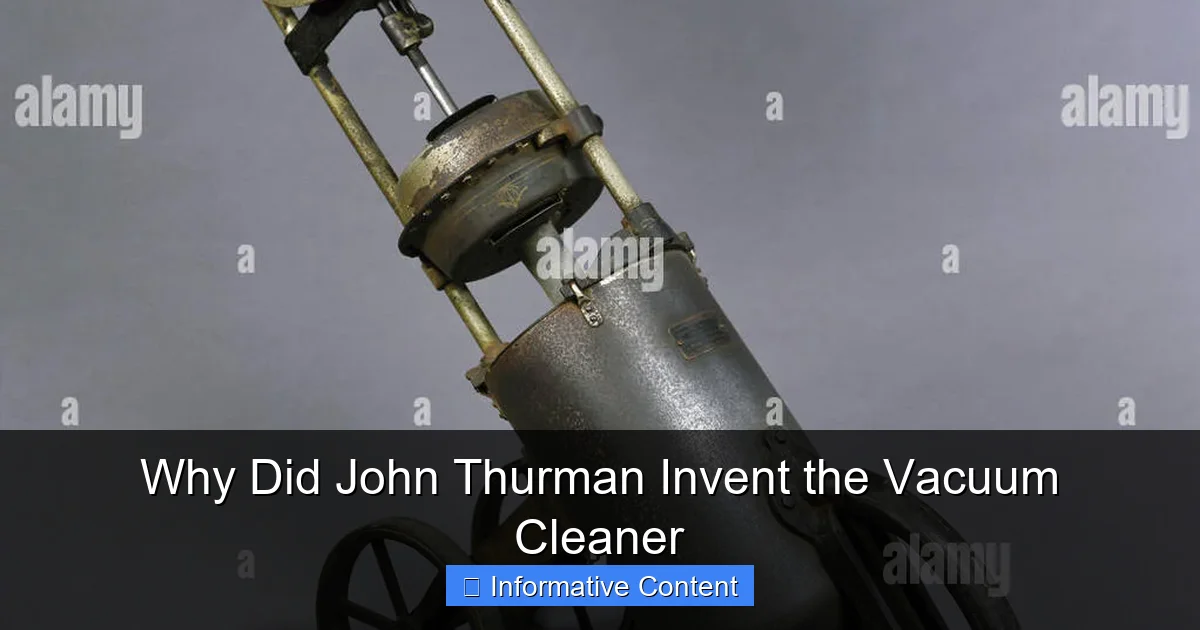
In the late 19th century, John Thurman observed the laborious and inefficient methods of carpet cleaning, primarily involving beating carpets outdoors, which created significant dust and health concerns. Driven by a desire for a cleaner and healthier home environment, Thurman patented his “pneumatic carpet renovator” in 1899. This early, horse-drawn machine used compressed air to blow dust into a receptacle, offering a revolutionary, albeit non-suction, mobile cleaning service that laid crucial groundwork for the modern vacuum cleaner.
Key Takeaways
- Addressing a Pervasive Problem: Before John Thurman, carpet cleaning was a strenuous, dusty, and often unhealthy chore, relying on manual beating and sweeping that merely displaced dirt.
- Thurman’s Innovative Solution: In 1899, John Thurman patented a “pneumatic carpet renovator,” an early motorized cleaning device designed to mechanize the dust removal process.
- How It Worked Differently: Unlike modern vacuum cleaners that use suction, Thurman’s invention operated by blowing compressed air onto carpets, dislodging dust and collecting it in a separate receptacle.
- A Mobile Cleaning Service: Thurman initially offered his invention as a professional cleaning service, bringing the large, horse-drawn machine to homes and businesses for on-site carpet cleaning.
- Pioneering Mechanized Cleaning: While not a suction vacuum, Thurman’s machine was a significant step in the mechanization of household chores, demonstrating the potential for automated dirt removal.
- Laying Foundational Ideas: Thurman’s work contributed to the ongoing quest for more effective cleaning technologies, influencing later inventors who developed the suction-based vacuum cleaner we know today.
Quick Answers to Common Questions
Who was John Thurman?
John Thurman was an American inventor from St. Louis, Missouri, who patented a “pneumatic carpet renovator” in 1899, often cited as one of the earliest motorized cleaning machines.
What problem did John Thurman’s invention solve?
Thurman’s invention aimed to solve the problem of inefficient, laborious, and dusty manual carpet cleaning methods (like beating rugs) that were common in the late 19th century.
How did John Thurman’s pneumatic carpet renovator work?
Unlike modern vacuum cleaners, Thurman’s machine used compressed air to blow dust and dirt off carpets, which was then collected in a separate receptacle. It did not use suction.
Was John Thurman’s invention a portable vacuum cleaner?
No, Thurman’s pneumatic carpet renovator was a large, horse-drawn machine, powered by a gasoline engine. It was brought to homes and businesses as a mobile cleaning service rather than being used as a portable household appliance.
What was the main difference between Thurman’s machine and later vacuum cleaners?
The main difference was the cleaning principle: Thurman’s machine used *blowing* air to dislodge and collect dust, while later, more effective vacuum cleaners, like Hubert Cecil Booth’s, adopted the principle of *suction* to pull dirt into the machine.
📑 Table of Contents
- Why Did John Thurman Invent the Vacuum Cleaner?
- Life Before the Machine: A Dusty Endeavor
- John Thurman’s Vision: A New Approach to Cleanliness
- Innovating Beyond the Broom: The Impact of Thurman’s Invention
- The Evolution of Vacuum Technology: From Blower to Sucker
- The Lasting Legacy: Appreciating Early Pioneers
- Conclusion: A Stepping Stone to a Healthier Future
Why Did John Thurman Invent the Vacuum Cleaner?
Imagine a world where cleaning your home meant hauling heavy rugs outside, hanging them on a line, and beating them relentlessly with a stick, all while a cloud of dust billowed around you. This wasn’t just a scene from a bygone era; it was the reality for countless households in the late 19th century. Dust, dirt, and allergens were a constant battle, and the methods available for tackling them were often more strenuous and less effective than we can even begin to comprehend today.
Enter John Thurman. In an age marked by burgeoning industrialization and a growing desire for improved hygiene, Thurman saw this dusty problem not as an insurmountable chore, but as an opportunity for innovation. He envisioned a better, more efficient way to clean, a method that wouldn’t just move dust around, but actually remove it. His quest to solve this pervasive household challenge led to the creation of what many consider one of the earliest motorized cleaning machines, a significant precursor to the modern vacuum cleaner.
But what exactly drove John Thurman to invent his “pneumatic carpet renovator,” and what was life like before such a groundbreaking idea emerged? Let’s take a fascinating journey back in time to explore the dusty origins of mechanized cleaning and understand the pivotal role Thurman played in shaping our clean homes.
Life Before the Machine: A Dusty Endeavor
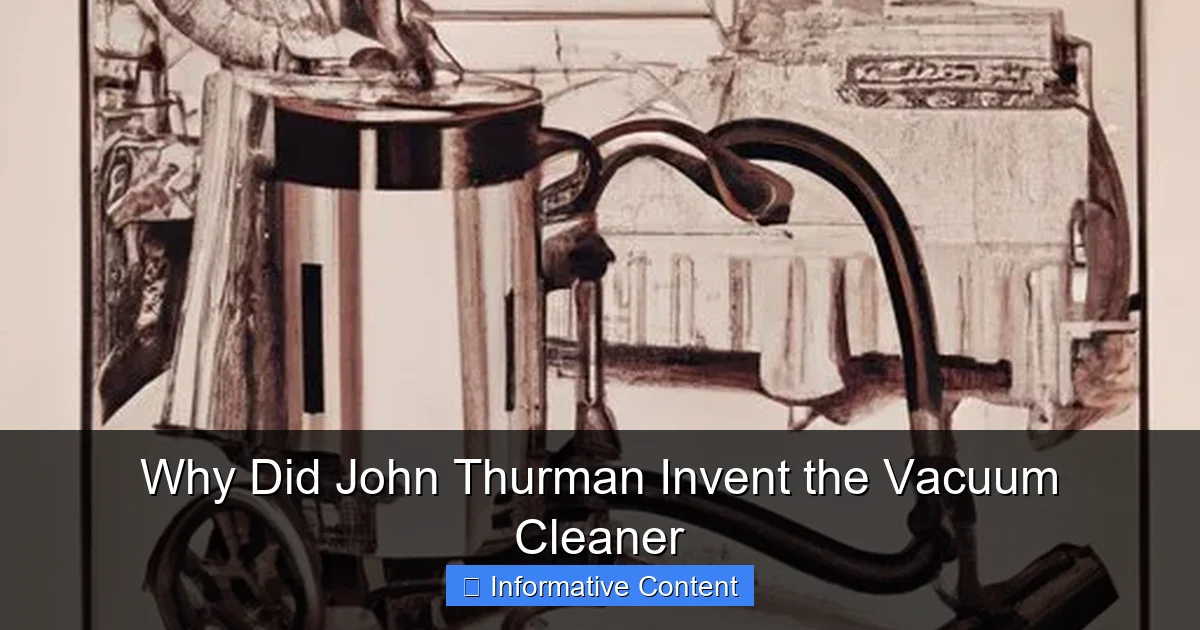
Visual guide about Why Did John Thurman Invent the Vacuum Cleaner
Image source: lihpao.com
To truly appreciate John Thurman’s invention, we first need to understand the world he lived in. The late 1800s were a time of tremendous change, but when it came to household chores, especially cleaning, methods remained largely antiquated and incredibly labor-intensive. Homes were constantly battling dust, soot from coal fires, and tracked-in dirt, and keeping them clean was a never-ending struggle.
The Tedious Chore of Carpet Cleaning
Before any form of mechanized cleaner, carpets were a symbol of luxury and comfort, but they were also massive dust traps. Cleaning them was a dreaded, back-breaking chore. Typically, once or twice a year, families would embark on what was known as “spring cleaning,” a rigorous overhaul of the entire house. For carpets, this often meant:
- Manual Beating: Carpets were removed from the house, draped over a clothesline or a special rack, and vigorously beaten with carpet beaters – often wicker or wire tools. This process was incredibly effective at dislodging dirt, but it also created enormous clouds of dust, scattering allergens and fine particles into the air and onto anyone nearby.
- Sweeping and Brushing: Indoors, daily cleaning involved brooms and brushes. While these could remove loose surface dirt, they were largely ineffective against embedded dust and often just pushed dust from one place to another.
- Damp Sawdust: A common trick was to sprinkle damp sawdust or tea leaves on carpets before sweeping. The idea was that the damp particles would trap dust, making it easier to sweep away. While somewhat helpful, it was far from a perfect solution.
These methods were not only inefficient but also posed significant health risks. Constantly inhaling dust and particulate matter contributed to respiratory issues and general discomfort. There was a clear, pressing need for a better way to achieve true cleanliness, one that didn’t involve creating more mess in the process.
John Thurman’s Vision: A New Approach to Cleanliness
Amidst this dusty backdrop, John S. Thurman, an inventor from St. Louis, Missouri, began to ponder a more advanced solution. He wasn’t the first to think about mechanical cleaning, but his approach was distinct and pushed the boundaries of what was possible at the time.
The Eureka Moment: Identifying a Need
While details about Thurman’s specific “eureka” moment are scant, it’s easy to imagine him observing the laborious process of carpet beating or the endless fight against dust in homes and public spaces. He must have recognized the fundamental flaw in existing methods: they simply didn’t *remove* the dust effectively. Instead, they mostly redistributed it, making the air quality worse and leaving fine particles embedded deep within fabrics. Thurman’s innovative mind likely turned to the idea of using mechanized power to somehow extract or contain this dust, rather than just disturbing it. He saw the potential for a service that could bring professional-level cleaning directly to people’s homes, saving them time, effort, and exposure to harmful dust.
The Pneumatic Carpet Renovator: How It Worked
In 1899, John Thurman received U.S. Patent No. 634,042 for his “pneumatic carpet renovator.” This was a truly remarkable machine for its time, though it operated quite differently from the vacuum cleaners we use today. Here’s how it worked:
- Not Suction, But Blowing: Crucially, Thurman’s machine did *not* use suction to pull dirt up from the carpet. Instead, it used compressed air to *blow* dust and dirt off the carpet’s surface and out of its fibers.
- Collection System: As the dirt was blown loose, a separate collection system, likely a bag or chamber, would capture the dislodged particles. This was a significant improvement over beating, which sent dust flying everywhere.
- Powered by Gasoline: The machine was powered by a gasoline engine, which ran an air pump to generate the necessary compressed air. This made it one of the earliest instances of a motorized cleaning device.
- Mobile and Massive: Thurman’s renovator was a large, horse-drawn apparatus. It wasn’t something you’d push around your living room. Instead, it was brought to homes and businesses on demand, much like a modern mobile car wash or professional cleaning service.
Thurman’s invention was a bold step forward. It represented a fundamental shift from manual, physically demanding cleaning to a mechanized, power-assisted approach. It aimed to offer a cleaner home with less effort, directly addressing the health and efficiency concerns of the era.
Innovating Beyond the Broom: The Impact of Thurman’s Invention
John Thurman’s pneumatic carpet renovator quickly gained attention, primarily because it offered a service that was revolutionary for its time. It was a clear demonstration of how technology could significantly improve daily life and public health.
Offering a Service, Not Just a Product
Thurman didn’t initially envision selling his machines for individual household use. Given their size, complexity, and the need for a gasoline engine and a horse to move them, that wouldn’t have been practical. Instead, he established the “Thurman Vacuum Cleaner Company” (despite it not using actual vacuum suction as we understand it) in St. Louis. He offered a house-to-house cleaning service, advertising that his machine would come to your home, and an operator would clean your carpets on site.
Imagine the scene: a large, horse-drawn contraption pulling up to your house, humming with the sound of its gasoline engine, ready to tackle the dust and grime. For many, this was an incredibly novel and convenient service. It meant no more lugging heavy rugs outside, no more backaches from beating, and a noticeable improvement in indoor air quality after the service. It was a luxury cleaning experience, affordable perhaps only to the well-to-do, but it showcased the immense potential of mechanized cleaning.
Laying the Groundwork for Future Innovations
While Thurman’s “vacuum cleaner” didn’t use suction, its significance cannot be overstated. It was a pioneering effort in the mechanization of household hygiene. His invention demonstrated several crucial concepts that would influence future developments:
- Motorized Power: He proved that a gasoline engine could be effectively used to power a cleaning mechanism, freeing people from purely manual labor.
- Dust Containment: By collecting the dislodged dust in a receptacle, his machine showed a path towards cleaner air, rather than just moving dust around.
- Professional Cleaning Model: His mobile service model highlighted the demand for convenient, effective, and outsourced cleaning solutions.
Thurman’s machine had its limitations. It was loud, expensive, and its “blowing” method, while effective at dislodging surface dirt, might not have been as thorough at deep cleaning as later suction-based models. Yet, it sparked imaginations and paved the way for others to refine the concept of a dust-removing machine.
The Evolution of Vacuum Technology: From Blower to Sucker
John Thurman’s work was a critical stepping stone, but the story of the vacuum cleaner continued to evolve rapidly in the early 20th century. The next major leap came with the introduction of suction technology.
The Shift to Suction Power
Just two years after Thurman patented his pneumatic renovator, in 1901, British inventor Hubert Cecil Booth introduced his own version of a motorized cleaning machine. Booth’s “Puffing Billy” was also a large, horse-drawn apparatus brought to homes for cleaning, but it employed a fundamentally different and more effective principle: *suction*.
Booth’s machine used a pump to create a partial vacuum, drawing air and dirt *into* the machine, where it was filtered. This method proved to be far superior for deep cleaning carpets and upholstery, as it could pull embedded dirt and dust from within the fibers more effectively than blowing. The concept of “vacuum” was born in the cleaning context.
The Modern Vacuum Cleaner: A Legacy of Innovation
The early 20th century saw a flurry of inventions building on Thurman’s and Booth’s pioneering work. Inventors like James Murray Spangler (who invented an electric suction-type portable vacuum cleaner in 1907, later improved and marketed by William Henry Hoover) refined the technology, making machines smaller, more affordable, and eventually, electric.
Today’s lightweight, powerful, and versatile vacuum cleaners – whether upright, canister, robotic, or handheld – are the direct descendants of these early innovations. They owe their existence to the foundational ideas of inventors like John Thurman, who first dared to imagine a world where dirt could be tamed by a machine. His pneumatic renovator, though different from today’s vacuums, challenged the status quo and demonstrated the profound impact that mechanized cleaning could have on health, hygiene, and convenience.
The Lasting Legacy: Appreciating Early Pioneers
John Thurman’s invention reminds us that progress is often built in stages, with each inventor adding a piece to a larger puzzle. His “pneumatic carpet renovator” was more than just a patent; it was a bold statement about the future of household chores and cleanliness.
More Than Just a Patent
Thurman’s contribution highlights the human drive to simplify labor and improve living conditions. He didn’t just invent a machine; he invented a *service* that fundamentally changed people’s expectations for a clean home. He demonstrated that advanced technology could be applied to everyday problems, setting a precedent for future innovations in domestic appliances. His work, even if overshadowed by later suction-based designs, was a crucial part of the evolutionary chain that led to the comfortable, hygienic homes we enjoy today.
Think about the effort saved, the dust not breathed in, and the sheer convenience offered by Thurman’s system. It wasn’t perfect, but it was a clear step towards a healthier and less laborious domestic life.
Modern Cleaning Efficiency: A Nod to the Past
Today, we take our vacuum cleaners for granted. We effortlessly glide them across floors, marvel at robotic cleaners that do the work for us, and rely on powerful suction to keep our homes pristine. When you next vacuum, take a moment to appreciate the journey this technology has taken.
Consider these practical tips that echo the spirit of Thurman’s innovation:
- Regular Cleaning: Like Thurman’s mobile service, regular cleaning prevents dust buildup.
- Proper Tools: Use the right vacuum and attachments for different surfaces to maximize efficiency, much like Thurman’s specialized machine for carpets.
- Air Quality Matters: Modern vacuums often have HEPA filters, continuing Thurman’s implicit goal of improving indoor air quality by truly removing, not just displacing, dust.
These small actions connect us to a long history of human ingenuity, spurred by pioneers like John Thurman who sought to make life just a little bit cleaner, a little bit easier, and a whole lot healthier.
Conclusion: A Stepping Stone to a Healthier Future
John Thurman’s invention of the pneumatic carpet renovator in 1899 was a testament to the power of observation and ingenuity. He didn’t invent the suction vacuum cleaner as we know it, but he invented a revolutionary *motorized cleaning machine* that fundamentally changed how people thought about tackling dust and dirt. His contribution arose from a clear need: to move beyond the primitive, dusty, and unhealthy methods of manual carpet cleaning that defined the late 19th century.
By introducing a horse-drawn, gasoline-powered device that blew and collected dust, Thurman offered a vital cleaning service and laid crucial groundwork for the future. His work paved the way for subsequent innovations, inspiring inventors like Hubert Cecil Booth and James Murray Spangler to refine the concept of mechanical dust removal, eventually leading to the ubiquitous and indispensable suction vacuum cleaners of today. So, the next time you power up your vacuum, remember John Thurman, a true pioneer who dared to dream of a cleaner, less dusty world, one powerful puff of air at a time.
🎥 Related Video: The electric vacuum cleaner was first patented by John S. Thurman in 1898.
📺 Incredible Engineering
A vacuum cleaner works by creating suction using a motor-driven fan. When the fan spins, it pushes air out, lowering the pressure …
Frequently Asked Questions
What year did John Thurman invent his cleaning machine?
John Thurman received the patent for his “pneumatic carpet renovator” in 1899. This makes his invention one of the earliest motorized cleaning devices designed for carpets.
Did John Thurman’s invention use suction like modern vacuums?
No, John Thurman’s machine did not use suction. Instead, it operated by blowing compressed air onto carpets to dislodge dust and dirt, which was then collected in a designated chamber.
How was John Thurman’s cleaning machine powered?
Thurman’s pneumatic carpet renovator was powered by a gasoline engine. This engine drove an air pump to create the compressed air needed for the cleaning process.
Did people buy John Thurman’s machine for their homes?
Not typically. Due to its large size and complexity (it was horse-drawn), John Thurman’s machine was primarily operated as a mobile cleaning service, brought to homes and businesses on demand.
How did Thurman’s invention influence later vacuum cleaner designs?
While not a suction vacuum, Thurman’s invention was crucial for pioneering the concept of motorized, mechanized cleaning and demonstrating the demand for such services, paving the way for later inventors who developed suction-based technologies.
What were carpet cleaning methods like before Thurman’s invention?
Before Thurman’s invention, carpet cleaning involved arduous manual labor, such as hauling carpets outdoors to beat them vigorously with sticks, sweeping with brooms, or using damp sawdust to try and trap dirt.