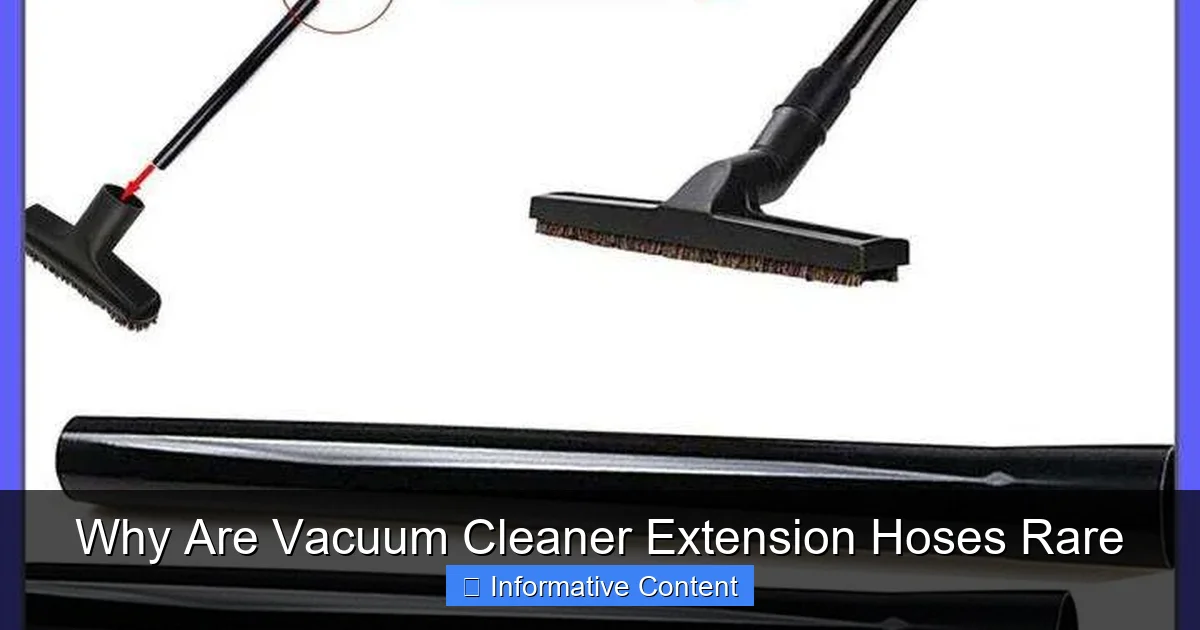
Vacuum cleaner extension hoses are rare mainly due to engineering challenges that compromise suction power and efficiency. Adding length significantly increases airflow resistance, making your vacuum less effective. Beyond performance issues, these hoses introduce safety risks like tripping hazards and storage problems, while also making the vacuum less convenient and heavier to use. Manufacturers often prioritize integrated, optimized designs over add-ons that could detract from the overall user experience.
Have you ever been in the middle of cleaning, vacuum in hand, only to find that your hose just isn’t long enough? Maybe you’re trying to reach a tricky cobweb on the ceiling, clean under a bed without moving it, or vacuum the stairs from a single plug socket. It’s a common frustration. You might think, “Why don’t they just make vacuum cleaner extension hoses?” It seems like such a simple solution, right? Just add more hose!
But if you’ve ever gone looking for a universal extension hose for your upright or canister vacuum, you’ve probably noticed they’re surprisingly hard to find. They aren’t a standard accessory, and for good reason. What seems like a straightforward fix actually introduces a whole host of engineering, performance, safety, and practical challenges that most manufacturers try to avoid. Let’s dive into why vacuum cleaner extension hoses are a rare sight in the cleaning aisle.
This isn’t about vacuum companies being stubborn or not understanding your needs. It’s about fundamental physics, user experience, and smart design choices. Adding length to a vacuum hose isn’t like adding an extension cord to an electrical appliance. With an electrical cord, the main concern is voltage drop, which is manageable. With a vacuum hose, you’re dealing with airflow dynamics, suction power, and the delicate balance of an engineered system. Every extra foot changes how the vacuum works, often not for the better.
Key Takeaways
- Suction Loss is Primary: The biggest reason vacuum cleaner extension hoses are rare is that added length dramatically reduces suction power and airflow, making the vacuum less effective.
- Engineering Challenges: Longer hoses require more robust materials to prevent kinking but must remain flexible and lightweight, a difficult balance to strike without impacting performance.
- Safety and Practicality Concerns: Extension hoses create tripping hazards, are cumbersome to store, and add weight, diminishing the vacuum’s ease of use and overall safety.
- Motor Strain: An extended hose forces the vacuum’s motor to work harder to maintain airflow, potentially leading to overheating and a shorter lifespan for the appliance.
- Manufacturer Priorities: Vacuum manufacturers focus on optimizing integrated designs for efficiency, maneuverability, and user satisfaction, rather than offering attachments that could compromise these core features.
- Cost and Demand: Developing durable, efficient extension hoses would increase production costs, and the market demand isn’t high enough to justify these challenges for most mainstream models.
- Existing Alternatives: For extended reach, alternatives like longer power cords, specialized vacuum types (canister, central vacs), or specific long-reach attachments are often more effective solutions.
Quick Answers to Common Questions
Why do extension hoses reduce vacuum suction?
Adding an extension hose increases the length air must travel, creating more friction and resistance, which directly reduces the vacuum’s suction power at the cleaning end.
Are universal vacuum cleaner extension hoses available at all?
While rare for general models, some specific vacuum brands or industrial vacuums might offer proprietary extension hoses designed to work with their particular system, but they are not universally interchangeable.
Can a long extension hose damage my vacuum cleaner?
Yes, a long extension hose forces the motor to work harder, increasing heat and strain, which can lead to overheating and shorten the motor’s lifespan over time.
What’s a better alternative for reaching high places?
For high places, using a rigid extension wand with a dusting or crevice tool is often more effective than an extension hose, as it maintains better suction and is easier to control.
Do central vacuum systems use extension hoses?
Central vacuum systems inherently use very long hoses that connect to wall inlets. These systems are designed with powerful motors to compensate for the hose length, making them an excellent solution for extended reach.
📑 Table of Contents
The Design Challenges of Extending Suction
At the heart of the matter, a vacuum cleaner is all about creating a powerful airflow to pick up dirt. When you add more hose, you mess with that delicate balance.
Airflow and Suction Loss
Think about trying to drink through a very long straw. The longer the straw, the harder you have to suck, and sometimes you just can’t get much liquid up. A vacuum cleaner works on a similar principle. It creates a low-pressure area (suction) that pulls air and debris through the hose. When you add an extension hose, you’re increasing the distance that air has to travel. This means more friction against the inside walls of the hose, which reduces the air’s speed and, consequently, the suction power at the nozzle.
This effect is called “pressure drop” or “airflow resistance.” Even a perfectly smooth hose adds resistance. If the hose isn’t perfectly smooth on the inside (and most aren’t, to allow for flexibility), that resistance increases even more. The longer the hose, the greater the resistance, and the weaker the vacuum becomes at the cleaning end. For a vacuum cleaner to work effectively, it needs strong, consistent suction. An extension hose often makes this impossible for anything more than very light debris.
Material Limitations and Durability
Vacuum hoses need to be flexible enough to bend and reach awkward spots, but also durable enough to withstand being pulled, stepped on, and rubbing against furniture. They also need to be airtight to prevent suction loss. Finding a material that is both extremely flexible, durable, lightweight, and smooth on the inside is a tough engineering challenge.
Adding an extension hose means the material needs to maintain its integrity over an even greater length. A longer hose is more prone to kinks, cracks, and punctures, all of which would lead to significant suction loss or even render the vacuum useless. Manufacturers would need to use incredibly high-quality, reinforced materials, which would drive up the cost of these vacuum cleaner extension hoses significantly.
Weight and Maneuverability Concerns
Imagine dragging an extra 10 or 20 feet of hose around while you clean. Even if it’s lightweight, that added bulk and length makes the vacuum much harder to maneuver. You’d be constantly wrestling with the hose, trying to untangle it, or moving the vacuum unit itself more frequently. The entire point of a flexible hose is to make cleaning easier, not harder.
A long, heavy hose can also put stress on the connection points to the vacuum and attachments. Over time, these connections could wear out or break more quickly. The ideal vacuum cleaner is one that is easy to use, light, and agile. A long, unwieldy extension hose would undermine these core design goals.
Electrical and Safety Implications
Visual guide about Why Are Vacuum Cleaner Extension Hoses Rare
Image source: lvb.co.za
It’s not just about suction; there are also important safety considerations when you start thinking about extending the reach of a vacuum cleaner.
Power Draw and Motor Strain
When a vacuum cleaner encounters greater resistance, like that created by a long extension hose or a clogged filter, its motor has to work much harder to maintain the desired airflow. This increased effort draws more electrical power and generates more heat within the motor. Over time, operating the vacuum cleaner under such strain can lead to the motor overheating, potentially causing damage or significantly shortening the appliance’s lifespan.
Modern vacuums often have thermal cut-offs to prevent catastrophic motor failure, but frequent activation of these safety features indicates that the vacuum is being pushed beyond its intended limits. Using a very long vacuum cleaner extension hose would likely trigger these cut-offs more often, making cleaning a stop-and-start frustration.
Kinking and Obstructions
A vacuum hose relies on a clear, unobstructed path for optimal performance. Longer hoses, especially if they are not made from premium, kink-resistant materials, are much more likely to bend sharply or collapse. A kink acts like a blockage, instantly stopping or severely restricting airflow. This not only causes immediate suction loss but also further strains the motor.
Furthermore, a very long hose increases the chances of small objects getting stuck inside. If debris gets lodged far down an extension hose, it can be incredibly difficult to retrieve, leading to persistent blockages and a perpetually underperforming vacuum. This means more maintenance and more frustration for the user.
Tripping Hazards and Storage
Let’s be honest, even a standard vacuum hose can be a bit of a tripping hazard, especially in a busy home. Now imagine an extra 10, 15, or even 20 feet of hose snaking across your floors. That’s a significant increase in the risk of someone stumbling and falling. This is a major safety concern, particularly in homes with children, pets, or elderly residents.
Beyond safety, consider the practicalities of storing such a long hose. Standard vacuum hoses are designed to coil neatly or attach to the vacuum itself. An extra-long vacuum cleaner extension hose would be cumbersome, taking up significant storage space and likely becoming a tangled mess. This practical inconvenience further detracts from the user-friendly experience that manufacturers aim for.
User Experience and Practicality
Manufacturers always have the end-user in mind. If an accessory makes the vacuum harder to use, it’s generally not something they will push.
Assembly and Disassembly Frustration
If you had a vacuum cleaner extension hose, you’d likely need to attach it when you needed extra reach and then remove it for everyday cleaning to avoid the performance and safety issues mentioned above. This constant attaching and detaching adds extra steps to your cleaning routine.
Over time, connection points can wear out, or become loose, leading to air leaks and further suction loss. The convenience factor, which is a big selling point for many vacuum cleaners, would be severely diminished by requiring frequent assembly and disassembly of a special vacuum cleaner extension hose. People want to clean quickly and easily, not spend time fiddling with attachments.
Storage Solutions (or lack thereof)
As briefly touched upon, where do you put an extra-long, often rigid, vacuum cleaner extension hose when you’re not using it? Most vacuum cleaners are designed with integrated storage for their standard attachments – a crevice tool, a dusting brush, perhaps an upholstery tool. There’s usually no dedicated space for an additional, lengthy hose.
This means you’d have another bulky item to store in your broom closet or utility room, potentially getting tangled with other cleaning supplies or simply taking up valuable space. This logistical headache is another reason why such accessories are not widely adopted or offered by manufacturers.
The “Too Much Hose” Problem
While you might sometimes crave more reach, there are many times when an overly long hose would be a hindrance. For quick clean-ups, vacuuming small areas, or using the vacuum as a hand-held for crumbs, a short, manageable hose is ideal. If a very long extension hose was permanently attached, it would make these simple tasks much more awkward.
Even if it were detachable, the need to switch between standard and extended hose for different tasks can be tedious. Manufacturers aim for versatility and ease of use in a single, well-designed package, rather than requiring users to constantly reconfigure their appliance.
Manufacturer Perspectives and Market Demand
Ultimately, product development comes down to a balance of cost, benefit, and what the market truly wants and needs.
Cost-Benefit Analysis for Manufacturers
For a vacuum cleaner manufacturer, adding an extension hose to their product line isn’t just about making the hose itself. They would need to:
- Design a hose that minimizes suction loss and is durable.
- Test it extensively with various vacuum models to ensure compatibility and performance.
- Source high-quality materials, which are more expensive.
- Account for increased packaging and shipping costs for a larger accessory.
- Provide customer support for issues related to the extension hose.
When weighed against the potential problems (customer complaints about reduced suction, safety concerns, storage issues) and the likely limited demand for such a niche product, the cost-benefit analysis often doesn’t favor producing universal vacuum cleaner extension hoses.
Niche Market vs. Mass Appeal
The vast majority of vacuum cleaner users operate within a certain range of cleaning tasks that are adequately covered by the standard hose length and power cord. While some users might occasionally wish for more reach, it’s not a universal pain point that justifies a major product line expansion.
Manufacturers focus on features and designs that appeal to the broadest possible customer base – things like powerful suction, lightweight design, multi-surface capability, and ease of storage. A product like a universal vacuum cleaner extension hose targets a very specific, relatively small niche, and developing for niche markets typically requires significant justification.
Focusing on Integrated Solutions
Instead of offering add-on vacuum cleaner extension hoses, manufacturers often try to solve the reach problem through integrated design solutions. This could mean:
- Longer built-in power cords that let you move the entire vacuum further.
- More efficient onboard hoses that extend further than previous models while maintaining suction.
- Specialized tools and attachments with longer wands or narrower profiles designed for specific difficult-to-reach areas.
- Developing different types of vacuums, like canister vacuums, which inherently offer more flexibility and reach with their primary hose.
These solutions are designed to work seamlessly with the vacuum’s existing engineering, ensuring optimal performance and user experience without the compromises of a generic add-on extension hose.
Alternatives and Workarounds
So, if a dedicated vacuum cleaner extension hose isn’t the answer, what can you do when you need extra reach? Luckily, there are several effective strategies.
Longer Power Cords
Often, the limitation isn’t the vacuum’s hose, but how far you can plug the vacuum in. Many modern upright and stick vacuums come with surprisingly long power cords. If yours doesn’t, or if you just need a bit more flexibility, a good quality indoor extension cord can often solve the problem without impacting vacuum performance. Just make sure it’s rated for the vacuum’s wattage to avoid electrical issues. This allows you to move the entire vacuum unit closer to the area you need to clean, effectively extending your overall reach.
Different Vacuum Types (Canisters, Central Vacs)
If reach is a primary concern for you, considering a different type of vacuum cleaner might be the best long-term solution.
- Canister Vacuums: These models typically feature a main unit that houses the motor and dustbin, with a long, flexible hose that connects to various attachments. This design inherently offers much greater reach and maneuverability compared to many upright models, as you’re only handling the lightweight hose and wand.
- Central Vacuum Systems: For the ultimate in reach and power, a central vacuum system is installed directly into your home. You plug a very long, lightweight hose into wall inlets, and the main power unit is located elsewhere (e.g., garage or basement). This eliminates the need to lug a vacuum around and provides superior suction over vast areas.
Specialized Attachments
Most vacuums come with a suite of attachments, and some are specifically designed for extended reach:
- Crevice Tools: These long, narrow tools are perfect for getting into tight spaces, corners, and along baseboards.
- Extension Wands: Many canister and some upright vacuums include rigid extension wands that can be attached to the hose, giving you several extra feet to reach ceilings, high shelves, or under furniture. Some are telescopic, allowing you to adjust the length.
- Flexible Crevice Tools: These are like extra-long, bendable crevice tools that can snake into really awkward spots, like between refrigerator coils or under car seats.
Always check what attachments are available for your specific vacuum model, as you might already own a solution!
Smart Cleaning Habits
Sometimes, the best solution is simply to adjust your cleaning routine. Instead of trying to force your vacuum to reach every corner from a single spot, move furniture, or reposition the vacuum unit more frequently. For high-up areas, a dusting brush on an extension wand can often get the job done effectively without needing the full power of the vacuum’s suction. Regular, preventative cleaning also means less heavy-duty vacuuming is required.
In the end, while the idea of a universal vacuum cleaner extension hose seems convenient, the realities of physics, engineering, safety, and user experience make them a rare and often impractical solution. Manufacturers prioritize integrated design and effective performance, leading them to offer different types of vacuums or specialized attachments that achieve extended reach without compromising on power or ease of use.
So, the next time you’re contemplating why vacuum cleaner extension hoses are rare, you’ll know it’s not an oversight, but a considered design choice aiming for the best possible cleaning experience. Choose the right tool for the job, and your cleaning frustrations will likely disappear.
🎥 Related Video: Vacuum Cleaner Hoses
📺 yourspares
You may have found your vacuum cleaner has lost suction, this could mean there is a split in your hose causing the air to escape.
Frequently Asked Questions
Why aren’t vacuum cleaner extension hoses a standard accessory?
Vacuum cleaner extension hoses aren’t standard because they significantly reduce suction power, create safety hazards like tripping risks, are cumbersome to store, and add weight, compromising the overall user experience that manufacturers aim to optimize.
Does a longer power cord affect vacuum performance differently than a longer hose?
Yes, a longer power cord primarily affects electrical resistance (voltage drop), which is generally manageable and doesn’t directly impact suction strength. A longer hose, however, directly affects airflow resistance, which is critical for vacuum performance.
Are there any specific types of vacuums designed for extra reach?
Canister vacuums are often preferred for their superior reach and maneuverability due to their long, flexible hoses and lightweight wands. Central vacuum systems offer the ultimate extended reach solution for an entire home.
What are the main safety concerns with using a DIY vacuum extension hose?
DIY vacuum extension hoses can lead to severe suction loss, increased motor strain and overheating, kinking that blocks airflow, and significant tripping hazards, none of which are ideal for safe and effective cleaning.
Why don’t manufacturers just build longer hoses into their vacuums?
Manufacturers balance hose length with performance, maneuverability, and storage. An excessively long built-in hose would compromise suction, make the vacuum bulky and unwieldy, and be difficult to store compactly.
How can I clean under low furniture if my vacuum hose isn’t long enough?
For cleaning under low furniture, consider using specialized flat or articulating floor tools, a crevice tool on an extension wand, or moving the furniture slightly to access the area directly. A robotic vacuum can also be a great solution for regular under-furniture cleaning.