
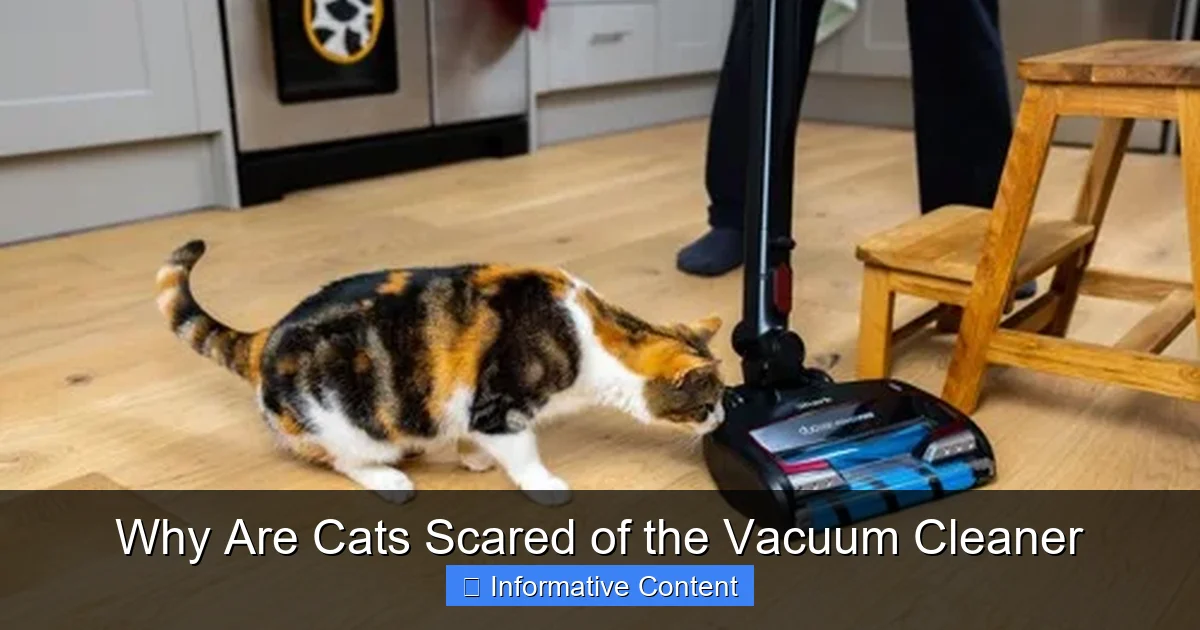
Cats often exhibit intense fear towards vacuum cleaners due to a perfect storm of sensory overload and instinctual responses. Their highly sensitive hearing perceives the vacuum’s loud, unpredictable noise as a significant threat, while its large, moving form and strange vibrations trigger their natural prey instincts. Understanding these core reasons can help cat owners mitigate their pet’s stress during cleaning time.
Has your beloved feline friend ever transformed into a startled, wide-eyed fluff ball at the mere sight or sound of your vacuum cleaner? You’re certainly not alone! It’s a classic scenario: you roll out the trusty cleaning machine, and your cat bolts under the sofa, hisses, or stares with an intensity usually reserved for birds outside the window. This common phenomenon often leaves cat owners scratching their heads, wondering, “Why are cats scared of the vacuum cleaner?”
It might seem like a silly fear to us, but for our sensitive feline companions, the vacuum cleaner isn’t just a noisy appliance; it’s a colossal, unpredictable, and frankly, terrifying monster. To truly understand this deep-seated aversion, we need to step into a cat’s paws, so to speak, and explore the world through their heightened senses and ancient instincts. Let’s unravel the mystery behind why this everyday household tool can turn even the bravest cat into a quivering mess.
The Sensory Assault: Why the Vacuum is Overwhelming
Cats experience the world much differently than humans do. Their senses are incredibly acute, designed for hunting and survival. What seems like a minor inconvenience to us can be a full-blown assault for them.
Loud Noises and Sensitive Hearing
One of the primary reasons cats are scared of the vacuum cleaner is its intense noise output. Cats possess an incredible range of hearing, far superior to ours. While humans can hear sounds up to about 20 kHz, cats can detect sounds up to 64 kHz – nearly three times higher! This means that not only do they hear the vacuum’s roar at a much louder volume, but they also perceive high-frequency components that we can’t even register. Imagine someone yelling directly into your ear for an extended period, but add in sharp, piercing frequencies you can’t block out. That’s a closer approximation of what a vacuum sounds like to a cat.
Moreover, the vacuum’s noise is often sudden and unpredictable. It might start abruptly, change pitch as it encounters different surfaces, or emit strange whirring and sucking sounds. For an animal that relies on subtle auditory cues to detect prey or danger, such an overwhelming and chaotic soundscape is incredibly alarming. It overrides all other sensory input, making the cat feel vulnerable and disoriented.
Unusual Appearance and Movement
Beyond the sound, the vacuum cleaner itself is an unusual sight. It’s a large, often clunky, moving object that doesn’t resemble anything natural in their environment. Cats are visually oriented creatures, and they naturally become wary of large, unfamiliar objects, especially those that move in unpredictable ways. A vacuum glides across the floor, sometimes bumping into things, sometimes changing direction suddenly. This erratic movement can mimic the behavior of a large, aggressive predator, or at least a very confused and threatening entity.
Consider the perspective of a small animal. A vacuum cleaner can appear enormous, looming over them as it sweeps across their territory. Its long hose might look like a snake, or its spinning brushes might seem like menacing jaws. These visual cues, combined with the terrifying sound, solidify the vacuum’s status as a threat in the cat’s mind. It’s a prime example of why cats are scared of the vacuum cleaner – it just *looks* wrong.
Vibrations and Airflow
It’s not just about what they hear and see. Cats are also highly sensitive to vibrations. When a vacuum cleaner is running, it creates significant vibrations that travel through the floor. Cats, with their delicate paw pads and innate sensitivity, can feel these vibrations intensely. It can make the ground feel unstable, creating a sense of unease and making their perceived safe space suddenly feel compromised.
Additionally, vacuums expel air, often creating unusual drafts or air currents. While humans might barely notice, a cat’s whiskers (vibrissae) are incredibly sensitive tools for navigating their environment and detecting changes in air pressure. Unpredictable air currents from the vacuum can be disorienting and uncomfortable, further adding to the overwhelming sensory input and making the entire experience unpleasant and threatening. This combination of sensory inputs explains a great deal about why cats are scared of the vacuum cleaner.
Instinctual Reactions: The Fight-or-Flight Response
Cats are wired with ancient instincts honed over millennia of hunting and survival. These instincts are the underlying force behind many of their behaviors, including their reactions to perceived threats.
Prey Instincts and Perceived Threat
Despite being domesticated for thousands of years, cats retain strong predatory instincts. However, they also possess well-developed prey instincts. In the wild, a large, loud, approaching entity would almost certainly signify danger – a larger predator, a rival, or something else to be avoided. The vacuum cleaner, with its size, noise, and aggressive movement, directly taps into these primeval fears.
For a cat, the vacuum isn’t just a noisy machine; it could be interpreted as a potential predator. Their natural response is either to flee (flight) or, if cornered, to defend themselves (fight). Most cats choose flight, seeking refuge in high places or under furniture where they feel safe and hidden from the perceived threat. This instinctual drive to escape danger is a powerful reason why cats are scared of the vacuum cleaner.
Lack of Control and Predictability
Cats thrive on predictability and control over their environment. They have a strong need to understand their surroundings and know what to expect. The vacuum cleaner shatters this sense of control. It appears suddenly, moves unpredictably, and emits noises that are impossible for them to anticipate or understand.
This lack of control can be incredibly stressful for a cat. They can’t make it stop, they can’t fight it effectively, and they can’t predict its next move. This helplessness exacerbates their fear, leading to heightened anxiety and a desire to escape the situation entirely. A cat’s inability to control or predict the “vacuum monster” is a core reason why they exhibit such strong fear responses.
Negative Associations and Past Experiences
Just like humans, cats are capable of learning and forming associations. If a cat has had a particularly frightening experience with a vacuum cleaner, this can solidify their fear, making future encounters even more stressful.
Classical Conditioning and Learned Fear
Cats can be classically conditioned to fear certain stimuli. If the first few encounters a kitten has with a vacuum cleaner are overwhelmingly negative – perhaps it was too close, too loud, or startled them severely – they will quickly associate the vacuum (and even its sight or the sound of it being brought out) with intense fear and stress.
This learned fear can generalize. A cat might not just fear the specific vacuum cleaner but *any* vacuum cleaner, or even objects that vaguely resemble it. The simple act of pulling the vacuum out of the closet can trigger an anticipatory fear response, even before the machine is turned on. This explains why some cats might already be in hiding by the time you plug in the appliance.
Anticipatory Anxiety
Over time, a cat that has had repeated negative experiences with a vacuum cleaner can develop anticipatory anxiety. This means they start to show signs of stress and fear *before* the vacuum is even turned on. They might hide when they see you getting it out, or become agitated by the familiar rumbling sound of it being wheeled across the floor. This preemptive stress response is a clear sign of a deeply ingrained fear. Understanding these learned behaviors is crucial when trying to help a cat overcome their aversion. It’s not just the immediate threat, but the memory and expectation of it, that explains why cats are scared of the vacuum cleaner.
Individual Differences: Why Not All Cats React the Same
While many cats share a similar aversion to vacuum cleaners, the intensity of their fear can vary significantly. Just like people, cats have unique personalities and past experiences that shape their responses.
Personality and Temperament
Some cats are naturally more confident, bold, and adventurous, while others are inherently shy, timid, and cautious. A cat’s underlying temperament plays a huge role in how they react to startling stimuli like a vacuum. A naturally confident cat might simply observe the vacuum from a distance, perhaps with a flick of an ear, before casually retreating to a safe spot. A timid cat, however, might panic, hide for hours, or even exhibit aggressive behavior out of fear.
Younger cats or those still in their developmental stages might also react differently compared to older, more settled felines. A cat’s individual personality is a significant factor in explaining why cats are scared of the vacuum cleaner to varying degrees.
Early Socialization and Exposure
A cat’s experiences during kittenhood are critical in shaping their adult behavior. Kittens exposed to a wide range of sights, sounds, and experiences in a positive and gentle way tend to grow into more well-adjusted and less fearful adults. If a kitten was gently introduced to the sound of a vacuum cleaner from a distance, with positive reinforcement, they might be less likely to develop a strong phobia later on.
Conversely, a kitten who had a traumatic first encounter with a vacuum, or one who was not properly socialized to various household noises, might develop a more severe and lasting fear. This early learning period is a powerful determinant of how a cat will react to stressors throughout its life, including noisy cleaning appliances.
Practical Tips for Helping Your Cat Cope
Understanding why cats are scared of the vacuum cleaner is the first step. The next is to take action to help your feline friend feel safer and less stressed during cleaning time. It’s about managing their environment and gradually changing their perception.
1. Gradual Desensitization and Counter-Conditioning
This is often the most effective long-term strategy. The goal is to slowly expose your cat to the vacuum while associating it with positive experiences.
- Start Small: Begin by leaving the vacuum cleaner out in a room *without* turning it on. Let your cat explore it on their own terms, offering treats or toys nearby.
- Introduce Sound Gently: Once your cat is comfortable with its presence, turn the vacuum on briefly from a distance, perhaps in another room, or just for a second. Immediately give your cat a high-value treat or engage them in a favorite game. The key is to keep the experience positive and very short.
- Increase Gradually: Over days or weeks, slowly increase the duration and proximity of the vacuum’s operation, *always* pairing it with positive reinforcement. If your cat shows any signs of fear, you’ve gone too fast; revert to an earlier, more comfortable step.
2. Create Safe Zones
Ensure your cat always has a designated safe space they can retreat to when the vacuum is in use. This could be a high shelf, a cozy cat tree, a carrier, or a quiet room with the door closed. Make sure this space is readily accessible before you start cleaning. Feeling like they have an escape route and a secure hiding spot can significantly reduce their anxiety. Provide blankets, familiar smells, and perhaps even some comforting toys in this safe zone.
3. Timing is Key
If possible, try to vacuum when your cat is less likely to be present or directly impacted.
- Vacuum when they’re asleep: Some cats are deep sleepers, but this can also startle them awake.
- Vacuum when they’re out: If your cat has outdoor access, you might try vacuuming when they are enjoying time outside.
- Vacuum one room at a time: Isolate your cat in a separate, quiet room while you clean another area. Then, once you’re done with that room and the noise has stopped, let them out before you move on to the next section.
4. Positive Reinforcement
Always associate the vacuum cleaner with good things. Give your cat special treats, praise, or engage in a favorite play session *after* the vacuum has been put away. This helps create a more positive overall impression. Avoid scolding or forcing your cat to stay near the vacuum; this will only increase their fear.
5. Consider Quieter Options
If you’re in the market for a new vacuum, look for models advertised as “low noise” or “quiet operation.” While no vacuum is entirely silent, some are significantly less jarring than others, which can make a big difference for your sensitive feline. Robot vacuums, for instance, are often much quieter and can be programmed to run when your cat is less active or even away from home. Their slow, predictable movement can also be less alarming than a large, fast upright model.
6. Stay Calm Yourself
Cats are highly attuned to our emotions. If you’re stressed or anxious about your cat’s reaction to the vacuum, they will pick up on that. Maintain a calm, reassuring demeanor, even if your cat is initially frightened. Your calmness can help convey that there’s no real danger.
Conclusion
The mystery of why cats are scared of the vacuum cleaner isn’t really a mystery once we understand their unique sensory world and powerful instincts. What seems like a harmless household chore to us is, for many cats, a terrifying invasion by a loud, visually alarming, and unpredictably moving entity. Their sensitive hearing, acute vision, and deep-seated fight-or-flight responses combine to make the vacuum cleaner a prime target for their fear.
By recognizing the root causes of this common feline phobia, we can approach cleaning time with greater empathy and understanding. Implementing gradual desensitization, providing safe havens, and using positive reinforcement can go a long way in helping our cherished companions feel more secure. With a little patience and a lot of love, you can help your cat navigate the scary world of household chores, turning what was once a monster into a less intimidating, albeit still noisy, part of their environment.
Key Takeaways
- Sensory Overload: Cats have extremely sensitive hearing and the vacuum cleaner’s high decibel levels and unpredictable sounds can be genuinely painful and terrifying for them.
- Threat Perception: The vacuum’s large, moving, and often aggressive-looking form can be perceived as a large predator or an intruder, triggering a cat’s innate fight-or-flight response.
- Lack of Control: Cats are creatures of routine and control. The sudden, uncontrollable appearance and noise of the vacuum disrupt their sense of safety and predictability.
- Negative Associations: A cat might develop an even stronger fear if early experiences with the vacuum were particularly frightening or stressful, leading to classical conditioning.
- Vibrations and Airflow: Beyond just noise, the vacuum creates ground vibrations and unusual airflow patterns, adding to the sensory assault and making the environment feel unstable and threatening.
- Individual Differences: Not all cats react the same way. A cat’s personality, past experiences, and early socialization play a significant role in how intensely they fear the vacuum cleaner.
- Coping Strategies: Owners can help by providing safe spaces, desensitizing their cat gradually, using positive reinforcement, and vacuuming when the cat is in a different room or outdoors.
Quick Answers to Common Questions
Can all cats be trained not to fear the vacuum?
While complete elimination of fear is difficult for severely phobic cats, most can be helped to cope better with gradual desensitization and positive reinforcement, reducing their stress levels significantly.
Is it okay to force my cat to stay near the vacuum to “get used to it”?
No, absolutely not. Forcing a cat into a fearful situation will only increase their anxiety, solidify the negative association, and can damage your bond with them.
My cat just ignores the vacuum. Is that normal?
Yes, some cats are naturally more confident or have been well-socialized to various noises. Their calm reaction is a reflection of their individual temperament and experiences.
Are certain vacuum types less scary for cats?
Generally, quieter models, like some robot vacuums or stick vacuums, can be less startling than powerful upright models. Robot vacuums also move more predictably, which can be less alarming.
What if my cat hides for hours after I vacuum?
This indicates significant stress. Ensure they have a safe, quiet retreat. Next time, try to vacuum when they are in a different room or use gradual desensitization methods to reduce their anxiety over time.
🎥 Related Video: Why are cats afraid of vacuum cleaners? 😸🐈
📺 Curious Paw
Ever wondered why your feline friend runs for cover whenever you turn on the vacuum cleaner? It’s not just the loud noise that’s …
Frequently Asked Questions
Why do cats hate loud noises in general?
Cats possess extremely sensitive hearing, designed to detect subtle sounds like prey movement. Loud, sudden, or high-pitched noises are not only startling but can also be physically painful or disorienting for their delicate auditory systems, triggering a natural instinct to flee or hide from potential danger.
Do cats remember negative experiences with the vacuum?
Yes, cats have excellent associative memory. If an experience with the vacuum was particularly frightening or stressful, they can quickly form a strong negative association, remembering the fear and reacting with anxiety to the vacuum’s sight or sound in the future.
Should I comfort my cat when they’re scared of the vacuum?
It’s best to provide a safe space and allow your cat to retreat there. While well-intentioned, directly comforting a very frightened cat can sometimes inadvertently reinforce the fearful behavior or make them feel trapped. Instead, offer gentle reassurance once they’ve found their safe spot and the vacuum is off.
Can a cat develop a phobia of other household appliances too?
Yes, any household appliance that produces loud, sudden noises, vibrations, or unpredictable movements – such as blenders, hair dryers, or washing machines – can potentially trigger fear in sensitive cats, especially if their initial experiences were negative.
Is there a specific age when cats are more sensitive to vacuum noise?
Kittens are often more susceptible to developing fears if not properly socialized during their critical developmental window (typically 2-7 weeks of age). However, adult cats can also develop or intensify fears at any age due to new experiences or changes in their environment.
How can I make my cat feel safe during vacuuming without constantly giving treats?
Beyond treats, focus on creating consistent safe zones where your cat can retreat undisturbed. Maintain a calm demeanor yourself, vacuum only when necessary, and consider using a quieter vacuum or vacuuming one room at a time while your cat is secured in another part of the house.