
Navigating the cost of a robot vacuum cleaner in 2025 can seem tricky, but it’s all about understanding value. Prices range from under $250 for basic models to over $1200 for premium, feature-rich devices. Your ideal choice depends on your home’s needs, desired smart features, and overall budget. This guide helps you pinpoint the right robot vacuum cleaner for your home and wallet.
How Much Is A Robot Vacuum Cleaner 2025 Price Guide
Welcome to our comprehensive guide on understanding the cost of robot vacuum cleaners in 2025! If you’re tired of manual vacuuming and thinking about letting a smart device handle the chore, you’ve come to the right place. The world of robot vacuum cleaners has grown incredibly sophisticated. This means more options, but also a wider range of prices. Knowing how much is a robot vacuum cleaner will save you time and money.
By 2025, robot vacuum technology has seen significant advancements. Features once reserved for premium models are now trickling down to mid-range options. This guide will walk you through the various price points, explain what features influence these costs, and help you determine the best robot vacuum cleaner for your home and budget. We aim to make your buying decision informed and stress-free. Let’s dive in!
Key Takeaways
- Price Spectrum: In 2025, robot vacuum cleaners vary widely, from budget-friendly options under $250 to high-end models exceeding $1200, catering to diverse needs and budgets.
- Feature-Driven Costs: Key factors driving prices include advanced navigation (Lidar), self-emptying capabilities, integrated mopping, powerful suction, and sophisticated obstacle avoidance.
- Match Needs to Features: Before buying, assess your home’s size, floor types, and pet situation. Don’t overspend on features you won’t use. A basic robot vacuum cleaner might be perfect for simple tasks.
- Brand and Reputation: Established brands often command higher prices due to reliability, customer support, and innovation, but newer brands offer competitive alternatives.
- Smart Shopping is Key: Look for deals during major sales events, consider refurbished units, or explore slightly older models to get premium features at a lower price point.
- Consider Long-Term Costs: Factor in the ongoing expense of replacement parts like brushes, filters, and dust bags when calculating the true cost of owning a robot vacuum cleaner.
Quick Answers to Common Questions
What’s the best time to buy a robot vacuum cleaner in 2025?
Major sales events like Black Friday, Cyber Monday, and Amazon Prime Day usually offer the steepest discounts. Also, keep an eye out for new model releases, as older versions often drop in price.
Do I really need a self-emptying dock for my robot vacuum cleaner?
While not strictly necessary, a self-emptying dock significantly boosts convenience, reducing how often you need to interact with the robot to about once a month. It’s a great feature if you hate emptying dustbins or have pets.
How much suction power does my robot vacuum cleaner need if I have pets?
For homes with pets, aim for a robot vacuum cleaner with at least 2500-3000 Pa of suction power. Higher suction ensures effective pickup of pet hair from both hard floors and carpets, making a big difference in cleanliness.
Are refurbished robot vacuum cleaners a good idea?
Yes, absolutely! Certified refurbished robot vacuum cleaners from reputable sellers or manufacturers can offer excellent value. They undergo thorough inspection and often come with a warranty, allowing you to get a high-end model for a mid-range price.
What’s the single most important feature to look for in a robot vacuum cleaner?
Advanced navigation and mapping (like Lidar) is arguably the most crucial feature. It ensures efficient, thorough cleaning in an organized pattern, prevents missed spots, and allows for smart features like no-go zones and specific room cleaning.
Understanding What Drives Robot Vacuum Cleaner Prices in 2025
The price tag on a robot vacuum cleaner isn’t just arbitrary. It reflects a combination of technology, design, brand reputation, and included features. Understanding these drivers is the first step to knowing how much is a robot vacuum cleaner for your specific needs.
Navigation and Mapping Technology
This is often one of the biggest price differentiators.
- Basic Navigation (Under $250): Entry-level robot vacuum cleaners often use bump-and-go navigation. They move randomly until they hit an obstacle, then change direction. They don’t map your home.
- Advanced Navigation (Mid-Range $250 – $600): These models typically use vSLAM (visual Simultaneous Localization and Mapping) or basic gyroscopic sensors. They create a simple map and follow a more organized path. They might remember basic layouts.
- Lidar and AI Mapping (High-End $600+): Premium robot vacuum cleaners use Lidar (Light Detection and Ranging) or advanced cameras combined with AI. They create highly accurate, detailed maps of your home. This allows for room-specific cleaning, no-go zones, and multi-floor mapping. This technology significantly adds to the cost of a robot vacuum cleaner.
Suction Power (Pa) and Cleaning Performance
A robot vacuum cleaner’s ability to pick up dirt is crucial. Suction power is measured in Pascals (Pa).
- Standard Suction (Under $250): Often around 1500-2000 Pa. Suitable for hard floors and low-pile carpets with light debris.
- Enhanced Suction (Mid-Range $250 – $600): Typically 2500-3500 Pa. Better for medium-pile carpets, pet hair, and heavier dirt.
- Powerful Suction (High-End $600+): Can exceed 4000 Pa, sometimes even 8000 Pa. Excellent for deep cleaning thick carpets, tackling significant pet hair, and large homes.
Battery Life and Charging Solutions
The longer a robot vacuum cleaner can run, the more ground it can cover on a single charge.
- Basic Battery (Under $250): Run times of 60-90 minutes. May not return to the charger automatically or struggle with larger homes.
- Standard Battery with Auto-Recharge (Mid-Range $250 – $600): 120-180 minutes of run time. Most return to their dock, recharge, and resume cleaning if necessary.
- Long-Life Battery with Smart Recharge (High-End $600+): 180-240+ minutes. These often feature intelligent recharging, where they only charge enough to finish the job, saving time.
Smart Features and Connectivity
Connectivity enhances user experience and control.
- Basic Control (Under $250): Often includes a remote control or simple buttons on the device itself.
- App Control and Wi-Fi (Mid-Range $250 – $600): Connects to your home Wi-Fi, allowing control via a smartphone app. You can schedule cleans, view basic maps, and check battery status.
- Advanced App Control, Voice Assistants & Smart Home Integration (High-End $600+): Full app control with detailed mapping, no-go zones, virtual walls, cleaning history, and integration with Alexa or Google Assistant. Some can integrate with other smart home systems.
Self-Emptying Docks and Automatic Refilling
These convenience features significantly increase the price.
- Manual Emptying (Under $600): Most entry and mid-range robot vacuum cleaners require you to manually empty their dustbin after each clean.
- Self-Emptying Docks (Mid-Range $400 – $1200+): Many modern robot vacuum cleaners come with a dock that automatically sucks the debris from the robot’s bin into a larger bag or bin in the dock. This means you only have to empty the dock every few weeks. This adds considerably to how much is a robot vacuum cleaner.
- Self-Washing/Drying Mop Pads & Water Refilling (High-End $800+): The most advanced docks not only empty dust but also clean and dry the mop pads and refill the robot’s water tank for mopping. This offers unparalleled hands-free operation.
Mopping Capabilities and Water Tanks
Many robot vacuum cleaners now offer a mopping function.
- Basic Wet Wiping (Under $350): A small water tank and a microfiber cloth that dampens the floor. Suitable for light surface cleaning on hard floors.
- Integrated Mopping with Controlled Water Flow (Mid-Range $350 – $700): Larger water tanks, electronic water pumps for controlled dampness, and sometimes vibrating mop pads for better scrubbing.
- Advanced Mopping Systems (High-End $700+): Features like sonic mopping (vibrating at high frequencies), rotating mop pads for deep scrubbing, and automatic mop lifting on carpets to avoid wetting them.
Advanced Obstacle Avoidance and AI
This technology helps the robot vacuum cleaner navigate complex environments.
- Basic Sensors (Under $250): Infrared sensors to detect walls and drop sensors to prevent falls.
- Standard Obstacle Avoidance (Mid-Range $250 – $600): Improved bumper sensors, some visual sensors to identify larger objects.
- AI-Powered Obstacle Recognition (High-End $600+): Uses cameras and AI algorithms to identify and intelligently avoid common household obstacles like cables, shoes, and pet waste. This prevents tangles and messy accidents.
Brand Reputation and Warranty
Established brands often come with a higher price tag.
- Newer/Less Known Brands (Competitive Pricing): May offer good features for less, but support can vary.
- Established Brands (Higher Pricing): Brands like iRobot (Roomba), Roborock, Ecovacs, Dreame, and Eufy have a proven track record, extensive customer support, and robust warranties. They invest heavily in R&D, which reflects in how much is a robot vacuum cleaner from their lineup.
Robot Vacuum Cleaner Price Tiers: What to Expect in 2025

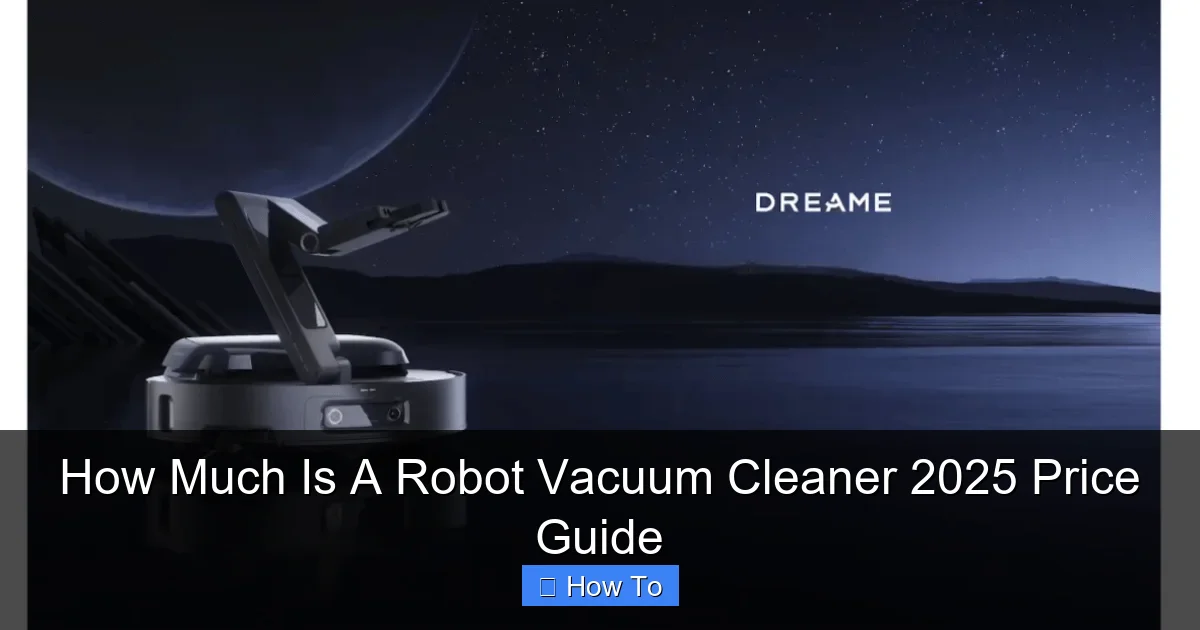
Visual guide about How Much Is A Robot Vacuum Cleaner 2025 Price Guide
Image source: bestvacuumexpert.com
Let’s break down the typical price ranges for robot vacuum cleaners in 2025 and what you can generally expect at each level.
Entry-Level Models (Typically Under $250)
These are perfect for smaller homes or apartments with mostly hard floors and minimal pet hair.
- Features: Basic bump-and-go or simple gyroscopic navigation. Standard suction (around 1500-2000 Pa). Limited battery life (60-90 mins). Remote or on-device controls. Manual dustbin emptying.
- Best For: Light daily cleaning, maintaining tidiness, first-time robot vacuum cleaner owners on a tight budget.
- Expectations: May not clean in organized patterns, can get stuck more often, and require more user intervention.
Mid-Range Performers ($250 – $600)
This is the sweet spot for many, offering a great balance of features and value.
- Features: More organized navigation (vSLAM, basic Lidar in some newer models). Improved suction (2500-3500 Pa). App control with Wi-Fi connectivity. Longer battery life (120-180 mins) with auto-recharge. Some models include basic mopping or even self-emptying docks.
- Best For: Medium to larger homes, homes with pets, mixed floor types (hardwood, carpets), users who want more convenience and smarter cleaning without breaking the bank.
- Expectations: Good cleaning performance, mapped cleaning paths, and decent smart features. A solid robot vacuum cleaner for most households.
High-End and Premium Innovators ($600 – $1200+)
These are the cream of the crop, offering the latest technology and ultimate convenience.
- Features: Advanced Lidar or AI vision navigation for precise mapping and obstacle avoidance. Powerful suction (4000 Pa and above). Extended battery life (180-240+ mins). Comprehensive app control with no-go zones, multi-floor mapping. Fully integrated mopping with advanced scrubbing. Self-emptying docks, self-washing/drying mop pads, and auto-refilling tanks are common.
- Best For: Large homes, multiple floors, homes with significant pet hair, users who demand the best technology, minimal manual intervention, and a truly hands-free cleaning experience.
- Expectations: Exceptional cleaning, highly intelligent navigation, and maximum automation. These top-tier robot vacuum cleaners offer a luxury cleaning experience.
How to Determine Your Ideal Robot Vacuum Cleaner Budget
Now that you know what drives prices, how do you figure out how much is a robot vacuum cleaner that’s right for *you*?
Assess Your Home’s Needs: Size, Layout, Floor Types
Your living space dictates many feature requirements.
- Small Apartment (Under 800 sq ft): An entry-level robot vacuum cleaner might suffice. You don’t need extensive battery life or complex mapping.
- Medium Home (800-1500 sq ft): Mid-range models are likely your best bet. Organized cleaning paths and good battery life are important.
- Large Home or Multi-Floor (1500+ sq ft): You’ll benefit from premium features like Lidar mapping, multi-floor support, and longer battery life. A self-emptying robot vacuum cleaner will be a huge time-saver.
- Floor Types: Mostly hard floors? Suction power can be lower. Lots of carpets? You’ll need higher suction. Mixed floors? Consider a robot vacuum cleaner that handles both well, especially one with auto-lift mopping.
- Pets: Pet hair requires stronger suction, tangle-free brushes, and ideally, a self-emptying dock to minimize maintenance.
Prioritize Features That Truly Matter to You
Make a list of “must-have” and “nice-to-have” features.
- Must-Haves: Do you absolutely need strong suction for pet hair? Is precise mapping crucial for setting no-go zones? Do you despise emptying dustbins (self-emptying)?
- Nice-to-Haves: Would you enjoy voice control? Is simultaneous vacuuming and mopping a bonus? Can you live without advanced obstacle avoidance if it means a lower price?
Don’t pay for features you won’t use. This is key to finding the best value robot vacuum cleaner.
Consider Long-Term Running Costs
The initial purchase price isn’t the only cost.
- Replacement Parts: Brushes, filters, and mop pads need replacing every few months, depending on usage. These costs add up over time. Some brands offer cheaper parts than others.
- Dust Bags: If you opt for a self-emptying dock, you’ll need to buy replacement dust bags periodically. Check the cost and availability of these before committing.
- Warranty and Support: A longer warranty or readily available customer service can save you money on repairs down the line.
Smart Shopping: Tips for Finding the Best Deals in 2025
Even with a clear idea of how much is a robot vacuum cleaner you want, you can still save money.
Leverage Holiday Sales and Promotions
Major sales events are prime opportunities to snag a deal on a robot vacuum cleaner.
- Black Friday/Cyber Monday: Expect the deepest discounts on a wide range of models.
- Amazon Prime Day: Often features exclusive deals on various smart home gadgets.
- Seasonal Sales: Look out for back-to-school sales, spring cleaning promotions, or end-of-year clearances.
Explore Refurbished or Older-Gen Models
You can often get premium features at a mid-range price.
- Refurbished Units: Many manufacturers and reputable retailers sell certified refurbished robot vacuum cleaners. These are often returned units that have been thoroughly inspected, repaired (if needed), and cleaned. They come with a warranty and significant savings.
- Last Year’s Models: When new models are released, the previous year’s flagships often see substantial price drops. These older models still offer excellent performance and features.
Compare Prices Across Multiple Retailers
Don’t buy from the first place you look.
- Check major electronics retailers, online marketplaces, and even the manufacturer’s direct website.
- Use price comparison websites to quickly see where the best deals are.
- Sign up for newsletters from your preferred brands or stores to receive alerts on discounts.
Common Misconceptions About Robot Vacuum Cleaner Costs
Let’s clear up some common misunderstandings about how much a robot vacuum cleaner might cost.
“More Expensive Always Means Better”
Not necessarily. While premium models offer more features, an entry-level robot vacuum cleaner might be “better” for someone living in a small studio apartment who just needs basic daily tidying. Overpaying for unused features is a waste.
“All Robot Vacuums Are the Same”
Definitely not. The technology, build quality, and software vary immensely. A $150 robot vacuum cleaner will perform very differently from a $1000 model. Understand these differences to set realistic expectations for your purchase.
“Maintenance is Negligible”
This is a common oversight. While robot vacuums reduce manual labor, they still require some maintenance. Brushes need cleaning, filters need tapping out or replacing, and dustbins need emptying (unless you have a self-emptying dock). Factor in the time and cost of replacement parts.
Troubleshooting Your Robot Vacuum Cleaner Purchase Decision
It’s easy to feel overwhelmed by the choices. Here are some tips to “troubleshoot” your decision-making process.
The Overwhelm of Choices
There are hundreds of robot vacuum cleaner models out there.
- Solution: Start with your budget. This immediately narrows down your options. Then, identify your absolute non-negotiable features (e.g., must handle pet hair, must have mapping). Work from there.
Balancing Features vs. Budget
You might find a robot vacuum cleaner with everything you want, but it’s just out of your price range.
- Solution: Prioritize. Which features can you live without or compromise on slightly? Could an older model with similar features be more affordable? Sometimes waiting for a sale can bridge the gap.
Future-Proofing Your Investment
Technology evolves rapidly. You don’t want your new robot vacuum cleaner to be obsolete in a year.
- Solution: Look for models that receive regular software updates. Brands with a strong reputation for innovation tend to support their devices longer. While you can’t stop progress, choosing a mid-to-high-range model often means better core technology that will remain relevant for longer.
Conclusion
Deciding how much is a robot vacuum cleaner worth investing in for your home in 2025 is a personal journey. It’s about balancing your budget with your cleaning needs and desired level of automation. From basic models under $250 that offer daily tidying to premium devices over $1200 providing a completely hands-free, intelligent cleaning experience, there’s a robot vacuum cleaner for everyone.
By understanding the factors that influence pricing—like navigation, suction power, smart features, and self-emptying docks—you can make an informed decision. Remember to assess your home’s unique requirements, prioritize essential features, and always keep an eye out for smart shopping opportunities like sales and refurbished options. With this guide, you’re now equipped to confidently choose the perfect robot vacuum cleaner that brings both cleanliness and convenience to your 2025 home. Happy cleaning!
🎥 Related Video: Best Robot Vacuum Cleaner 2025
📺 The Grapevine
Mega comparison of over 50 robot vacuums products to help identify the best robot vacuums for you in 2025. Amazon buying …