
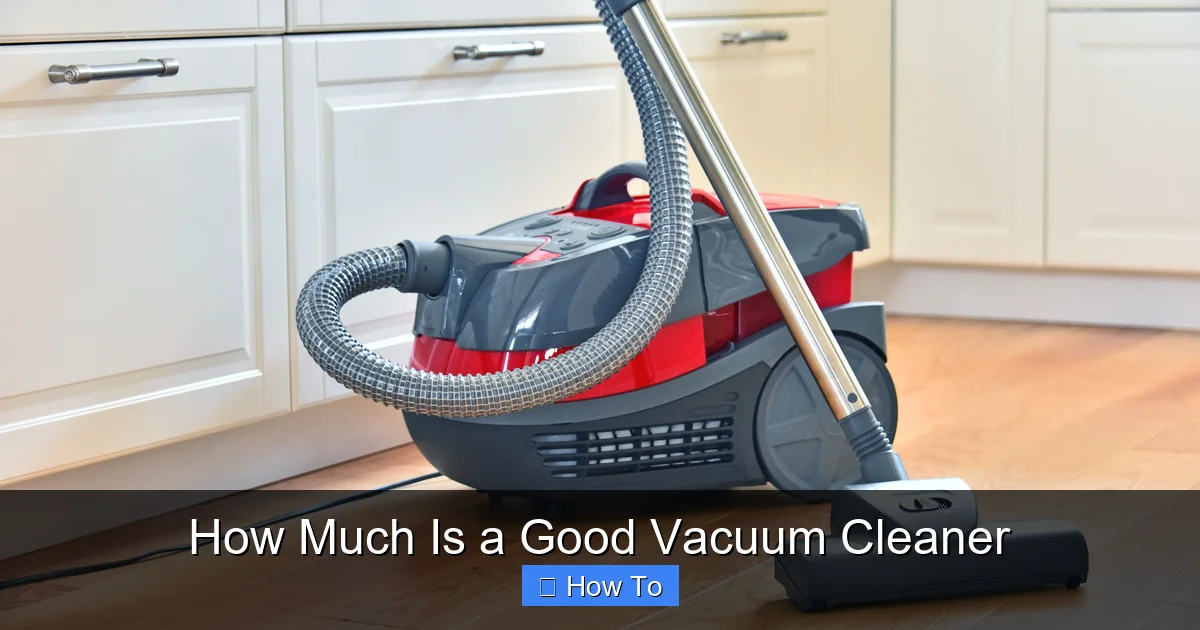
Defining “how much is a good vacuum cleaner” isn’t about a single price tag, but rather finding the best value for your specific needs. A truly good vacuum cleaner offers performance, durability, and features that align with your home, lifestyle, and budget. This guide will walk you through understanding different price points and what makes an investment worthwhile, ensuring you get excellent cleaning power without overspending.
How Much Is a Good Vacuum Cleaner?
Welcome to the ultimate guide on understanding the true cost of a good vacuum cleaner! If you’re standing in an aisle, scrolling through endless online options, or just starting your research, you’ve probably asked yourself: “How much is a good vacuum cleaner, really?” It’s a fantastic question, and the simple answer is: it depends! There isn’t a single magical price tag for “good.” Instead, “good” means finding the perfect balance between performance, durability, and features that meet *your* specific cleaning needs and budget.
This comprehensive guide will help you navigate the often-confusing world of vacuum prices. We’ll break down what makes a vacuum “good,” explore different price ranges, highlight the factors that influence cost, and provide practical tips to ensure you invest wisely. By the end, you’ll feel confident making an informed decision about how much you should spend to get a truly excellent cleaning companion for your home.
Key Takeaways
- “Good” is Personal: The ideal price for a good vacuum cleaner depends entirely on your specific cleaning needs, home type, pet ownership, and allergy concerns.
- Price Ranges Vary Widely: Expect to pay anywhere from under $150 for basic models, $150-$400 for mid-range, and $400-$800+ for high-end or specialty vacuums.
- Key Price Influencers: Factors like brand reputation, motor power, filtration (HEPA), build quality, included accessories, and smart technology significantly impact a vacuum’s cost.
- Value Over Low Price: Don’t just chase the lowest price. A cheaper vacuum that fails quickly or doesn’t meet your needs is a poor investment. Focus on durability and effective performance.
- Research is Crucial: Before buying, read reviews, compare models, and consider the long-term costs of bags, filters, and potential maintenance.
- Consider Long-Term Costs: Initial purchase price is only part of the equation. Factor in the cost and availability of replacement bags, filters, and potential repairs over the vacuum’s lifespan.
Quick Answers to Common Questions
What’s the absolute minimum I should spend for a decent vacuum?
For a basic, functional vacuum that handles light messes on hard floors, you might find decent options starting around $100-$150. However, for more robust cleaning or features, expect to invest more.
Is a higher wattage always better for suction?
Not necessarily. While wattage relates to motor power, suction power is also heavily influenced by design, airflow, and sealing. A lower wattage vacuum with excellent design can outperform a higher wattage one with poor airflow.
Should I buy a bagged or bagless vacuum?
Bagless vacuums are convenient as you don’t buy bags, but emptying them can release dust. Bagged vacuums are often better for allergy sufferers as the dust is contained, but they have ongoing bag costs.
How often should I replace my vacuum’s filters?
It depends on the filter type and your usage. Some filters are washable and last a year or more; others are disposable and should be changed every 3-6 months. Always check your vacuum’s manual for specific recommendations.
Are robotic vacuums worth the higher price?
For convenience and daily maintenance, yes, they can be. However, they are generally best for maintaining cleanliness rather than deep cleaning, and you might still need a traditional vacuum for stairs or tough spots.
Step 1: Define “Good” – Understanding Your Needs First
Before we even talk about dollars and cents, let’s talk about *you*. What makes a vacuum cleaner “good” for one person might be completely different for another. Understanding your specific needs is the most crucial step in determining how much is a good vacuum cleaner for *your* home.
Consider Your Type of Flooring
Are your floors mostly hardwood, tile, or laminate? Or do you have plush carpets, low-pile rugs, or a mix of everything?
- Hardwood/Tile: You’ll want a vacuum with strong suction and soft brushes that won’t scratch surfaces. Canister vacuums or stick vacuums often excel here.
- Carpets/Rugs: An upright vacuum with a powerful brush roll is usually ideal for digging deep into carpet fibers. Adjustability for different pile heights is a bonus.
- Mixed Flooring: Many modern vacuums offer multi-surface capabilities, often with a brush roll shut-off feature for hard floors. This might mean a slightly higher price for versatility.
Factor in Pet Ownership
If you have furry friends, pet hair becomes a major concern. Pet owners often need vacuums with:
- Strong Suction: To pick up embedded hair.
- Tangle-Free Brush Rolls: To prevent hair from wrapping and clogging.
- Specialized Attachments: Such as pet turbo brushes for upholstery.
- Advanced Filtration: To capture pet dander (see below).
These specialized features often push the price up, but they are absolutely worth it for a truly “good” clean in a pet-friendly home.
Address Allergy Concerns
For allergy sufferers, filtration is paramount. A good vacuum cleaner in this context must:
- Feature a HEPA Filter: Captures 99.97% of particles down to 0.3 microns, including pollen, dust mites, and pet dander.
- Have a Sealed System: Ensures that all the air filtered through the vacuum exits through the HEPA filter, preventing dust from leaking out elsewhere.
Vacuums with robust HEPA filtration and sealed systems tend to be on the higher end of the price spectrum, but they offer significant health benefits.
Think About Your Home Size and Layout
- Small Apartments: A lightweight stick vacuum or compact canister might be perfect. Cordless models offer convenience.
- Multi-Story Homes: A lightweight design or a convertible stick/handheld model can make stairs easier.
- Large Homes: You might prefer an upright with a wider cleaning path for efficiency, or a powerful canister for versatility across different areas. Cordless options will need excellent battery life.
Consider Desired Features and Convenience
Do you dream of a robotic vacuum? Prefer bagless convenience or the hygienic disposal of bagged models?
- Cordless vs. Corded: Cordless offers freedom but requires charging and often has a shorter run time. Corded offers unlimited power but less mobility. Cordless models generally cost more for comparable power.
- Bagged vs. Bagless: Bagged vacuums are often better for allergy sufferers but require buying replacement bags. Bagless are convenient but emptying them can be dusty.
- Attachments: Crevice tools, upholstery brushes, dusting brushes, pet tools – the more included, often the higher the price.
- Smart Features: Robotic vacuums with app control, mapping, and voice assistant integration are at the top end of the price range.
Step 2: Understanding Price Ranges for a Good Vacuum Cleaner

Visual guide about How Much Is a Good Vacuum Cleaner
Image source: pyxis.nymag.com
Now that you know *what* you need, let’s explore how much these features typically cost. “How much is a good vacuum cleaner?” has several answers depending on the tier.
Entry-Level Vacuums (Under $150)
At this price point, you’ll find basic uprights, stick vacuums, and handheld models.
- What to Expect: Adequate suction for light messes, often plastic construction, limited features, and basic filtration. They might struggle with deep carpets or heavy pet hair.
- Who It’s Good For: Students, small apartments with mostly hard floors, as a secondary vacuum for quick clean-ups, or for homes with minimal cleaning demands.
- Example: A basic Eureka, Bissell, or Dirt Devil upright.
Mid-Range Vacuums ($150 – $400)
This is the sweet spot for many homeowners looking for a good balance of performance and features.
- What to Expect: Improved suction, better build quality, multi-surface capabilities, some specialized attachments, and often HEPA-level filtration (though not always a fully sealed system). You’ll find a wide variety of uprights, canisters, and some robust stick vacuums here.
- Who It’s Good For: Most households with a mix of flooring, pet owners with moderate shedding, and those looking for reliable daily cleaning.
- Example: Popular models from Shark, Hoover, and some Dyson stick vacuums might fall into the higher end of this range during sales.
High-End Vacuums ($400 – $800+)
This category includes premium brands and models designed for superior performance and durability.
- What to Expect: Powerful motors, excellent suction, durable construction (often metal components), advanced sealed HEPA filtration, specialized tools, and longer warranties. Cordless models in this range offer longer battery life and stronger suction.
- Who It’s Good For: Pet owners with heavy shedding, allergy sufferers who need pristine air quality, large homes, and anyone seeking a vacuum built to last with top-tier performance.
- Example: Miele canister vacuums, high-end Dyson uprights/stick vacuums, some premium Shark models, and Sebo vacuums.
Luxury/Specialty Vacuums ($800+)
At the top tier, you’ll find highly specialized or luxury models.
- What to Expect: Often includes high-end robotic vacuums with advanced mapping and self-emptying features, or commercial-grade vacuums adapted for home use. Exceptional build quality, cutting-edge technology, and comprehensive warranties are standard.
- Who It’s Good For: Those who prioritize automation, commercial cleaning needs, or have very specific requirements and a generous budget.
- Example: Top-tier Roomba or Roborock models, high-end Miele or Sebo uprights, Kirby vacuums.
Step 3: Factors That Influence the Price of a Good Vacuum Cleaner
Why does one vacuum cost $100 and another $1000? Several key elements drive the price. Understanding these helps you gauge how much is a good vacuum cleaner *for the money*.
Brand Reputation and Warranty
Established brands known for quality (like Miele, Dyson, Sebo) often command higher prices due to their R&D, advanced technology, and customer support. A longer, more comprehensive warranty also adds to the perceived value and cost.
Motor Power and Suction Strength
More powerful motors generally translate to better suction, especially important for deep carpets and pet hair. High-performance motors, which are often more durable and efficient, contribute significantly to the overall price.
Filtration System (Especially HEPA and Sealed Systems)
As mentioned, HEPA filters and completely sealed systems are crucial for allergy sufferers. The engineering required to create a truly sealed system that prevents dust leakage is complex and adds to the manufacturing cost.
Build Quality and Materials
Cheaper vacuums often use lighter, less durable plastics. More expensive models incorporate sturdier plastics, metal components (like brush rolls or wands), and higher-quality wheels, all of which contribute to longevity and thus, a “good” investment.
Included Attachments and Accessories
A vacuum that comes with a range of specialized tools – a pet turbo brush, crevice tool, upholstery brush, dusting brush, and more – typically costs more than a bare-bones model. These accessories enhance versatility and cleaning efficiency.
Technology and Smart Features
Robotic vacuums with sophisticated navigation, Wi-Fi connectivity, app control, self-emptying bins, and advanced sensors come with a premium price tag. Similarly, cordless vacuums with high-capacity, long-lasting batteries and powerful digital motors are more expensive.
Step 4: Shopping Smart – Getting the Best Value for Your Money
Knowing how much is a good vacuum cleaner means not just understanding prices, but also how to get the most for your investment.
Read Reviews and Comparisons
Always check independent reviews from trusted sources (like Consumer Reports) and read user testimonials. Pay attention to comments about durability, suction power over time, and customer service. This will tell you if a vacuum truly offers good long-term value.
Consider Refurbished Models or Sales Events
You can often find high-end models at a significant discount by purchasing refurbished units directly from the manufacturer or through reputable retailers. Major sales events (Black Friday, Prime Day, seasonal sales) are also excellent times to snag a good deal.
Test Drive If Possible
If you have the opportunity, visit a store where you can physically test a vacuum. Feel its weight, maneuverability, and listen to its noise level. This hands-on experience can be invaluable.
Factor in Long-Term Costs
The initial purchase price isn’t the only cost.
- Bags and Filters: For bagged vacuums, consider the ongoing cost of replacement bags. For both bagged and bagless, research the cost and frequency of filter replacements.
- Maintenance: Are parts easily replaceable? Is there a good service network if something goes wrong?
- Energy Consumption: While often minor, some industrial-strength models can use more power.
Step 5: Red Flags and What to Avoid
Not every expensive vacuum is “good,” and not every cheap one is “bad.” But there are some warning signs to watch for.
Unrealistic Claims
Be wary of vacuums making outlandish claims about suction or filtration without credible third-party verification. If it sounds too good to be true for the price, it probably is.
Lack of Warranty or Poor Customer Support
A good vacuum cleaner should come with a solid warranty (at least 1-2 years, ideally longer for higher-end models). Check reviews about the brand’s customer service; you want support if you encounter issues.
Overpaying for Unnecessary Features
Don’t get swayed by a long list of features you’ll never use. If you have no pets, paying extra for specialized pet tools is a waste. If you have only hard floors, a powerful brush roll for deep carpets might be overkill.
Step 6: Troubleshooting – Ensuring Your “Good” Vacuum Stays Good
Even if you’ve invested in what you believe is a good vacuum cleaner, issues can arise. Here’s how to ensure your investment continues to deliver value.
My New Vacuum Isn’t Performing as Expected. Was It a Good Value?
- Check for Clogs: This is the most common issue. Disconnect from power and check the hose, brush roll, and filters for blockages.
- Empty the Dust Bin/Change Bag: A full bin or bag drastically reduces suction.
- Clean/Replace Filters: Clogged filters are a major cause of poor performance. Follow manufacturer guidelines for cleaning or replacement.
- Adjust Settings: Ensure you’re using the correct height setting for carpets and the appropriate power mode (if available).
- Review Warranty: If issues persist after basic troubleshooting, consult your manual and contact customer support. A “good” vacuum should have reliable support.
How Can I Extend the Life of My Vacuum and Maximize Its Value?
- Regular Maintenance: Empty the bin/change the bag regularly, clean or replace filters as recommended, and keep the brush roll free of hair and debris.
- Store Properly: Keep your vacuum in a dry, safe place where it won’t be knocked over or exposed to extreme temperatures.
- Use Correctly: Don’t vacuum liquids or large, sharp objects unless your vacuum is specifically designed for wet pickup or heavy-duty tasks.
- Protect the Cord: If corded, avoid running over the cord or yanking it from the outlet.
By taking good care of your vacuum, you ensure that the investment you made in a “good” cleaner continues to pay off for years to come.
Conclusion: The True Cost of a Good Vacuum Cleaner
So, how much is a good vacuum cleaner? It’s not a fixed dollar amount but rather a thoughtful investment in a tool that effectively meets your household’s unique cleaning demands, budget, and longevity expectations. For some, a good vacuum might be a reliable $200 upright that tackles pet hair efficiently. For others, it could be a $700 HEPA-sealed canister providing pristine air quality.
By carefully assessing your needs, understanding the impact of features on price, and shopping smartly, you can confidently determine the right price point for *your* good vacuum cleaner. Remember, the best value often lies not in the cheapest option, but in the one that delivers consistent performance, durability, and peace of mind for years to come. Happy vacuuming!