
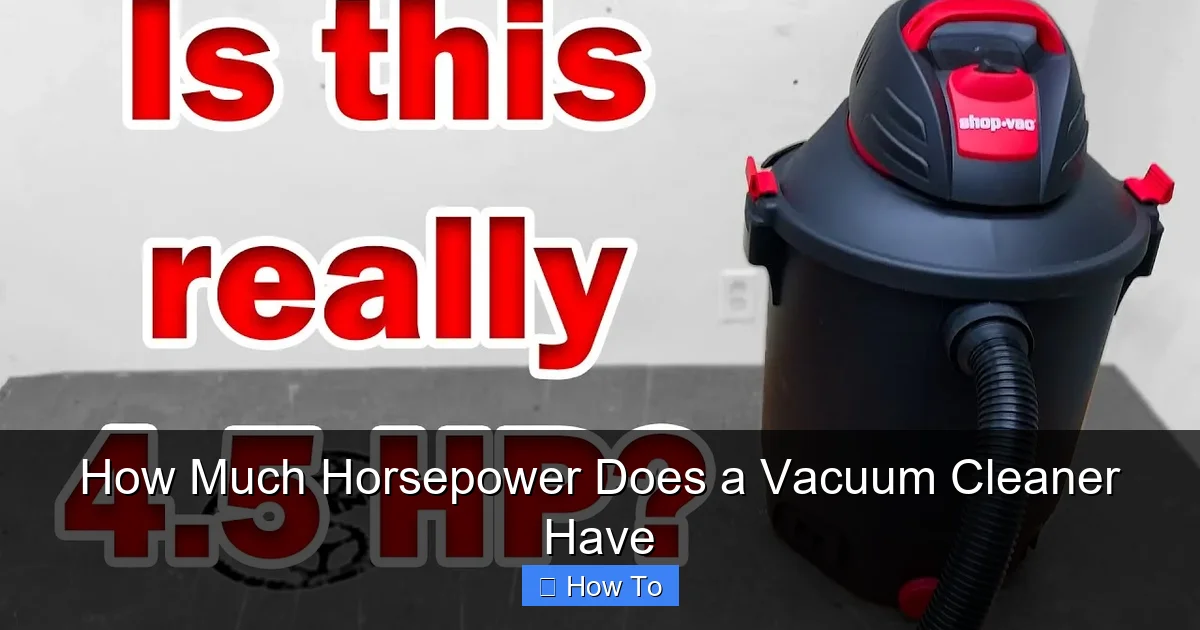
Many wonder how much horsepower a vacuum cleaner has, but horsepower isn’t the standard metric for these appliances. While you *can* theoretically convert a vacuum’s electrical watts to horsepower (typically around 1 to 2 HP for common models), this number is highly misleading. The most accurate way to understand a vacuum’s actual cleaning ability is by looking at air watts, which measure both airflow and suction power, providing a much better indicator of performance.
How Much Horsepower Does a Vacuum Cleaner Have
Have you ever looked at your vacuum cleaner and wondered, “How much horsepower does a vacuum cleaner have?” It’s a common question, especially when you think about the powerful motors in cars or other heavy-duty equipment. However, the answer is more nuanced than a simple number. For vacuum cleaners, horsepower isn’t the standard metric, and focusing on it can be quite misleading.
In this comprehensive guide, we’re going to dive deep into the world of vacuum cleaner power. We’ll explore why horsepower isn’t the right way to measure a vacuum’s performance, what metrics you *should* be looking at, and how to truly understand what makes a vacuum powerful and effective. By the end, you’ll be able to confidently assess any vacuum cleaner’s capabilities, moving beyond the myth of “how much horsepower does a vacuum cleaner have” to truly informed decision-making.
Key Takeaways
- Horsepower is Misleading: Vacuum cleaners are not typically rated in horsepower (HP). While a theoretical conversion is possible, it doesn’t accurately reflect cleaning performance.
- Watts (Electrical Input) are Not Suction Power: The wattage listed on a vacuum primarily indicates its electrical power consumption, not necessarily its effective cleaning strength. Higher watts don’t always mean better suction.
- Air Watts are the Best Indicator: Air watts are the most useful metric, measuring the actual power delivered to the cleaning surface (a combination of airflow and suction). Look for this rating to compare models effectively.
- Other Important Metrics: Suction power (measured in kPa or inches of water lift) and airflow (measured in CFM or L/s) also contribute significantly to a vacuum’s effectiveness, especially for specific tasks.
- Theoretical HP Range: Most household vacuum cleaners, if converted from their electrical wattage, would fall in the range of 1 to 2.5 theoretical horsepower.
- Efficiency Matters: A vacuum’s design, motor efficiency, filtration system, and brush roll all play crucial roles in how effectively it cleans, regardless of its raw power input.
- Focus on Cleaning Performance: When choosing a vacuum, prioritize air watts, suction, airflow, and features like brush design over a meaningless horsepower conversion.
Quick Answers to Common Questions
What is the most important power rating for a vacuum?
The most important power rating for a vacuum cleaner is “air watts.” This metric directly measures the actual cleaning power by combining both airflow and suction, giving you a clear picture of its effectiveness.
Can a vacuum cleaner have too much suction?
Yes, in some cases. While strong suction is generally good, excessive suction can make a vacuum hard to push on carpets, potentially damage delicate rugs or flooring, or even make it less efficient at picking up larger debris by sealing too tightly to the surface.
Do cordless vacuums have less “horsepower” than corded ones?
Cordless vacuums often have lower electrical wattage ratings and thus theoretically lower “horsepower” if converted. However, modern cordless models use highly efficient digital motors to deliver impressive air watts and cleaning performance comparable to, or even exceeding, many corded vacuums, making the “horsepower” comparison irrelevant.
Why do some vacuums list watts but not air watts?
Some manufacturers may only list electrical watts because it’s a straightforward measure of power consumption and sometimes perceived by consumers as an indicator of strength. Air watts are a more complex performance metric, and sometimes smaller or less expensive models might omit them if their performance isn’t a key selling point.
Does the size of the vacuum affect its “horsepower”?
The physical size of a vacuum doesn’t directly dictate its “horsepower” or effective cleaning power. While larger vacuums might have bigger motors, it’s the motor’s efficiency, the overall design, and how well it converts electrical energy into suction and airflow (measured in air watts) that truly determine its cleaning capability.
Understanding Vacuum Cleaner Power Metrics
Let’s start by clarifying why the question “how much horsepower does a vacuum cleaner have” isn’t the most helpful one. Then, we’ll introduce the metrics that really matter.
Why Horsepower Isn’t the Right Measure for Vacuums
You might be used to seeing horsepower (HP) ratings on cars, lawnmowers, or even some workshop tools. Horsepower is a unit of power that measures the rate at which work is done. One mechanical horsepower is equivalent to lifting 33,000 pounds one foot in one minute. While accurate for engines, it’s not practical for vacuum cleaners because their primary function isn’t raw mechanical output to drive wheels or blades.
Vacuum cleaners are designed to create suction and airflow to lift dirt. The efficiency of a vacuum in converting electrical energy into cleaning power is complex and involves many factors beyond just the motor’s raw power. Trying to answer “how much horsepower does a vacuum cleaner have” directly doesn’t account for air resistance, seal quality, hose diameter, filtration, or brush roll design, all of which are critical to performance.
The Importance of Watts (Input Power)
When you look at a vacuum cleaner, you’ll almost always see a wattage (W) rating. This number indicates the electrical input power the vacuum draws from your wall socket. Common household vacuum cleaners typically range from 800W to 2000W.
It’s tempting to think that higher wattage automatically means more powerful suction. However, this isn’t always true. Watts measure *electrical consumption*, not *cleaning output*. A vacuum might draw a lot of electricity but be inefficient at converting that into useful suction and airflow. Conversely, a well-designed, more efficient vacuum might use fewer watts but deliver superior cleaning performance. So, while watts give you an idea of energy usage, they don’t directly answer “how much horsepower does a vacuum cleaner have” in terms of cleaning ability.
Introducing Air Watts: The Gold Standard
If you want to know the true cleaning power of a vacuum, air watts (AW) are the metric you should be looking for. Air watts are a measure of the effective power output of a vacuum cleaner, taking into account both airflow (how much air moves) and suction power (how strongly the air moves).
The formula for air watts is:
Air Watts = 0.11725 * Airflow (CFM) * Suction (inches of water lift)
Or, if using metric units:
Air Watts = 0.000338 * Airflow (L/s) * Suction (kPa)
This makes air watts incredibly useful because they tell you how much power is actually being used to pick up dirt. A vacuum with high air watts will generally have better cleaning performance than one with low air watts, regardless of its electrical wattage or theoretical horsepower. For household use, a good vacuum might have anywhere from 100 to 300+ air watts, with high-performance models exceeding 400 AW.
Suction Power (kPa or Inches of Water Lift)
Suction power, also known as static pressure or water lift, measures how strongly a vacuum can pull air into its nozzle. It’s often expressed in kilopascals (kPa) or inches of water lift (H2O). Higher numbers indicate stronger suction.
Strong suction is crucial for lifting stubborn dirt, deep-seated pet hair, or heavy debris from carpets. However, extreme suction isn’t always necessary or even desirable; too much can make a vacuum hard to push on carpets or damage delicate surfaces. A typical household vacuum might offer 15-25 kPa (or 60-100 inches of water lift).
Airflow (CFM or L/s)
Airflow measures the volume of air that passes through the vacuum cleaner’s system in a given amount of time. It’s typically expressed in cubic feet per minute (CFM) or liters per second (L/s). High airflow is essential for picking up light, bulky debris like pet hair, dust bunnies, or cereal. It also helps move dirt efficiently through the hose and into the dustbin.
A good balance of both suction and airflow is key for effective cleaning. A vacuum with high suction but low airflow might struggle with larger debris, while one with high airflow but low suction might not be able to pull dirt from deep within carpet fibers.
Converting Vacuum Power to Horsepower (and Why It’s Misleading)
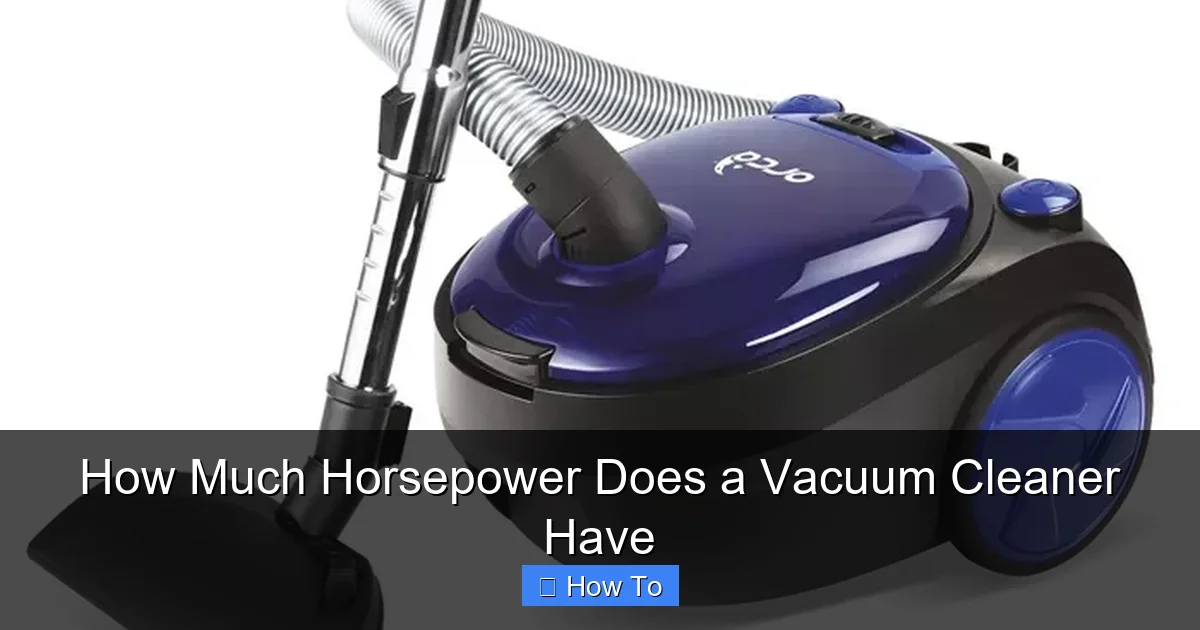
Visual guide about How Much Horsepower Does a Vacuum Cleaner Have
Image source: bestfloorscrubber.com
Since the question “how much horsepower does a vacuum cleaner have” is so common, let’s address how you *could* theoretically convert a vacuum’s electrical wattage to horsepower, and then reiterate why it’s not a useful metric.
The Theoretical Calculation (Watts to HP)
The conversion factor is simple: 1 mechanical horsepower is approximately equal to 746 watts.
So, if you want to convert your vacuum cleaner’s electrical input wattage to theoretical horsepower, you would use this formula:
Theoretical Horsepower = Electrical Watts / 746
Let’s look at some examples:
- A 1200-watt vacuum: 1200 W / 746 W/HP ≈ 1.6 HP
- A 1500-watt vacuum: 1500 W / 746 W/HP ≈ 2.0 HP
- An 1800-watt vacuum: 1800 W / 746 W/HP ≈ 2.4 HP
Based on these calculations, a typical household vacuum cleaner, in terms of its raw electrical power input, might theoretically have between 1.5 to 2.5 horsepower. This is a direct answer to “how much horsepower does a vacuum cleaner have” if you’re talking about the *motor’s electrical input capacity*.
Why This Conversion Doesn’t Tell the Whole Story
It’s crucial to understand that the theoretical horsepower calculated above is based on the vacuum’s *electrical input* and does not represent its *effective cleaning power*. Here’s why this number is highly misleading:
- Motor Efficiency: No motor is 100% efficient. A significant portion of the electrical energy drawn by the motor is lost as heat due to friction and electrical resistance. This lost energy doesn’t contribute to suction or airflow.
- Power Distribution: The total electrical power is distributed throughout the vacuum. Some powers the motor, some might power a brush roll motor, some is lost as heat, and some is used for lights or other features. Not all of it contributes to the actual air movement that cleans.
- System Losses: Air has to move through filters, hoses, and nozzles. Each of these components creates resistance, reducing the effective suction and airflow delivered to the cleaning head. A poorly designed system will have more losses, meaning less cleaning power even with a “high HP” motor.
- Nozzle and Brush Roll Design: The design of the cleaning head, including the brush roll and its seals, plays a massive role in how effectively dirt is agitated and picked up. A highly efficient brush roll can make a vacuum with moderate power outperform a high-power, poorly designed one.
- Filtration System: Multi-stage filtration, especially HEPA filters, can create significant resistance to airflow. While essential for air quality, this resistance directly impacts the amount of air watts a vacuum can produce.
So, while you can technically calculate “how much horsepower does a vacuum cleaner have” from its wattage, this number is a poor indicator of its actual performance. It’s like measuring a car’s engine horsepower without considering its weight, aerodynamics, or transmission—you get a number, but it doesn’t tell you how fast or efficiently it will drive.
How to Determine a Vacuum Cleaner’s *Effective* Cleaning Power
Instead of asking “how much horsepower does a vacuum cleaner have,” shift your focus to these more relevant factors when evaluating a vacuum.
Look for Air Watts First
As discussed, air watts are your best friend. Always check the specifications for an air watt rating when comparing models. It’s the most comprehensive measure of a vacuum’s ability to create both suction and airflow, which translates directly to cleaning performance. Aim for at least 100-150 AW for basic cleaning, and 200+ AW for more robust performance on carpets or homes with pets.
Consider Suction Power and Airflow
If air watts aren’t listed (which can happen, especially with older or very budget-friendly models), look for separate ratings for suction power (kPa or inches of water lift) and airflow (CFM or L/s). Remember, you want a good balance of both. High suction is great for deep cleaning, while high airflow is excellent for picking up larger debris and pet hair.
Factor in Brush Roll Design and Filtration
The power generated by the motor is only effective if it’s applied correctly at the cleaning surface.
- Brush Roll: A powerful, motor-driven brush roll (especially on uprights and some stick vacuums) can agitate carpet fibers, lifting embedded dirt and pet hair, making the vacuum far more effective than raw suction alone. Look for brush rolls that can be turned off for delicate surfaces or bare floors.
- Filtration: While HEPA filters are fantastic for trapping allergens, they can restrict airflow if not properly maintained. Consider the filter type and ease of cleaning or replacement.
Read Reviews and User Experiences
Real-world performance can vary greatly from theoretical specs. Always read reviews from other users and independent testing organizations. They can provide invaluable insights into how well a vacuum actually performs on different surfaces, its durability, and ease of use, giving you a practical answer to its cleaning power, far beyond “how much horsepower does a vacuum cleaner have.”
Practical Examples: What Different Power Ratings Mean
Let’s put these metrics into perspective with some examples of common vacuum types.
Entry-Level Vacuums
These are often smaller, lighter models, sometimes handheld or basic stick vacuums.
- Electrical Watts: 400W – 1000W
- Theoretical HP (if converted): ~0.5 – 1.3 HP
- Air Watts: 50 AW – 120 AW
- Suction/Airflow: Moderate, suitable for light debris and quick clean-ups on hard floors. They typically struggle with deep carpets or heavy messes.
For simple tasks, their actual cleaning power (air watts) is sufficient, even if their “horsepower” is low.
Mid-Range Vacuums
This category includes many standard uprights, canister vacuums, and more robust stick vacuums.
- Electrical Watts: 1000W – 1500W
- Theoretical HP (if converted): ~1.3 – 2.0 HP
- Air Watts: 120 AW – 250 AW
- Suction/Airflow: Good balance, capable of handling most household cleaning tasks on various surfaces, including low to medium pile carpets.
This is where the combination of air watts, good suction, and decent airflow starts to make a significant difference in everyday cleaning effectiveness.
High-Performance Vacuums
These are often premium uprights, powerful canister vacuums, or specialized models designed for homes with pets or allergies.
- Electrical Watts: 1500W – 2000W+
- Theoretical HP (if converted): ~2.0 – 2.7 HP+
- Air Watts: 250 AW – 400 AW+
- Suction/Airflow: Excellent, designed for deep cleaning, high-pile carpets, heavy pet hair, and large homes. They often feature advanced filtration and powerful brush rolls.
These vacuums demonstrate that while the theoretical horsepower might not seem astronomically higher than a mid-range model, their superior air watts and overall design result in vastly better cleaning capabilities.
Troubleshooting Common Misconceptions About Vacuum Power
Let’s tackle a few other common beliefs that often lead people astray when thinking about “how much horsepower does a vacuum cleaner have” or how powerful a vacuum truly is.
“Higher Watts Always Means Better Suction” (Not necessarily true)
As we’ve covered, electrical wattage (input power) does not directly equate to effective cleaning power (output power). A 2000W vacuum with poor design and efficiency might deliver fewer air watts than a well-engineered 1500W model. Always prioritize air watts over electrical watts. Regulations in some regions (like the EU) even cap maximum electrical wattage to encourage manufacturers to design more efficient vacuums, proving that lower wattage can still mean excellent performance.
“A Heavy Vacuum is More Powerful” (Often unrelated)
While robust construction can sometimes correlate with higher quality components, the weight of a vacuum is not a direct indicator of its power or performance. Some heavy vacuums are simply bulky or made of less advanced materials. Conversely, many lightweight stick vacuums and cordless models now offer impressive cleaning power thanks to advanced motor technology and efficient design. Judge a vacuum by its performance metrics, not its heft.
“More Attachments Mean Better Cleaning” (Quality matters more than quantity)
A vacuum cleaner can come with a dizzying array of attachments. While specialized tools can be incredibly useful for specific tasks (like crevice tools for tight spaces or upholstery brushes), a large number of attachments doesn’t inherently mean the *core* vacuum is more powerful or effective. The quality and design of the primary cleaning head and the vacuum’s air watts are far more important for overall cleaning performance than a vast accessory kit.
Conclusion
The question “how much horsepower does a vacuum cleaner have” is a fascinating one, but it quickly leads us down a path that isn’t particularly helpful for understanding a vacuum’s true capabilities. While you can theoretically convert a vacuum’s electrical wattage to horsepower (typically yielding 1 to 2.5 HP for household models), this number is a red herring. It only tells you about the raw electrical power consumed, not how effectively that power is converted into dirt-lifting force.
Instead, remember that **air watts are the gold standard** for measuring a vacuum’s effective cleaning power, combining both suction and airflow into a single, meaningful metric. Always look for air watts, and consider supplemental information like specific suction power (kPa or inches of water lift) and airflow (CFM or L/s). Beyond these numbers, the design of the brush roll, filtration system, and overall construction also play critical roles in how well a vacuum performs.
By focusing on these relevant metrics and understanding the nuances of vacuum cleaner technology, you’ll be well-equipped to choose a vacuum that truly meets your cleaning needs, leaving the misleading concept of “how much horsepower does a vacuum cleaner have” behind. Happy vacuuming!