

Discovering how much it costs to run a vacuum cleaner is simpler than you think. This guide breaks down the key factors, from power ratings and electricity rates to usage patterns, helping you accurately calculate your vacuum’s operational expenses. You’ll also find practical tips to minimize these costs, ensuring your cleaning routine is both effective and budget-friendly while understanding the total cost of ownership.
How Much Does It Cost to Run a Vacuum Cleaner
Have you ever stopped to think about how much electricity your vacuum cleaner actually uses? It’s easy to overlook this everyday appliance when we consider our household energy consumption. After all, it’s not a refrigerator running 24/7 or a washing machine cycling for an hour. But understanding the cost to run a vacuum cleaner can empower you to make smarter choices, both for your wallet and the environment.
This comprehensive guide will demystify the running costs of your vacuum cleaner. We’ll break down all the factors that influence its energy usage, walk you through a simple step-by-step calculation, and provide practical tips to help you reduce those costs. By the end, you’ll know exactly how much it costs to run a vacuum cleaner in your home and how to keep those expenses as low as possible.
Key Takeaways
- Easy Calculation: Determining the electricity cost of running your vacuum cleaner involves a simple formula: (Vacuum Wattage x Usage Hours) / 1000 x Electricity Rate.
- Key Factors: Your vacuum’s power rating (watts), your local electricity rate (per kWh), and how often/long you vacuum are the primary drivers of electricity cost.
- Hidden Costs Matter: Beyond electricity, factor in the recurring costs of bags, filters, belts, and potential repairs to get a complete picture of your vacuum’s running expenses.
- Vacuum Type Differences: Corded, cordless, and robotic vacuums have distinct energy consumption patterns and associated costs, mainly due to continuous operation versus charging cycles.
- Maintenance Saves Money: Regular cleaning of filters, emptying dustbins, and checking for clogs significantly improves efficiency, reducing the power needed and extending your vacuum’s lifespan.
- Energy Efficiency Pays Off: Investing in a more energy-efficient model or optimizing your vacuuming habits can lead to noticeable long-term savings on your utility bills.
Quick Answers to Common Questions
How do I find my vacuum cleaner’s power rating?
Look for a sticker or plate on the vacuum itself, usually on the back or bottom, where it will list the wattage (W) or amperage (A). If you find only amps, multiply by your local voltage (e.g., 120V in North America) to get watts.
What’s the easiest way to find my electricity rate?
Your monthly electricity bill is the best source. Look for the charge per kilowatt-hour (kWh). If you can’t find it, your utility provider’s website or customer service can give you the current rate.
Does regular maintenance really save money?
Absolutely! Keeping filters clean, emptying dustbins, and clearing blockages ensures your vacuum operates at peak efficiency. This means it uses less power to do its job effectively, reducing electricity consumption and prolonging its lifespan, saving on repair or replacement costs.
Is it cheaper to run a corded or cordless vacuum?
The direct electricity cost for running a cordless vacuum through battery charging is typically lower than a corded one for similar cleaning time. However, cordless vacuums have the added long-term cost of eventual battery replacement, which can be significant.
Should I factor in the cost of vacuum bags and filters?
Yes, always include these consumables when calculating the total cost to run a vacuum cleaner. These recurring expenses, while small individually, add up over time and are an essential part of keeping your vacuum functioning correctly and efficiently.
Unpacking the Factors That Determine Your Vacuum’s Running Cost
Before we dive into calculations, let’s understand what makes one vacuum cleaner cost more or less to run than another. Several key factors come into play.
Your Vacuum’s Power Consumption (Watts or Amps)
Every electrical appliance has a power rating, usually listed in Watts (W) or Amps (A). This rating tells you how much electricity the vacuum cleaner uses when it’s operating. Generally, a higher wattage means more power consumed and, consequently, a higher electricity cost.
* Corded Vacuums: These often have higher wattages (e.g., 1000W to 2000W) because they draw continuous power directly from an outlet.
* Cordless Vacuums: Their motors might be rated in Watts, but the actual power draw relates to charging the battery. While running, their motors typically use less instantaneous power than a large corded model.
* Robotic Vacuums: These have the lowest direct operating wattage, but their overall consumption includes standby power and charging cycles.
Your Local Electricity Rates (Cents per kWh)
This is a critical factor you can’t control but must know. Electricity is measured and billed in kilowatt-hours (kWh). Your utility company charges a certain rate per kWh. This rate varies significantly by location, time of day (for time-of-use plans), and even by season. A higher electricity rate means everything costs more to run, including your vacuum cleaner.
How Often and How Long You Vacuum
This might seem obvious, but it’s often underestimated. Someone who vacuums for 30 minutes once a week will have a much lower running cost than someone who vacuums for an hour every day. The total “on-time” of your vacuum cleaner directly impacts its electricity consumption.
The Type of Vacuum Cleaner You Own
As briefly mentioned, different types of vacuum cleaners have different energy profiles:
* Corded Upright/Canister: Designed for powerful, sustained cleaning. They consume power continuously when switched on.
* Cordless Stick/Handheld: Operate on battery power. Their running cost is tied to how often and how long you charge them. The charging process itself consumes electricity.
* Robotic Vacuums: These clean autonomously and return to a charging dock. Their cost involves both their cleaning cycles and the standby power used while docked and awaiting commands.
Beyond Electricity: Maintenance and Consumables
While not directly an electricity cost, the overall “cost to run a vacuum cleaner” should include consumables. Bags, filters, and sometimes even belts need regular replacement. Neglecting maintenance can also indirectly increase electricity costs, as a clogged filter makes the motor work harder. We’ll cover these “hidden” costs later in more detail.
Step-by-Step Guide: Calculating Your Vacuum Cleaner’s Electricity Cost
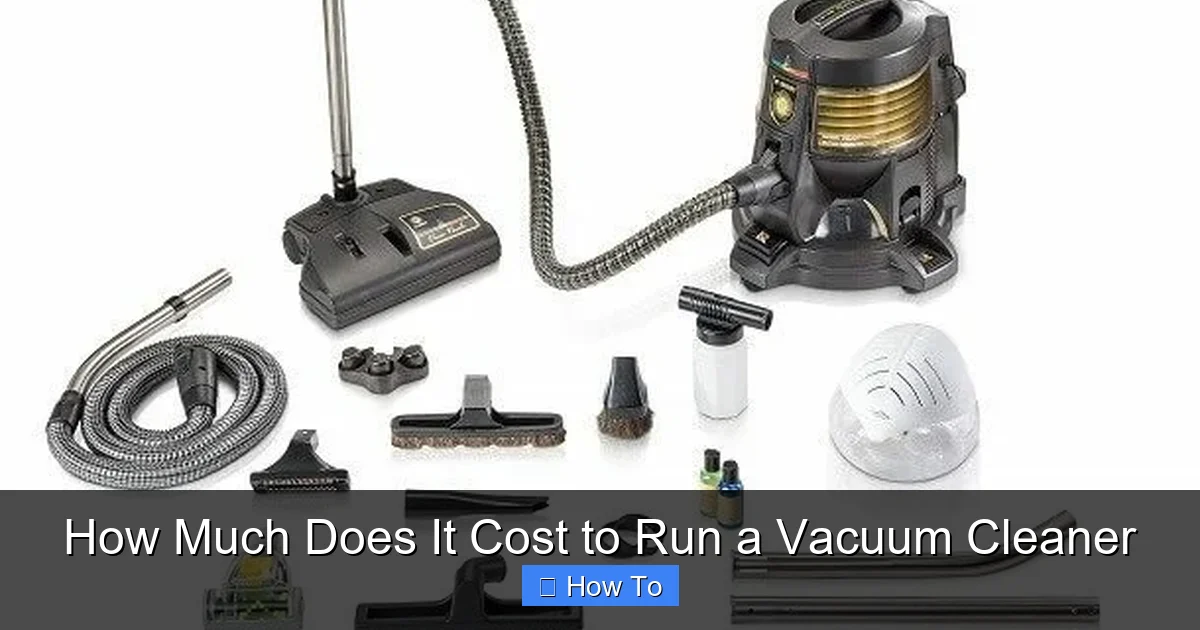
Visual guide about How Much Does It Cost to Run a Vacuum Cleaner
Image source: thepricer.org
Now, let’s get practical. Here’s how you can calculate how much does it cost to run a vacuum cleaner in your home.
Step 1: Locate Your Vacuum Cleaner’s Power Rating
The first thing you need is your vacuum’s power consumption.
* Check the Label: Look for a sticker or plate on your vacuum cleaner, usually on the back, bottom, or near the cord entry. It will state the wattage (W) or amperage (A).
* Look Up the Manual/Manufacturer’s Website: If you can’t find it on the vacuum itself, consult the owner’s manual or the manufacturer’s official website.
* Conversion (if only Amps are listed): If you only see Amps (A), you can estimate the wattage. In North America, household voltage (V) is typically 120V. The formula is: Watts (W) = Amps (A) x Volts (V). So, a 10 Amp vacuum at 120V would be 10A * 120V = 1200 Watts.
Let’s assume for our examples you have a corded vacuum rated at 1200 Watts.
Step 2: Find Your Electricity Rate
This information is crucial and readily available.
* Check Your Utility Bill: Your monthly electricity bill will clearly state your residential electricity rate, typically in cents or dollars per kilowatt-hour (kWh). Make sure you’re using the “supply” or “generation” rate, as some bills include delivery charges separately. For consistency, convert it to dollars per kWh (e.g., 15 cents/kWh = $0.15/kWh).
* Contact Your Utility Provider: If you can’t find it, give your electricity company a call.
* Online Search: Many utility providers list their rates on their websites.
For our examples, let’s use a common rate of $0.15 per kWh.
Step 3: Estimate Your Vacuuming Time
Be realistic about how long you actually use the vacuum cleaner.
* Track Your Usage: For a week or two, simply time your vacuuming sessions. Note down how many minutes you spend actively vacuuming, not just moving the vacuum around or emptying it.
* Calculate Weekly/Monthly Average: Add up your minutes and convert to hours. For instance, if you vacuum for 30 minutes twice a week, that’s 60 minutes or 1 hour per week.
Let’s say you vacuum for 1 hour per week.
Step 4: Calculate Daily, Weekly, or Monthly Kilowatt-Hours (kWh)
Now we put the numbers together to find out how much electricity your vacuum consumes. The formula is:
(Wattage in Watts x Usage Hours) / 1000 = Kilowatt-hours (kWh)
Why divide by 1000? Because 1 kilowatt (kW) equals 1000 watts. Your electricity bill is in *kilo*watt-hours, so we need to convert.
Using our example values:
(1200 Watts x 1 Hour/Week) / 1000 = 1.2 kWh per week
Step 5: Determine the Electricity Cost
Finally, multiply your kWh by your electricity rate.
kWh x Electricity Rate = Electricity Cost
Using our example values:
1.2 kWh/Week x $0.15/kWh = $0.18 per week
To get a monthly cost (roughly 4 weeks): $0.18/week x 4 weeks = $0.72 per month.
To get an annual cost: $0.18/week x 52 weeks = $9.36 per year.
As you can see, for a typical corded vacuum used moderately, the electricity cost to run a vacuum cleaner is surprisingly low!
Step 6: Don’t Forget Consumables and Maintenance
While these aren’t electricity costs, they are part of the true running cost.
* Bags and Filters: If your vacuum uses bags, you’ll need to buy them regularly. Filters also need to be replaced periodically (e.g., every 6-12 months for HEPA filters).
* Belts: The brush roll belt can wear out and need replacement, typically every 1-2 years.
* Minor Repairs: Occasional costs for things like a new hose or a small part.
Factor these into your annual budget to get a complete picture of how much it costs to run a vacuum cleaner. For example, if you spend $30 on bags and filters per year, add that to your $9.36 electricity cost, bringing your total to $39.36 per year.
Real-World Examples: How Much Does It Cost to Run Different Vacuums?
Let’s apply our calculation to different vacuum types, using an average electricity rate of $0.15/kWh.
Example 1: The Corded Upright Vacuum
* Power: 1500 Watts (W)
* Usage: 1.5 hours per week
* Calculation:
* (1500 W x 1.5 Hours) / 1000 = 2.25 kWh per week
* 2.25 kWh x $0.15/kWh = $0.3375 per week
* Monthly (approx.): $0.3375 x 4 = $1.35
* Annually: $0.3375 x 52 = $17.55
* Conclusion: Even a powerful corded vacuum used frequently has a very modest electricity running cost.
Example 2: The Cordless Stick Vacuum
Cordless vacuums don’t draw continuous power while running. Instead, their cost is associated with charging their battery. A typical stick vacuum battery might take 3-5 hours to fully charge, consuming around 0.1-0.2 kWh per charge cycle.
* Charging Power: Let’s assume a charger draws 30 Watts (0.03 kW) continuously for 4 hours to fully charge the battery.
* Usage: You fully charge it twice a week.
* Calculation:
* 0.03 kW x 4 hours/charge = 0.12 kWh per charge
* 0.12 kWh/charge x 2 charges/week = 0.24 kWh per week
* 0.24 kWh x $0.15/kWh = $0.036 per week
* Monthly (approx.): $0.036 x 4 = $0.144
* Annually: $0.036 x 52 = $1.87
* Conclusion: The electricity cost to run a vacuum cleaner of the cordless variety is exceptionally low, primarily because battery charging is very efficient. However, consider the eventual battery replacement cost, which can be significant.
Example 3: The Robotic Vacuum
Robotic vacuums are unique because they spend a lot of time on their charging dock, consuming standby power, in addition to power used during cleaning cycles.
* Cleaning Cycle: 30 Watts (W) for 1 hour of cleaning (0.03 kWh).
* Standby Power: 5 Watts (W) for 23 hours a day (when not cleaning).
* Usage: Cleans once a day for 1 hour.
* Calculation (Daily):
* Cleaning: (30 W x 1 Hour) / 1000 = 0.03 kWh
* Standby: (5 W x 23 Hours) / 1000 = 0.115 kWh
* Total Daily: 0.03 kWh + 0.115 kWh = 0.145 kWh per day
* Daily Cost: 0.145 kWh x $0.15/kWh = $0.02175 per day
* Monthly (approx.): $0.02175 x 30 = $0.65
* Annually: $0.02175 x 365 = $7.94
* Conclusion: Robotic vacuums are quite energy efficient, even with standby power. Their biggest “hidden” cost might be the eventual replacement of their internal battery, which can be expensive.
As these examples show, the electricity cost to run a vacuum cleaner is generally very low across all types. The biggest cost factor usually isn’t the electricity itself, but rather the initial purchase price and ongoing consumables/maintenance.
Practical Tips to Reduce Your Vacuum Cleaner’s Running Costs
While the electricity cost to run a vacuum cleaner might be small, every penny counts. Here are some smart ways to save.
Regular Maintenance is Key
This is perhaps the most impactful tip for both efficiency and longevity.
* Clean or Replace Filters: A clogged filter restricts airflow, forcing the motor to work harder and draw more power. Clean reusable filters regularly (as per manufacturer instructions) and replace disposable ones when needed.
* Empty the Dustbin/Change Bags: A full dustbin or bag also impedes airflow and reduces suction power. Empty or change them before they get completely full.
* Clear Blockages: Hoses and brush rolls can get clogged with hair, dust, or debris. Remove these blockages promptly to ensure optimal performance.
* Inspect Brush Rolls and Belts: A tangled brush roll can put strain on the motor. A worn or stretched belt means the brush roll isn’t spinning effectively, reducing cleaning power and potentially making you vacuum for longer.
Optimize Your Vacuuming Habits
A few simple changes can make a difference.
* Vacuum Strategically: Plan your vacuuming route to cover all areas efficiently without going over the same spot repeatedly or leaving the vacuum running unnecessarily.
* Don’t Over-Vacuum: Do you really need to vacuum daily? If you have low foot traffic, perhaps less frequent vacuuming is sufficient, saving time and energy.
* Address Spills Promptly: Spot clean small messes with a handheld vacuum or broom instead of pulling out the full-size unit every time.
Invest in Energy-Efficient Models
When it’s time to buy a new vacuum cleaner, consider its energy efficiency.
* Look for Lower Wattage: While high wattage can imply strong suction, many modern vacuums achieve excellent cleaning power with lower wattage motors due to improved design and airflow.
* Consider Suction Power vs. Motor Power: Good design is more important than raw motor power. A vacuum with efficient airflow and brush agitation might use less energy but clean more effectively than a higher wattage, poorly designed model.
* Choose the Right Type: If you only have hard floors or small areas, a low-power stick or robotic vacuum might be more suitable and efficient than a large upright.
Address Issues Promptly
Ignoring problems can lead to higher costs down the line.
* Don’t Let it Struggle: If your vacuum sounds like it’s struggling or the suction is weak, investigate the cause (clog, full bin, dirty filter). Continuing to use it in this state wastes energy and can cause premature motor wear.
* Battery Health: For cordless vacuums, follow manufacturer guidelines for charging to extend battery life. Replacing a battery can be a significant cost.
Beyond the Plug: The Hidden Costs of Your Vacuum Cleaner
To truly understand how much it costs to run a vacuum cleaner, we must look beyond just the electricity bill.
Replacements and Consumables
These are often forgotten but add up over time.
* Vacuum Bags: If your model uses bags, these are an ongoing expense. Generic brands can sometimes save money, but ensure they fit correctly and don’t compromise performance.
* Filters: HEPA filters, foam filters, and pre-motor filters all need periodic cleaning or replacement. High-quality filters can be pricey but are crucial for air quality and vacuum performance.
* Brush Rolls and Belts: Over time, brush rolls can become worn or damaged, and belts can stretch or break. These are relatively inexpensive parts but are necessary for effective cleaning.
Repairs and Parts
Like any appliance, vacuums can break down.
* Motor Issues: The motor is the heart of the vacuum. If it fails, repair can be costly, often leading to a decision to replace the entire unit.
* Hoses and Attachments: These can crack, tear, or get lost, requiring replacements.
* Battery Packs: For cordless and robotic vacuums, the battery is a finite component that will degrade over time. A replacement battery can cost anywhere from $50 to $200+, significantly impacting the long-term running cost.
Initial Purchase Price (Depreciation)
While not a “running” cost in the traditional sense, the initial investment is a major part of the total cost of ownership. A $50 vacuum will have a much lower overall cost than a $1000 vacuum, even if the more expensive one has slightly lower electricity consumption. Consider the lifespan of the appliance. A cheaper vacuum might need replacing sooner, potentially negating some of the initial savings.
Troubleshooting Common Vacuum Cost Concerns
Sometimes, your vacuum might seem more expensive to run than it should. Here are some common concerns and what to check.
“My Vacuum Seems to Use More Power Than It Should”
This is usually an efficiency problem, not necessarily a direct increase in electricity draw (though the motor may struggle).
* Check for Blockages: The most common culprit. A clogged hose, brush roll, or intake port makes the motor work harder to maintain suction, potentially increasing energy consumption and causing overheating.
* Dirty Filters: As mentioned, a dirty filter chokes the airflow. Clean or replace it.
* Full Dustbin/Bag: Ensure it’s not overfilled.
* Worn Belts or Brushes: If the brush roll isn’t spinning properly, you’ll need to make more passes, thus increasing usage time and perceived cost.
“My Cordless Vacuum’s Battery Life is Declining Rapidly”
Batteries have a finite number of charge cycles.
* Battery Age: Over time, all rechargeable batteries lose capacity. If your vacuum is several years old, this is normal.
* Charging Habits: Always follow the manufacturer’s charging instructions. Overcharging or constantly depleting the battery to zero can shorten its lifespan.
* Temperature: Extreme heat or cold can affect battery performance. Store your vacuum in a moderate environment.
* Replacement: If the decline is severe, it might be time for a new battery pack. Factor this into the total cost of running your cordless vacuum.
“My Electricity Bill is Higher Than Expected After Vacuuming”
While possible, it’s unlikely your vacuum cleaner is the sole cause of a significantly higher electricity bill.
* Recalculate: Double-check your vacuum’s wattage, usage time, and your electricity rate.
* Consider Other Appliances: Vacuums are generally low energy consumers compared to HVAC systems, water heaters, or even prolonged use of kitchen appliances. A spike in your bill is more likely due to changes in overall household energy consumption.
* Time-of-Use Rates: If you have time-of-use billing, vacuuming during peak hours might cost slightly more, but the overall impact is still small.
Conclusion: Smart Cleaning for a Smarter Budget
Understanding how much does it cost to run a vacuum cleaner reveals that its direct electricity consumption is usually a minimal household expense. For most homes, we’re talking about a few dollars a month, if that. However, the true running cost extends beyond the electricity bill to include essential consumables like bags and filters, as well as the potential for repairs and battery replacements.
By being aware of your vacuum’s power rating, your electricity rate, and your usage habits, you can easily calculate these costs. More importantly, by implementing simple maintenance routines and making informed choices when purchasing a new appliance, you can keep your vacuum cleaner running efficiently and affordably for years to come. Clean floors don’t have to come with a hefty hidden price tag when you’re equipped with the right knowledge.