Choosing the right vacuum cleaner in 2025 isn’t just about motor watts anymore. Our guide helps you understand that modern efficiency and air watts are crucial metrics for determining true suction power. Learn to assess your specific cleaning needs – from pet hair to floor types – to select a vacuum that delivers optimal performance without excessive energy consumption. Discover precisely how many watts vacuum cleaner is ideal for *your* home, ensuring a clean space and smart energy use.
How Many Watts Vacuum Cleaner Needs in 2025 Find Your Power
Welcome to 2025! You’re standing in the appliance aisle, or perhaps scrolling through a myriad of online options, searching for a new vacuum cleaner. And inevitably, you’re faced with that age-old question: “How many watts vacuum cleaner do I actually need?” It’s a question that has confused shoppers for years, and in today’s world of advanced technology and stricter energy regulations, the answer is more nuanced than ever before.
Gone are the days when a higher watt number automatically meant better suction. Today, efficiency, innovation, and smart design play a much larger role in determining a vacuum’s true cleaning prowess. This comprehensive guide will demystify vacuum cleaner wattage in 2025, helping you understand the real metrics that matter, so you can confidently choose the perfect power partner for your home.
By the end of this guide, you’ll learn how to:
- Understand the difference between motor watts and air watts.
- Assess your specific home cleaning needs.
- Interpret vacuum cleaner specifications accurately.
- Make an informed decision that balances power, efficiency, and budget.
Let’s dive in and find out precisely how many watts vacuum cleaner you should be looking for!
Key Takeaways
- Motor Watts vs. Air Watts: In 2025, focus on air watts (suction power at the nozzle) rather than just motor watts (energy consumed by the motor). Efficient motors deliver high performance with lower input power.
- Assess Your Needs First: Determine your specific cleaning challenges – floor types, presence of pet hair, allergy concerns, and home size – before looking at specifications. This dictates how much power you truly need.
- Cordless Revolution: For battery-powered vacuums, consider voltage, amp-hours (Ah), and runtime as key power indicators, not just the motor’s theoretical wattage. These tell you how long and how strongly it will clean.
- Efficiency is Key: Modern regulations prioritize energy efficiency. This means lower watt vacuums often perform as well or better than older, high-wattage models due to improved design and technology.
- Beyond Power Metrics: Don’t overlook essential features like filtration systems (HEPA), noise levels, specialized attachments, and smart technology (e.g., auto-adjusting suction) that significantly impact cleaning effectiveness and user experience.
- Don’t Fall for Wattage Myths: Higher motor watts do not automatically equate to superior cleaning power. Always look at the overall design, air watt ratings, and user reviews for a realistic assessment of performance.
Quick Answers to Common Questions
What are ‘Air Watts’ and why are they important?
Air watts measure the vacuum’s true suction power at the nozzle, combining airflow and suction. Unlike motor watts (energy consumption), air watts directly tell you how effectively the vacuum can pick up dirt, making it the most crucial metric for performance in 2025.
Do I need a high-wattage vacuum for pet hair?
Not necessarily high motor watts, but definitely high air watts. For pet hair, aim for vacuums with 180+ air watts and robust motorized brush heads, which effectively lift embedded hair from carpets and upholstery.
Are lower motor watts a sign of a less powerful vacuum?
No, not anymore! In 2025, lower motor watts often indicate a highly energy-efficient vacuum that achieves excellent suction (high air watts) with less electricity consumption, thanks to advanced motor and airflow design.
How do battery specs (V & Ah) relate to vacuum power?
For cordless vacuums, battery voltage (V) indicates potential power, and amp-hours (Ah) show battery capacity (how long it will run). Higher numbers generally mean more power and longer runtime, directly impacting the effective “wattage” of a cordless unit.
Should I prioritize a HEPA filter over higher watts?
If you or anyone in your home suffers from allergies or asthma, absolutely. A HEPA filter is vital for trapping microscopic allergens and improving air quality, a benefit that raw power alone cannot provide.
Step 1: Understand Watts in 2025 – It’s Not Just About the Motor
The first step to answering “how many watts vacuum cleaner needs” is to clarify what “watts” actually means in the context of modern vacuum cleaners. In 2025, the landscape has significantly shifted, largely due to energy efficiency directives.
Motor Watts (Input Power): The Old Metric
Motor watts, or input power, refers to the amount of electricity the vacuum cleaner’s motor consumes. Historically, a higher motor watt number suggested a more powerful motor. However, this figure primarily indicates energy consumption, not necessarily how effectively that energy is converted into suction power. Due to stricter energy efficiency standards implemented in various regions (like the EU, which has wattage caps), manufacturers are now designing vacuums that achieve superior cleaning results with lower motor wattages. So, don’t let a low motor watt number fool you; it often signifies a highly efficient machine.
Air Watts (Suction Power): The True Performance Metric
Air watts are the far more accurate and relevant metric for measuring a vacuum cleaner’s actual cleaning ability. Air watts represent the power produced at the cleaning head, considering both airflow (cubic feet per minute) and suction (inches of water lift). This is the power that actually picks up dirt from your floors. In 2025, many manufacturers openly advertise air watts because it provides a direct indication of how much suction power you’re truly getting. A vacuum with fewer motor watts but high air watts is a triumph of engineering efficiency.
Cordless Vacuums: The Battery Perspective
For cordless vacuums, the concept of “watts” gets even trickier. While they have internal motors with a watt rating, battery voltage (V) and amp-hours (Ah) are more crucial indicators of performance and runtime. A higher voltage generally means more potential power, and higher amp-hours mean a longer runtime. Many cordless models now feature “eco,” “standard,” and “boost” modes, allowing you to manage battery life and adjust suction as needed. When considering how many watts vacuum cleaner you need in a cordless model, think about voltage and runtime first.
Step 2: Assess Your Specific Cleaning Needs
Before you even look at a single specification, the most critical step is to understand your own home and cleaning habits. This assessment will help you determine the ideal power level and features you require, thereby influencing how many watts vacuum cleaner will serve you best.
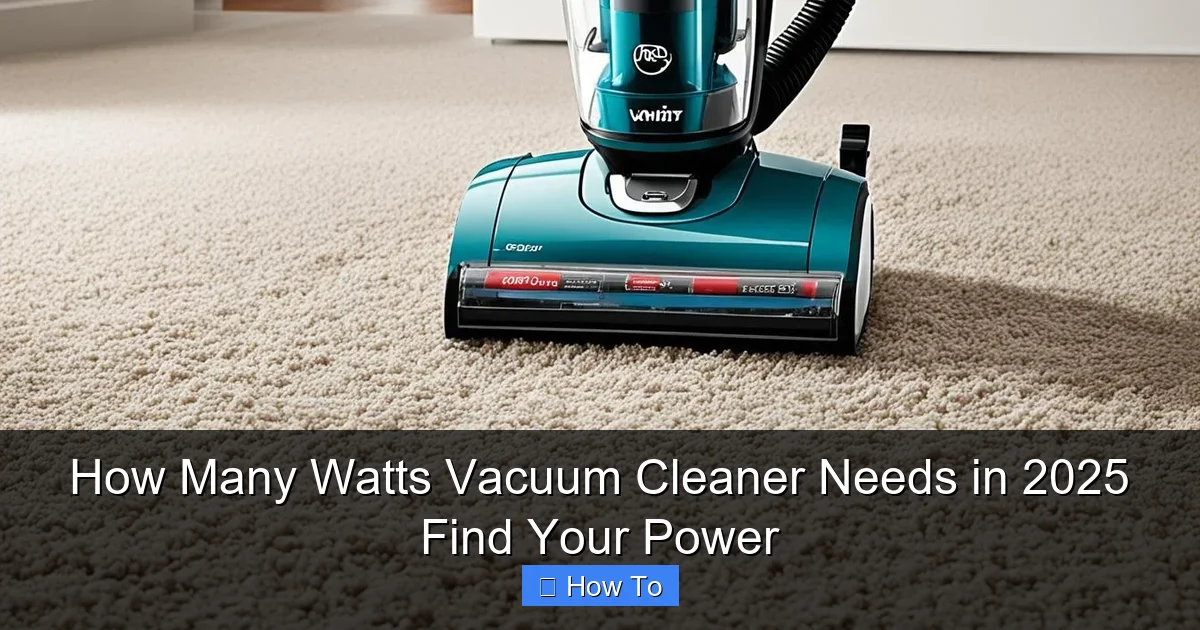
Visual guide about How Many Watts Vacuum Cleaner Needs in 2025 Find Your Power
Image source: vacmasterguide.com
What Type of Flooring Do You Have?
- Hard Floors (Hardwood, Tile, Laminate): These surfaces generally require less suction power to clean effectively. A vacuum with moderate air watts (around 80-120 air watts) is often sufficient. Look for soft brush rolls to protect surfaces.
- Low-Pile Carpets and Rugs: Slightly more power is needed to agitate fibers and lift dirt. A vacuum in the 120-180 air watt range is a good starting point.
- Medium to High-Pile Carpets, Shag Rugs: These demand significant suction and agitation to deep clean. Look for vacuums with 180+ air watts, often featuring powerful motorized brush heads, to effectively extract embedded dirt.
- Mixed Flooring: Most homes have a mix. Opt for a versatile vacuum with adjustable suction settings and brush rolls that can be switched off or are designed for multiple surfaces. This flexibility allows you to optimize how many watts vacuum cleaner uses for each specific task.
Do You Have Pets or Allergy Sufferers?
Pet hair and allergens require extra consideration. Pet hair can be stubborn and cling to carpets and upholstery. If you have furry friends, you’ll want a vacuum with strong air watts (180+ is ideal for pet hair on carpets) and specialized pet attachments (like mini motorized tools). Furthermore, a robust filtration system, particularly a HEPA filter, is essential for capturing pet dander, pollen, and other allergens, preventing them from being recirculated into the air. This feature is often found in higher-performing vacuums, irrespective of just how many watts vacuum cleaner motor consumes.
What’s Your Home Size and Layout?
- Small Apartments/Studios: A compact, lightweight stick vacuum or a small canister vacuum with moderate power is usually perfect. Cordless models offer excellent maneuverability.
- Medium-Sized Homes: A versatile upright or canister vacuum, or a powerful cordless stick vacuum with good battery life, will be suitable. Consider a model with a longer cord or good portability.
- Large Homes with Multiple Levels: You might benefit from a powerful upright for carpets and a separate lightweight stick or handheld for quick clean-ups and stairs. Alternatively, a powerful canister vacuum offers versatility for different areas.
How Often Do You Clean?
If you vacuum daily for quick clean-ups, a lightweight cordless stick vacuum might be your best friend. For weekly deep cleaning, a more robust corded upright or canister vacuum with higher air watts will be more efficient and durable. Your cleaning frequency directly impacts the type of sustained performance you need from your vacuum.
Step 3: Decode Vacuum Cleaner Specifications in 2025
Now that you know what you need, let’s look at the numbers and features that will guide your purchase. Understanding these will help you determine how many watts vacuum cleaner really needs for your specific situation.
Air Watts (The Most Important Number)
- 80-120 Air Watts: Excellent for hard floors, light rugs, and quick clean-ups.
- 120-180 Air Watts: Good for mixed flooring, low-to-medium pile carpets, and general household dirt.
- 180-250+ Air Watts: Ideal for homes with pets, medium-to-high pile carpets, allergy sufferers, and heavy-duty cleaning tasks. This range offers significant deep cleaning power.
Remember: These are general guidelines. Always cross-reference with user reviews and brand reputation.
Motor Watts (Input Power)
As discussed, lower motor watts in 2025 don’t mean less power. Due to energy regulations, many high-performance vacuums now operate efficiently between 500-900 motor watts. Some specialized industrial or older models might still list higher numbers, but for most residential users, focusing on air watts is more productive.
Battery Voltage (V) & Amp-Hours (Ah) for Cordless
For cordless models, these are key:
- Voltage (V): Often ranges from 18V to 32V or more. Higher voltage typically means more power.
- Amp-Hours (Ah): Indicates battery capacity and directly relates to runtime. A 4.0Ah battery will last longer than a 2.0Ah battery at the same voltage.
- Runtime: Crucial for cordless vacuums. Check the stated runtime for different power modes (eco, standard, boost). Look for at least 30-60 minutes on standard mode for most homes.
When asking how many watts vacuum cleaner you need in a cordless context, think about how long you need to clean and at what power level.
Filtration System
Beyond how many watts vacuum cleaner consumes, a good filtration system is paramount for air quality:
- HEPA Filter: Essential for allergy sufferers, capturing 99.97% of particles as small as 0.3 microns (including pet dander, dust mites, pollen).
- Multi-Stage Filtration: Many modern vacuums use several layers of filters to trap progressively smaller particles.
Step 4: Match Watts to Your Specific Requirements (Examples)
Let’s put it all together with some practical examples for how many watts vacuum cleaner categories you might consider.
For Light Cleaning & Hard Floors (Efficiency First)
- Target Air Watts: 80-120 AW
- Motor Watts: Often <600W (for corded), or a moderate voltage cordless (18V-22V with decent Ah).
- Example Scenario: Small apartment, mostly hardwood, occasional spills. You don’t need excessive power. An efficient, low motor watt corded vacuum or a lightweight cordless stick vacuum will suffice. Focus on maneuverability and gentle brush rolls.
For Mixed Surfaces & General Use (Balanced Power)
- Target Air Watts: 120-180 AW
- Motor Watts: 600-900W (for corded), or a mid-range voltage cordless (22V-25V with good Ah).
- Example Scenario: Medium-sized home with a mix of hard floors and low-to-medium pile carpets. You need enough power to handle everyday dirt and light carpet cleaning. Look for models with adjustable suction and versatile attachments.
For Heavy Duty, Pet Hair & Deep Pile Carpets (Maximum Suction)
- Target Air Watts: 180-250+ AW
- Motor Watts: Often 700-900W (for corded, but highly efficient), or a high-voltage cordless (25V+ with excellent Ah and boosted power mode).
- Example Scenario: Large home, multiple pets, deep pile carpets, allergy sufferers. You need robust, consistent suction and powerful agitation. These vacuums will be designed for maximum dirt pickup. Expect specialized pet tools and HEPA filtration.
Cordless Vacuums: The Battery-Powered Perspective
When considering how many watts vacuum cleaner needs in a cordless format, think about the total square footage you need to cover and how much battery life you need. A small apartment might be fine with 20-30 minutes of standard cleaning, while a larger home might require 60 minutes or more. Look at the total system: voltage, amp-hours, and the actual air watts it can deliver in its strongest mode. Many premium cordless models in 2025 can rival corded uprights in terms of suction power, but at a premium price.
Step 5: Consider Modern Features Beyond Raw Power
In 2025, a vacuum cleaner is more than just a motor and a hose. Many features enhance usability and performance, sometimes making a moderate wattage vacuum feel more powerful or effective.
Smart Features & AI
Modern vacuums often come with sensors that detect floor types and automatically adjust suction power, optimizing how many watts vacuum cleaner uses for each surface. Some even have dirt sensors that illuminate dirt or indicate when an area is thoroughly cleaned. These smart features mean you get effective cleaning without constantly fiddling with settings.
Noise Levels
High suction doesn’t have to mean high noise. Manufacturers are increasingly focusing on quieter operation. Check the decibel (dB) rating if noise is a concern for you.
Attachments and Versatility
A vacuum with excellent suction but poor attachments won’t be as effective. Look for a good range of tools: crevice tools, upholstery brushes, dusting brushes, and specialized pet tools. The versatility of a vacuum can make even a moderately powered machine incredibly effective for various tasks.
Maintenance & Durability
Consider the cost and availability of replacement filters, bags (if applicable), and brush rolls. A durable vacuum, even if it has a slightly higher upfront cost, will save you money and headaches in the long run.
Troubleshooting Common “Wattage” Misconceptions
“Higher watts always means better suction.”
Myth Busted: This is the biggest misconception. As discussed, motor watts primarily indicate energy consumption. Due to advanced motor design and aerodynamic airflow paths, a 700-watt vacuum in 2025 can easily outperform an older 2000-watt model in terms of actual dirt pickup. Focus on air watts and user reviews.
“My old vacuum was powerful; new, low-wattage ones aren’t as good.”
Understanding the Shift: It might feel less powerful because older vacuums often had less refined airflow, creating a louder, more aggressive sound without necessarily translating to better dirt removal. Modern vacuums are engineered to maximize suction at the nozzle while minimizing wasted energy and noise. The perception of power has changed with efficiency.
“Cordless vacuums aren’t powerful enough.”
Evolving Technology: This was true years ago, but in 2025, premium cordless stick vacuums from leading brands offer astonishing suction power, often comparable to, or exceeding, many corded uprights. The main trade-off remains runtime, which is also continually improving. Many users now find a single high-end cordless vacuum sufficient for their entire home.
Conclusion: Finding Your Power in 2025
The question of “how many watts vacuum cleaner needs” in 2025 isn’t about chasing the highest number. It’s about smart choices, efficiency, and matching the right tool to your specific job. You’re no longer simply buying raw power; you’re investing in intelligent design, advanced filtration, and optimized suction.
By focusing on air watts, considering your home’s unique characteristics, and valuing modern features, you can confidently select a vacuum cleaner that not only cleans your home spotlessly but also does so with greater energy efficiency and user convenience. Don’t be swayed by outdated metrics; embrace the sophisticated engineering of today’s vacuum cleaners to find your perfect cleaning companion.
🎥 Related Video: How Many Watts is Optimal for a High Performing Vacuum
📺 Experts in Vacuum
Here is our quick guide https://www.expertsinvacuum.com/how-many-watts-is-a-good-vacuum-cleaner/ In this video, we’ll explore …