
Understanding “how many watts is a vacuum cleaner” is key to managing your home’s energy use and preventing circuit overloads. This guide helps you easily find your vacuum’s wattage, whether by checking labels, manuals, or using modern energy meters. Knowing this information empowers you to make smarter purchasing decisions, optimize cleaning performance, and ensure your home’s electrical safety, especially with today’s energy-efficient technologies.
Discover How Many Watts Your Vacuum Cleaner Uses in 2025
Welcome to the ultimate guide on understanding your vacuum cleaner’s power consumption! In a world increasingly focused on energy efficiency and smart home management, knowing “how many watts is a vacuum cleaner” isn’t just a technical detail; it’s a vital piece of information for managing your energy bills, ensuring electrical safety, and making informed purchasing decisions. As we navigate 2025, vacuum technology has evolved, making the relationship between wattage and performance more nuanced than ever.
This comprehensive guide will walk you through everything you need to know. You’ll learn exactly where to find your vacuum’s wattage, what those numbers really mean, and how they impact your home. We’ll also dive into practical tips for maximizing efficiency and troubleshooting common issues. By the end, you’ll be an expert on your vacuum cleaner’s power usage, ready to clean with confidence and efficiency.
Key Takeaways
- Find Wattage Easily: Most vacuum cleaners have their wattage listed on a label, in the user manual, or on the manufacturer’s website.
- Wattage ≠ Suction Power: In 2025, modern vacuum technology means higher wattage doesn’t always equal superior cleaning; look for “Air Watts” for true suction.
- Prevent Circuit Overloads: Knowing your vacuum’s wattage helps ensure it doesn’t draw too much power, preventing tripped breakers and potential electrical issues.
- Impacts Energy Bills: A vacuum’s wattage directly influences its electricity consumption and, consequently, your household energy costs.
- Energy Efficiency Matters: As of 2025, many vacuums are designed for efficiency, delivering powerful cleaning with lower wattages, making informed choices crucial.
- Real-Time Measurement: For an accurate reading of your vacuum’s actual power draw during use, a “Kill A Watt” meter is an excellent tool.
- Maintain for Efficiency: Keeping filters clean and bags empty ensures your vacuum operates at peak efficiency, preventing it from working harder and drawing more power than necessary.
Quick Answers to Common Questions
What’s the easiest way to find my vacuum’s wattage?
The quickest method is to check the small label or plate usually found on the back, bottom, or side of your vacuum cleaner. Look for a number followed by “W” or “Watts.”
Does higher wattage always mean better suction?
Not necessarily, especially with modern vacuums in 2025. Advanced designs and motor technology mean many lower-wattage vacuums can achieve excellent suction. Look for “Air Watts” for a more accurate measure of cleaning power.
How can I estimate my vacuum’s power consumption for my electricity bill?
Take your vacuum’s wattage, divide by 1000 to get kilowatts (kW), then multiply by the number of hours you use it per month, and finally by your electricity cost per kilowatt-hour (kWh) to get an estimate.
Why does my circuit breaker trip when I use my vacuum?
This usually means your vacuum is drawing too much current for that specific electrical circuit. Try unplugging other high-draw appliances from the same circuit or plugging the vacuum into an outlet on a different circuit.
Are robotic vacuums typically more energy efficient?
Yes, robotic vacuums generally have much lower operating wattages (often 20-70W) compared to full-size upright or canister vacuums, making them very energy-efficient for their cleaning tasks.
Understanding Vacuum Cleaner Wattage in 2025
Before we dive into how to find the wattage, let’s understand what wattage is and why it’s so important for your vacuum cleaner, especially with the advancements we see in 2025.
What is Wattage, Really?
Put simply, wattage (measured in watts, W) is a unit of power. When you see a wattage rating on an appliance like your vacuum cleaner, it tells you how much electrical power the device consumes when it’s operating. Think of it as the rate at which electricity flows to make the vacuum motor work, power its brushes, and create suction. In electrical terms, Watts = Volts x Amps. Most household vacuums in regions like North America operate on 120 volts.
Why Wattage Matters for Your Home
Knowing how many watts is a vacuum cleaner is more important than you might think. Here’s why:
Energy Consumption & Bills
The higher the wattage, the more electricity your vacuum cleaner typically uses per hour of operation. This directly translates to your energy bill. In 2025, with rising energy costs and a greater focus on sustainability, understanding this consumption helps you make choices that can save you money and reduce your carbon footprint. An energy-efficient vacuum might have a lower wattage but still deliver excellent cleaning power due to superior design.
Circuit Overload Prevention
Every electrical circuit in your home has a limit to how much power it can safely handle (its amperage rating). If you plug in a high-wattage vacuum cleaner onto a circuit that’s already powering other high-draw appliances (like a microwave, toaster, or hair dryer), you risk drawing too much current. This causes the circuit breaker to trip, cutting power to prevent overheating and potential fire hazards. Knowing your vacuum’s wattage helps you avoid these inconvenient and potentially dangerous situations.
Performance vs. Efficiency Myth
Historically, many believed that a higher wattage automatically meant better suction and cleaning power. While a powerful motor certainly contributes, this isn’t always the case with modern vacuum cleaners in 2025. Thanks to engineering advancements, better airflow design, improved filtration, and more efficient motors (like brushless DC motors), many lower-wattage vacuums can now deliver comparable, or even superior, cleaning performance to older, high-wattage models. This is why manufacturers often highlight “Air Watts” alongside motor wattage – a more accurate measure of actual suction power at the nozzle.
Step-by-Step: How to Find Your Vacuum Cleaner’s Wattage
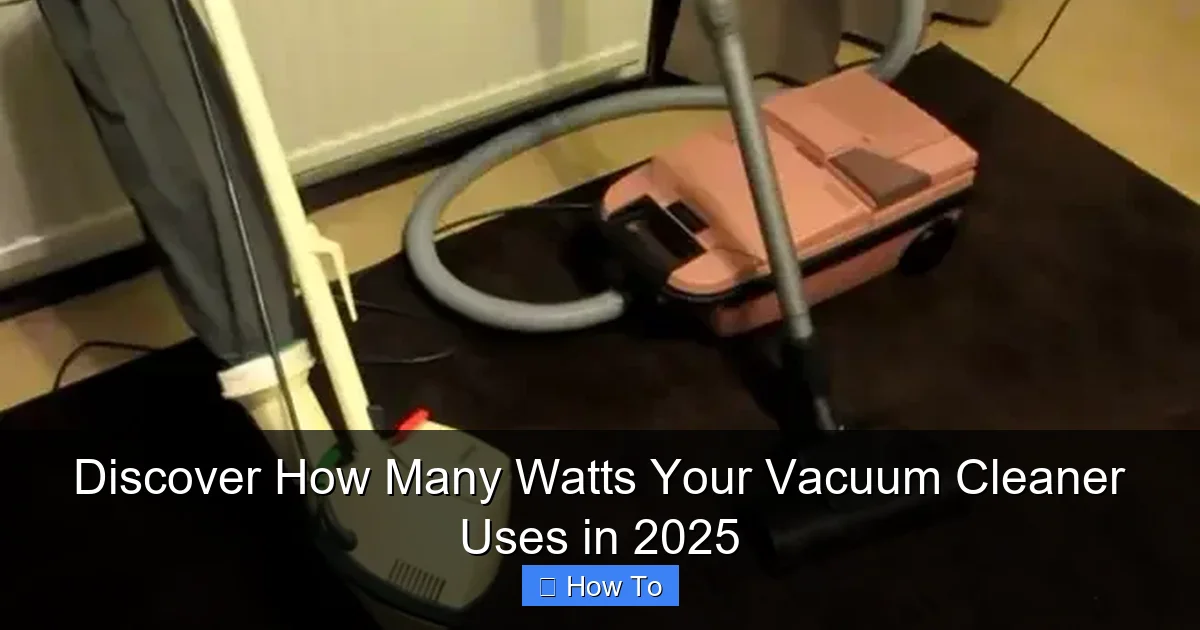
Visual guide about Discover How Many Watts Your Vacuum Cleaner Uses in 2025
Image source: cleaningbeasts.com
Finding out how many watts your vacuum cleaner uses is usually quite straightforward. Here’s a systematic approach to get that information:
Step 1: Check the Manufacturer’s Label or Plate
This is the most common and often easiest way to find your vacuum’s wattage.
- Where to Look: The label is typically a small sticker or engraved plate found on the vacuum cleaner itself. Check the back, bottom, or side of the main body of the vacuum. For uprights, it might be near the base or on the motor housing. For canisters, check the underside or back. Robotic vacuums often have it underneath or near the battery compartment.
- What to Look For: You’ll usually see “Watts,” “W,” “Power Consumption,” “Input Power,” or “Rated Power” followed by a number. For example, “1200W,” “1.2 kW,” or “Input: 10 Amps @ 120V (1200 Watts).” Some labels might only list “Amps” (A). If you find amps and volts, you can calculate the wattage (Watts = Volts x Amps). Most household circuits are 120V in North America.
Step 2: Consult the User Manual or Product Documentation
If the label isn’t clear or is missing, your vacuum cleaner’s manual is the next best place.
- Physical Manual: Flip through the pages, usually under “Specifications,” “Technical Data,” or “Troubleshooting” sections.
- Digital Manuals: Many manufacturers provide PDF versions of their manuals online. Go to the manufacturer’s website, find your specific model number (usually also on the label), and download the manual. Use the search function (Ctrl+F or Cmd+F) to look for “watts,” “power,” or “specifications.”
Step 3: Browse the Manufacturer’s Website or Product Page
If you still have the original packaging or know your vacuum’s exact model number, the manufacturer’s official website is a reliable source.
- Product Page: Navigate to the specific product page for your model. The wattage and other specifications are almost always listed in the “Tech Specs,” “Features,” or “Details” section.
- Comparison Tools: Some sites even have comparison tools that clearly lay out the wattage for various models.
Step 4: Use a Kill A Watt Meter
For the most accurate, real-time measurement of how many watts your vacuum cleaner *actually* uses during operation, a “Kill A Watt” meter (or similar electricity usage monitor) is an excellent tool.
- How to Use It: Simply plug the Kill A Watt meter into an electrical outlet, and then plug your vacuum cleaner into the meter. Turn on your vacuum. The meter will display the real-time wattage consumption.
- What It Measures: This device measures the actual power drawn, which can sometimes vary slightly from the rated wattage depending on the vacuum’s condition, cleaning mode, and the task at hand. It’s especially useful for older vacuums or if you’re curious about real-world usage.
Step 5: Estimate Based on Average Categories
If, for some reason, none of the above methods yield results (e.g., a very old vacuum with no labels or manual), you can use general estimates. Keep in mind these are broad averages for 2025 models and can vary widely:
- Upright Vacuums: Typically range from 600W to 1200W, though some older models could go higher.
- Canister Vacuums: Similar to uprights, often between 800W and 1400W.
- Robotic Vacuums: Generally much lower, usually between 20W and 70W for cleaning, but can draw more when charging.
- Handheld Vacuums: Low wattage, often 50W to 200W, depending on whether they are corded or battery-powered.
- Stick Vacuums (Cordless): Their motors typically draw between 100W and 300W during use, with charging power being much lower.
Decoding Vacuum Cleaner Specifications Beyond Watts
While knowing “how many watts is a vacuum cleaner” is fundamental, a truly informed decision or understanding requires looking at other specifications too, especially in the context of 2025’s advanced technology.
Suction Power (Air Watts)
This is arguably *the* most important metric for cleaning performance. Air Watts measure the power generated at the cleaning head, taking into account airflow and suction. A high-efficiency vacuum in 2025 might have a lower motor wattage but a high Air Watt rating, meaning it cleans effectively without consuming excessive electricity. Always look for this specification when comparing models.
Amperage (Amps)
Often listed as “A” on the label, amperage indicates the current drawn by the vacuum. This is crucial for circuit safety. Most standard household circuits are 15 amps or 20 amps. If your vacuum is 12 amps, it leaves little room for other high-draw appliances on the same 15-amp circuit.
Voltage (Volts)
This is the electrical potential difference. For most residential vacuums in North America, this will be 120V (or 110-120V). In other regions, it might be 220-240V. Ensure your vacuum’s voltage matches your household supply.
Motor Type and Efficiency
Modern vacuums increasingly use brushless DC motors, which are more energy-efficient and often more durable than traditional brushed motors. These motors can deliver powerful performance with lower wattage consumption, making them a hallmark of energy-efficient design in 2025.
Filtration Systems (HEPA, Cyclonic)
While not directly related to wattage, advanced filtration systems can impact perceived performance. A clogged filter will make a vacuum work harder, potentially drawing more power and reducing effective suction, regardless of its rated wattage.
What Influences a Vacuum Cleaner’s Actual Wattage Use?
The “rated wattage” on your vacuum is its maximum potential power draw. However, the actual power it consumes can fluctuate based on several factors:
Cleaning Mode (Eco vs. Max Power)
Many vacuums, especially cordless stick and robotic models, offer different power settings. An “Eco” or “Quiet” mode will use less wattage, while a “Max” or “Boost” mode will draw the full rated power for deeper cleaning.
Floor Type (Hardwood vs. Thick Carpet)
Cleaning thick pile carpet requires the motor to work harder than cleaning smooth hardwood floors. This increased effort can translate to a slightly higher power draw, especially if the vacuum has automatic floor detection that adjusts suction.
Filter Clogs and Bag Fullness
A dirty filter or a full dust bag restricts airflow. When airflow is restricted, the vacuum motor has to work much harder to maintain suction, potentially increasing its power consumption and reducing efficiency. This is a common reason why a vacuum might feel less powerful over time.
Age and Maintenance of the Vacuum
Older motors can become less efficient over time, potentially drawing more power to achieve the same results. Regular maintenance, such as cleaning filters and checking for blockages, ensures your vacuum runs at its optimal efficiency.
Energy Efficiency and Your Vacuum in 2025
In 2025, the conversation around “how many watts is a vacuum cleaner” has significantly shifted towards energy efficiency.
The Rise of Energy-Efficient Models
Manufacturers are continually innovating to provide powerful cleaning solutions with lower energy footprints. This means you can often find vacuums with 700-900 watts that perform as well as, or better than, older 1500-watt models, thanks to smarter design and advanced motor technology. Look for energy star ratings or similar certifications in your region.
Smart Vacuums and Optimized Power
Many modern robotic and even some upright vacuums feature smart technology that optimizes power usage. This includes sensors that detect floor type or dirt levels, adjusting suction power automatically. This means the vacuum only uses the wattage necessary for the task, leading to energy savings over time.
Making an Informed Purchase Decision
When buying a new vacuum in 2025, don’t just look at the wattage. Consider the Air Watts for true cleaning power, look for energy efficiency ratings, and read reviews that focus on real-world performance. A lower wattage combined with high Air Watts often indicates a superior, more efficient machine.
Troubleshooting Common Wattage-Related Issues
Understanding how many watts is a vacuum cleaner can help you diagnose and resolve several common household electrical issues.
Circuit Breaker Tripping
If your circuit breaker trips when you use your vacuum, it’s likely drawing too much current for that circuit.
- Solution: Unplug other high-wattage appliances from the same circuit. Try plugging the vacuum into an outlet on a different circuit. Check the vacuum’s label for amperage; if it’s very high (e.g., 12-15 amps), be mindful of what else is running.
Vacuum Not Performing as Expected
A vacuum that feels underpowered might not always be a wattage issue, but it’s related to how effectively that wattage is being used.
- Solution: Check for blockages in the hose or brush roll. Clean or replace filters. Empty the dust bag or canister. These maintenance steps ensure the vacuum is using its rated wattage efficiently to create suction.
Unexpectedly High Energy Bills
If your energy bills are unusually high and you suspect your vacuum cleaner, knowing its wattage is the first step.
- Solution: Calculate its energy usage: (Wattage / 1000) * Hours Used * Cost per kWh. Use a Kill A Watt meter for real-time data. If it’s an older, high-wattage model, consider upgrading to a more energy-efficient vacuum that delivers comparable performance with less power.
Conclusion
By now, you should feel confident in your understanding of “how many watts is a vacuum cleaner” and its broader implications for your home in 2025. From deciphering labels to understanding the nuances of modern energy-efficient designs, this knowledge empowers you to make smarter choices. You can now prevent tripped breakers, manage your energy bills more effectively, and select a vacuum that truly meets your cleaning needs without unnecessary power consumption.
Remember, a well-maintained vacuum runs more efficiently, regardless of its wattage. So keep those filters clean, empty those bags, and enjoy a cleaner home with peace of mind knowing you’re operating your appliance wisely and efficiently!
🎥 Related Video: How Many Watts is Optimal for a High Performing Vacuum
📺 Experts in Vacuum
Here is our quick guide https://www.expertsinvacuum.com/how-many-watts-is-a-good-vacuum-cleaner/ In this video, we’ll explore …