

When asking how many watts is a good vacuum cleaner, it’s crucial to understand that raw wattage isn’t the sole indicator of performance. While motor watts indicate power consumption, actual cleaning efficacy depends more on factors like suction power (air watts), brush roll design, filtration, and overall machine design. A higher wattage might suggest a stronger motor, but a well-engineered vacuum with fewer watts can often outperform a high-wattage, poorly designed one, especially with modern energy efficiency standards.
When you’re on the hunt for a new vacuum cleaner, it’s easy to get caught up in the numbers game. One of the first specifications you’ll likely notice on the box or product description is “watts.” Naturally, your mind might leap to the conclusion that more watts equal more power, and more power means a better, cleaner home. But is that truly the case? How many watts is a good vacuum cleaner, really?
The truth is, the answer is a bit more nuanced than a simple number. For years, manufacturers touted high wattage figures as a badge of honor, implying superior cleaning ability. However, the landscape of vacuum cleaner technology has evolved significantly, and with it, our understanding of what actually constitutes a powerful and effective clean. Let’s dive deep into the world of vacuum cleaner wattage and uncover what truly makes a vacuum cleaner “good.”
Key Takeaways
- Watts Measure Motor Power, Not Suction: The stated wattage of a vacuum cleaner primarily indicates the electrical power consumed by its motor, not necessarily its actual cleaning performance or suction strength at the nozzle.
- Air Watts Are a Better Metric: For evaluating true cleaning power, look for “air watts,” which combine airflow and suction to give a more accurate measure of a vacuum’s ability to lift dirt and debris.
- EU Regulations Impact Wattage: In regions like the European Union, regulations limit vacuum cleaner motor wattage (e.g., to 900W maximum), encouraging manufacturers to innovate for efficiency rather than raw power.
- Design and Features Matter More: A good vacuum cleaner’s effectiveness is heavily influenced by its overall design, including nozzle shape, brush roll type, filtration system, seal quality, and hose design.
- Consider Your Cleaning Needs: The “ideal” wattage (and performance metrics) varies based on your home’s flooring types, presence of pets, allergy concerns, and the specific tasks you need the vacuum for.
- Energy Efficiency is Key: Modern vacuums focus on maximizing cleaning power with less energy, meaning that lower wattage models can often be highly effective and more environmentally friendly.
- Read Reviews and Look for Specific Metrics: Instead of focusing solely on motor watts, consult expert reviews, look for specifications like air watts, CFM (cubic feet per minute), and water lift, and consider user feedback for real-world performance insights.
Quick Answers to Common Questions
What is the ideal wattage for a good vacuum cleaner?
There isn’t a single ideal wattage. In regulated markets like the EU, 900 watts is the maximum, and these vacuums are highly effective due to efficient design. For unregulated markets, anywhere from 700 to 1800 watts can be considered, but remember that actual cleaning power (air watts) is a better indicator.
Do higher watts always mean better suction?
No, not always. While a higher wattage motor has the potential for more power, a poorly designed vacuum can lose much of that power due to inefficient airflow paths, leaky seals, or a bad nozzle. A lower-wattage, well-engineered vacuum can often have superior suction where it counts—at the cleaning head.
What are “air watts” and why are they important?
Air watts measure a vacuum cleaner’s effective cleaning power by combining airflow and suction. It’s a much more accurate indicator of how well a vacuum can pick up dirt and debris than motor wattage alone. Higher air watts generally mean better cleaning performance.
Is a 600-watt vacuum cleaner strong enough?
Absolutely, a 600-watt vacuum cleaner can be very strong and efficient, especially with modern engineering focused on airflow optimization and nozzle design. Many high-performing models in regulated markets operate at or below 900 watts and provide excellent cleaning results.
How do I know if a vacuum cleaner has good suction without knowing its air watts?
If air watts aren’t listed, look for other indicators like CFM (airflow) and water lift (suction strength), if available. Otherwise, read independent reviews and consumer reports, which often test and compare real-world cleaning performance on various surfaces.
📑 Table of Contents
- What Do Watts Really Mean in a Vacuum Cleaner?
- Beyond Watts: Understanding True Suction Power
- Different Vacuum Types and Their Wattage Needs
- Factors Influencing “Good” Vacuum Performance Beyond Watts
- How Many Watts Is a Good Vacuum Cleaner for Different Needs?
- Making an Informed Decision: What to Look For
What Do Watts Really Mean in a Vacuum Cleaner?
First things first: let’s clarify what “watts” represent in the context of a vacuum cleaner. Simply put, the wattage rating on a vacuum cleaner refers to the electrical power consumed by its motor. It’s a measure of how much electricity the motor uses to generate its internal mechanisms, including spinning the fan that creates suction and powering the brush roll.
Motor Watts vs. Suction Power: Not the Same Thing
It’s a common misconception that high motor watts directly translate to high suction power. While there’s a correlation – a more powerful motor generally *can* generate more suction – it’s not a one-to-one relationship. Think of it like a car engine: a high-horsepower engine *can* make a car go fast, but if the car is poorly designed, too heavy, or has bad tires, that horsepower won’t fully translate into speed or efficiency on the road.
Similarly, a vacuum cleaner with a 2000-watt motor might consume a lot of electricity, but if its internal design is inefficient – with leaky seals, a poorly designed air path, or a cumbersome hose – much of that raw motor power is lost. It might just be making a lot of noise and heat without actually picking up more dirt. On the other hand, a meticulously engineered vacuum with a 900-watt motor could effectively channel its power into superior airflow and suction at the nozzle, leading to a much better clean.
The Impact of Energy Regulations
This distinction became particularly important with the introduction of energy efficiency regulations, especially in the European Union. In 2014, and further updated in 2017, the EU implemented regulations limiting the maximum wattage of vacuum cleaner motors to 1600 watts, and then to a strict 900 watts. This move was aimed at promoting energy efficiency and reducing the environmental impact of household appliances.
Did this mean all European vacuums suddenly became less powerful? Quite the opposite! It forced manufacturers to innovate. Instead of relying on brute force (high wattage), they had to focus on optimizing airflow, improving brush roll design, enhancing filtration, and creating more efficient nozzles. The result? Many modern European vacuums, despite their lower wattage, often outperform older, higher-wattage models in actual cleaning tests. This clearly shows that when we ask, “how many watts is a good vacuum cleaner,” the answer isn’t simply “more.”
Beyond Watts: Understanding True Suction Power
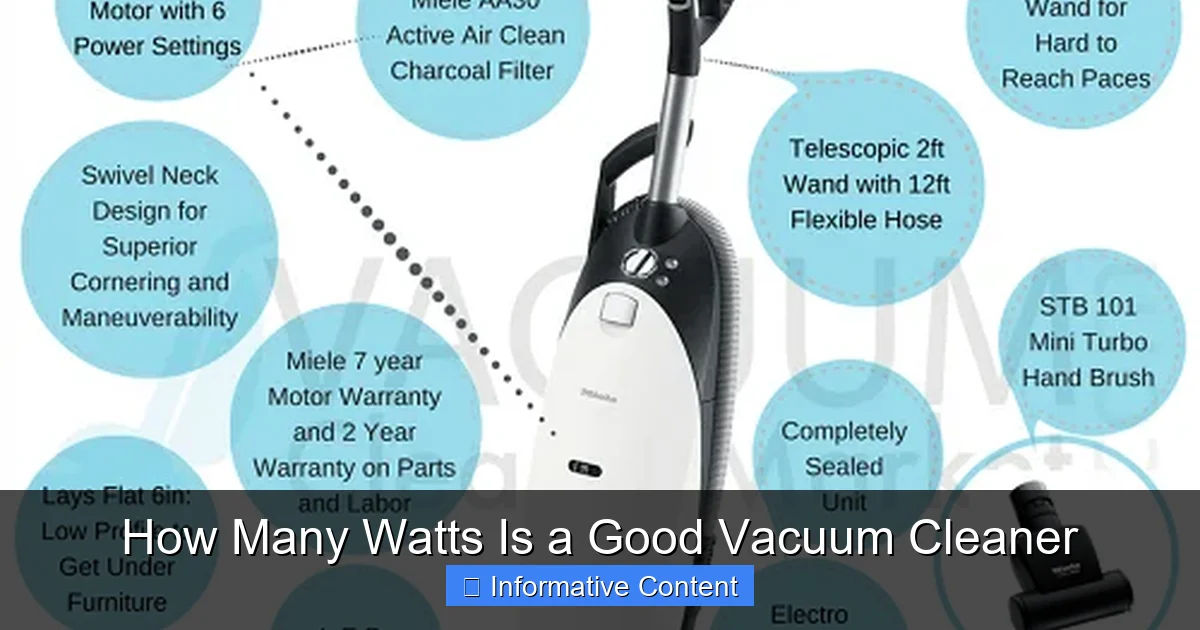
Visual guide about How Many Watts Is a Good Vacuum Cleaner
Image source: i.pinimg.com
If motor watts aren’t the be-all and end-all, what metrics should you look for to understand a vacuum’s actual cleaning capability? This is where other specifications come into play.
Air Watts (AW): The Most Telling Metric
If you see “air watts” listed, pay attention! Air watts are arguably the most accurate measure of a vacuum cleaner’s effective cleaning power. This metric quantifies the amount of power consumed by the vacuum to carry a unit of air through an opening. Essentially, it combines two crucial elements:
- Airflow (CFM – Cubic Feet per Minute): How much air the vacuum can move. Higher airflow is excellent for picking up light debris like dust and pet hair.
- Water Lift (inches of H2O): How much suction power the vacuum generates, measured by the height to which it can lift a column of water. Higher water lift is crucial for deep cleaning carpets and pulling embedded dirt.
A vacuum cleaner that balances good airflow with strong suction will have a higher air watt rating, indicating superior cleaning efficiency. For example, a good upright vacuum might have an air watt rating between 100-220 AW, while a powerful canister or central vacuum system could reach 200-300 AW or more. This is a much better indicator for determining how many watts is a good vacuum cleaner in terms of actual performance.
Other Performance Indicators
While air watts are king, other metrics can provide additional insights:
- Cubic Feet per Minute (CFM): As mentioned, this measures airflow. High CFM is great for bare floors and picking up larger, lighter debris quickly.
- Water Lift (inches of H2O): This specifically measures the strength of suction. High water lift is essential for deep cleaning carpets and removing heavy, embedded dirt.
Manufacturers don’t always list these figures, but if they do, they offer a more comprehensive picture than motor watts alone.
Different Vacuum Types and Their Wattage Needs
The “ideal” wattage, or rather the *effective* cleaning power, can also depend on the type of vacuum cleaner you’re considering. Different designs are optimized for different tasks.
Upright Vacuums
Traditional upright vacuums often feature powerful motors and direct airflow paths to their brush rolls, making them excellent for deep cleaning carpets. They often have higher motor wattages (historically 1000-1800W before regulations, now commonly 700-900W in regulated markets) to drive both suction and the rotating brush. For an upright, a good air watt rating for effective carpet cleaning would be in the range of 150-220 AW.
Canister Vacuums
Canister vacuums separate the motor and dirt collection from the cleaning head, offering greater versatility and maneuverability. Their motor wattages are comparable to uprights, but their design allows for more consistent suction across various attachments and floor types. A good canister vacuum, especially one with a powered brush head, will excel at both bare floors and carpets, often with similar air watt ranges to good uprights, but with better ergonomics for reaching tight spots.
Stick Vacuums and Cordless Models
These are designed for quick clean-ups and convenience. Cordless stick vacuums operate on battery power, meaning their “wattage” equivalent is often expressed differently (e.g., motor speed in RPM, battery voltage, or air watts directly). Due to battery limitations, their motors typically consume less power than corded models. A good stick vacuum might have air watts ranging from 50 AW to 150 AW (for premium models), prioritizing efficiency and agility over raw, continuous power. The question “how many watts is a good vacuum cleaner” here refers more to effective battery management and motor design than sheer electrical consumption.
Robot Vacuums
Robot vacuums have significantly lower power consumption and cleaning capability compared to manual vacuums, designed for maintenance cleaning rather than deep cleaning. Their “wattage” or power is minimal, focused on navigation and light debris pickup. You wouldn’t compare their motor watts directly to a full-sized upright.
Factors Influencing “Good” Vacuum Performance Beyond Watts
Beyond just watts or even air watts, several critical design elements contribute to how effectively a vacuum cleaner performs its job. These are often overlooked but are vital when deciding how many watts is a good vacuum cleaner for your home.
Nozzle and Brush Roll Design
This is huge! The design of the cleaning head and its brush roll has a massive impact on dirt pickup.
- Brush Roll Type: A good brush roll needs to be appropriate for your flooring. Stiff bristles are great for agitating carpet fibers to lift embedded dirt, while softer brushes are better for protecting delicate bare floors.
- Adjustability: The ability to adjust brush roll height or turn it off entirely prevents scratching bare floors and optimizes suction for different carpet pile heights.
- Nozzle Sealing: A well-sealed nozzle prevents suction loss, ensuring that the air and dirt are directed efficiently into the vacuum.
Filtration System
Especially important for allergy sufferers, the filtration system prevents dust and allergens from being expelled back into the air.
- HEPA Filtration: High-Efficiency Particulate Air (HEPA) filters capture 99.97% of airborne particles as small as 0.3 microns, including pollen, pet dander, and dust mites.
- Sealed System: A truly effective filtration system isn’t just about the filter itself, but a completely sealed vacuum body that prevents air from bypassing the filter.
Hose and Airflow Path Design
The internal pathways of the vacuum matter.
- Wide and Smooth Hoses: Minimize obstructions and blockages, allowing for better airflow.
- Direct Airflow: Efficiently designed internal paths reduce air turbulence and maintain suction power from the nozzle to the dirt bin.
Build Quality and Materials
Durable construction, quality seals, and robust materials contribute to a vacuum’s longevity and sustained performance, ensuring that its initial “good” cleaning power doesn’t degrade quickly.
How Many Watts Is a Good Vacuum Cleaner for Different Needs?
Let’s apply this knowledge to real-world scenarios. The “best” wattage, or rather, the most effective vacuum, depends heavily on your specific cleaning requirements.
For Homes with Mostly Bare Floors (Hardwood, Tile, Laminate)
For bare floors, strong airflow (CFM) is more important than deep suction (water lift) to pick up dust, crumbs, and pet hair. A vacuum with moderate wattage (e.g., 600-900W) but excellent airflow and a soft brush or bare floor tool can be incredibly effective. Look for models with good air watts (e.g., 100-150 AW) and a dedicated bare floor attachment that won’t scratch surfaces. Cordless stick vacuums are often a great choice here for convenience, where the question “how many watts is a good vacuum cleaner” really shifts to battery life and efficient motor design.
For Homes with Carpets and Rugs
If you have a lot of carpeting, especially thick pile or shag, you need a vacuum that can agitate and deep clean. This means a powerful brush roll and high water lift. An upright or canister vacuum with a motor wattage in the 700-900W range (in regulated markets) or higher (if unregulated) that effectively translates this into high air watts (150-220+ AW) will be ideal. A strong brush roll with a good motor to drive it is crucial here.
For Pet Owners
Pet hair presents a unique challenge. You need both strong suction to lift hair from carpets and upholstery, and excellent airflow to prevent clogs. A vacuum with specialized pet tools, a tangle-free brush roll, and strong air watts (180+ AW) is essential. Filtration is also key to capture pet dander. The motor wattage should be sufficient to power these features effectively. When considering how many watts is a good vacuum cleaner for pet hair, think about sustained power and efficient debris pickup.
For Allergy Sufferers
For those with allergies or asthma, filtration is paramount. You need a vacuum with a sealed HEPA filtration system. The motor wattage needs to be sufficient to maintain strong suction even through multiple filter layers, ensuring particles are captured, not just recirculated. While wattage itself isn’t the primary factor, a well-engineered vacuum designed for allergies will optimize its motor power for efficient air purification.
Making an Informed Decision: What to Look For
So, with all this information, how do you decide how many watts is a good vacuum cleaner for *your* needs? Here’s a practical guide:
- Don’t Obsess Over Motor Watts Alone: View motor watts as an indicator of potential, not guaranteed performance. Anything from 700W-900W (for corded models) is perfectly adequate if the vacuum is well-designed.
- Prioritize Air Watts (if available): This is your best single metric for cleaning power. Aim for 100-150 AW for general cleaning, and 180-220+ AW for deep cleaning carpets or pet hair.
- Consider Vacuum Type: Match the vacuum type (upright, canister, stick) to your home’s layout and predominant floor types.
- Examine Key Features:
- Brush Roll: Is it suitable for your floors? Can it be turned off?
- Filtration: Does it have a HEPA filter and a sealed system for allergies?
- Attachments: Does it come with tools for upholstery, crevices, and pet hair?
- Maneuverability and Weight: Is it easy to use and store?
- Read Reviews: Look for real-world user reviews and independent test results. They will tell you more about a vacuum’s actual performance than any single specification.
- Check for Energy Labels: These labels often provide information on energy efficiency and cleaning performance ratings (e.g., for carpets and hard floors), offering a holistic view beyond just watts.
In conclusion, the question “how many watts is a good vacuum cleaner” is less about a specific number and more about understanding the complex interplay of motor power, design efficiency, and specialized features. A “good” vacuum cleaner is one that effectively cleans your specific home, addresses your unique needs, and does so efficiently. Don’t let a high wattage number fool you; instead, look for thoughtful engineering and metrics that speak to actual cleaning prowess. Happy vacuuming!
Frequently Asked Questions
What is the difference between motor watts and air watts?
Motor watts indicate the electrical power consumed by the vacuum’s motor, essentially how much electricity it uses. Air watts, on the other hand, measure the vacuum’s actual cleaning power by combining airflow and suction at the cleaning head, giving a clearer picture of how effectively it lifts dirt.
Are high-wattage vacuums banned in some places?
Yes, in the European Union, regulations have limited the maximum motor wattage of vacuum cleaners to 900 watts since September 2017. This was done to promote energy efficiency and encourage manufacturers to innovate cleaner designs rather than relying on raw power consumption.
Does a cordless vacuum cleaner have watts?
Cordless vacuum cleaners are powered by batteries, so they don’t have a traditional “wattage” rating in the same way corded vacuums do. Their power is often described by battery voltage, battery run-time, or directly by their air watt performance, which is a better measure of their cleaning ability.
What wattage is considered good for pet hair?
For pet hair, focus less on motor wattage and more on strong air watts (ideally 180 AW or higher), combined with an effective brush roll and specialized pet tools. A well-designed vacuum with moderate motor wattage can easily outperform a high-wattage model lacking these features for pet hair removal.
Should I prioritize wattage or filtration for allergies?
For allergy sufferers, filtration is paramount. Look for a vacuum with a sealed HEPA filtration system that prevents allergens from escaping. While sufficient motor power is needed to maintain suction through these filters, it’s the quality and sealing of the filtration system that truly makes a difference for allergy relief.
Why do some cheap vacuums have very high wattage ratings?
Some cheaper vacuums, especially in unregulated markets, may boast high wattage ratings as a marketing tactic. However, without efficient design, much of that raw power is wasted as heat or noise, failing to translate into effective cleaning. It’s often a sign of outdated technology that hasn’t adapted to modern efficiency standards.