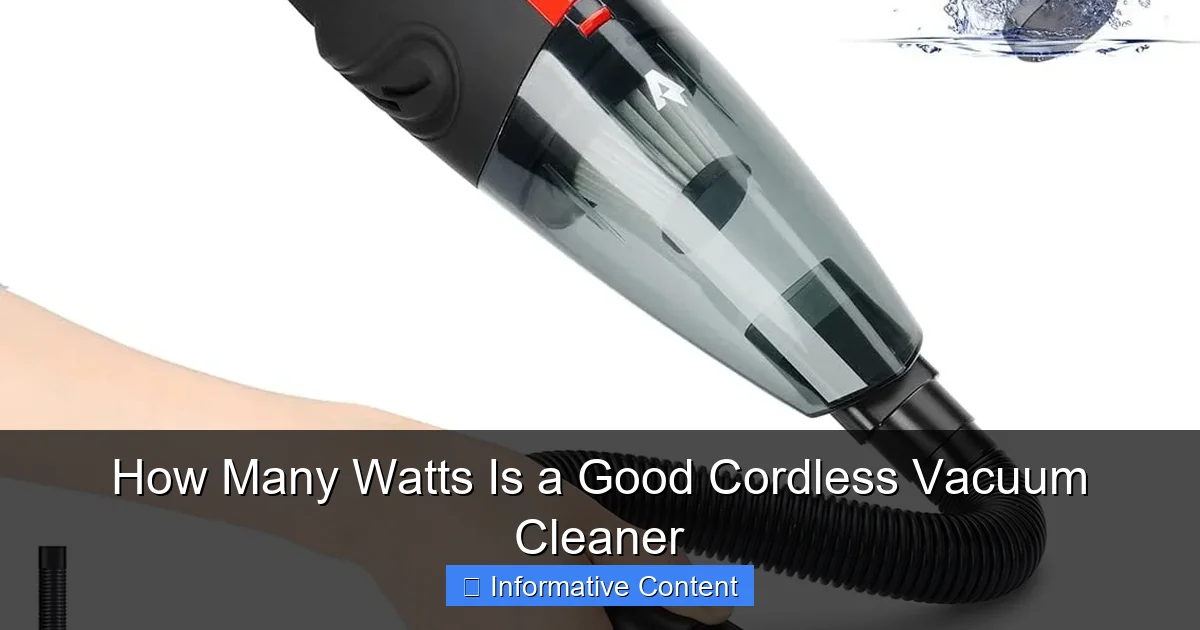
Understanding “how many watts is a good cordless vacuum cleaner” is more complex than it seems, as watts alone don’t tell the whole story for battery-powered devices. Instead, focus on metrics like air watts, kPa (kilopascals) for suction power, and battery voltage, which better reflect real-world cleaning performance. A “good” cordless vacuum delivers strong, consistent suction for your specific cleaning needs, balancing power with battery life and design efficiency.
How Many Watts Is a Good Cordless Vacuum Cleaner
So, you are in the market for a new cordless vacuum cleaner. You’ve heard friends rave about the convenience, the freedom, and the sheer power of modern stick vacuums. As you start browsing, you inevitably come across specifications like “watts,” “voltage,” “Air Watts,” and “kPa.” It can quickly get confusing, leaving you with one big question: how many watts is a good cordless vacuum cleaner?
You’re not alone in asking this! It’s a natural question, especially since we’ve been conditioned for years to associate higher wattage with more power in corded appliances. However, when it comes to the world of cordless vacuums, the answer is a little more nuanced than simply looking for the biggest number. In fact, focusing solely on watts might lead you down the wrong path entirely. Let’s dive deep and demystify what truly makes a cordless vacuum cleaner “good” and powerful.
Key Takeaways
- Watts Are Misleading for Cordless Vacuums: Unlike corded models, a high watt number on a cordless vacuum often refers to motor input power, not effective suction, making it a poor indicator of cleaning performance.
- Focus on Air Watts (AW) and kPa (Kilopascals): These metrics directly measure a vacuum’s actual cleaning power and suction strength at the nozzle, offering a much better comparison point than simple watts.
- Battery Voltage and Run Time Matter: Higher voltage (e.g., 20V, 25.2V) often correlates with more powerful motors and consistent suction, while longer run times ensure you can complete your cleaning tasks.
- Consider Your Cleaning Needs: A good cordless vacuum for quick clean-ups on hard floors might have different power requirements than one needed for deep cleaning pet hair from carpets.
- Motor Efficiency and Design Play a Huge Role: Advanced brushless motors and intelligent airflow designs can make a lower-wattage (or lower-rated) vacuum perform as well as, or even better than, a seemingly more powerful one.
- Attachments and Filtration Enhance Performance: Specialized brush heads and multi-stage filtration systems contribute significantly to effective cleaning, regardless of the raw power metrics.
- Read Reviews and Look for Real-World Tests: Product specifications are a start, but user experiences and independent tests provide the most reliable insights into a cordless vacuum’s actual effectiveness.
Quick Answers to Common Questions
What is the most important power metric for a cordless vacuum?
The most important power metric for a cordless vacuum is Air Watts (AW), as it combines both airflow and suction power, giving a comprehensive measure of cleaning effectiveness.
Is a higher wattage always better for a cordless vacuum?
No, a higher wattage is not always better for a cordless vacuum. Watts often indicate motor input power, not effective suction, and an inefficient motor with high watts might perform worse than an efficient one with lower watts.
What is a good range of Air Watts for a versatile cordless vacuum?
A good range of Air Watts for a versatile cordless vacuum suitable for mixed surfaces and moderate cleaning is typically between 100-150 AW.
How does battery voltage affect cordless vacuum performance?
Higher battery voltage (e.g., 20V, 25.2V) generally allows for more powerful motors and more consistent suction throughout the cleaning cycle, contributing to better overall performance.
Why are brushless motors preferred in cordless vacuums?
Brushless motors are preferred because they are more efficient, durable, and quieter than traditional brushed motors, converting more battery power into effective suction and less into wasted heat.
📑 Table of Contents
- Understanding Watts in Cordless Vacuums: Why It’s Tricky
- Beyond Watts: The Real Power Metrics
- What’s a “Good” Wattage (or Equivalent) for Different Cleaning Needs?
- Factors Influencing Cordless Vacuum Performance (Beyond Raw Power)
- Decoding Cordless Vacuum Specs: What to Look For
- Tips for Choosing the Right Cordless Vacuum
- Conclusion
Understanding Watts in Cordless Vacuums: Why It’s Tricky
When you look at a corded vacuum cleaner, watts typically refer to the electrical power the motor consumes. A higher wattage usually meant a more powerful motor and, by extension, stronger suction. This simple rule made purchasing relatively straightforward. However, cordless vacuums operate on batteries, introducing several new variables that complicate the wattage equation.
The Difference Between Input Watts and Suction Power
For many cordless vacuums, the “watts” listed in the specifications often refer to the *motor’s input power* – how much electrical power the motor draws from the battery. This isn’t the same as the *actual suction power* delivered at the nozzle, which is what truly cleans your floors. A motor might draw a lot of power (high watts), but if it’s inefficient, much of that power is lost as heat or noise, rather than being converted into airflow and suction.
The Role of Battery Power
Cordless vacuums are powered by batteries, and these batteries have specific voltages (e.g., 18V, 20V, 25.2V). The voltage, combined with the battery’s amperage (or Ah rating for capacity), determines how much energy the motor can draw and how consistently it can maintain power. A vacuum with a lower “wattage” but a higher voltage and a more efficient motor design can often outperform one with a seemingly higher wattage rating if the latter has an inefficient motor or a weaker battery system. Therefore, when pondering how many watts is a good cordless vacuum cleaner, it’s essential to look beyond that single number.
Beyond Watts: The Real Power Metrics
Since watts alone are not the most reliable indicator for cordless vacuums, what should you look for instead? Manufacturers and independent reviewers use more accurate metrics to describe a cordless vacuum’s cleaning prowess.
Air Watts (AW): The Gold Standard for Cleaning Power
If there’s one specification you should pay close attention to, it’s Air Watts (AW). Air Watts measure the effectiveness of a vacuum cleaner in terms of both airflow and suction power. It’s a calculation based on how much air the vacuum moves and how much force it uses to move that air.
Think of it this way: a vacuum needs to suck air (airflow) and lift debris (suction). Air Watts combine these two critical aspects into a single, comprehensive measurement. A higher Air Watt rating generally means a more powerful and effective vacuum cleaner.

Visual guide about How Many Watts Is a Good Cordless Vacuum Cleaner
Image source: m.media-amazon.com
- How it’s measured: Air Watts are derived from the airflow (in cubic feet per minute or CFM) and the water lift (in inches of water), representing suction force.
- What’s a good Air Watt number? For cordless stick vacuums, a range of 80-120 AW is often considered good for general cleaning on hard floors and light carpets. High-performance models designed for deep cleaning and pet hair can go up to 150-200 AW or even higher. When considering how many watts is a good cordless vacuum cleaner, think about its Air Watts instead.
Suction Power Measured in Kilopascals (kPa)
Another common metric you’ll see is kPa, or kilopascals. kPa specifically measures the static pressure or the strength of the vacuum’s suction. This tells you how well the vacuum can lift heavy debris or pull dirt from deep within carpet fibers.
- What it means: A higher kPa indicates stronger suction force.
- Typical range: For cordless vacuums, you might see ratings anywhere from 8 kPa (for basic handhelds) to 25 kPa or even 30 kPa for powerful stick models. Anything above 20 kPa for a stick vacuum is generally considered quite good for tackling tougher messes.
Motor Power and Efficiency
While the general “watts” might be vague, some manufacturers refer to the specific motor power in watts or even highlight the type of motor. Brushless DC motors are a significant advancement in cordless vacuum technology.
- Brushless Motors: These are more efficient, durable, and quieter than traditional brushed motors. They convert more electrical energy into mechanical power (suction) and less into heat, meaning better performance from the same battery power and often a longer lifespan.
- Impact on “Good” Wattage: A highly efficient brushless motor with a nominal wattage might actually deliver more effective cleaning power than a higher-wattage, less efficient brushed motor.
What’s a “Good” Wattage (or Equivalent) for Different Cleaning Needs?
The concept of “good” is subjective and depends heavily on what you need your cordless vacuum to do. When you ask yourself how many watts is a good cordless vacuum cleaner, rephrase it to: what level of power is good for *my* needs?
For Quick Clean-ups and Hard Floors
If your primary need is quick daily tidying, sweeping up crumbs, pet hair, and dust on hard floors, you don’t necessarily need the absolute highest power.
- Air Watts: 80-100 AW is usually sufficient.
- kPa: 15-20 kPa will handle most light debris effectively.
- Battery: A 18V or 20V system with a decent run time (e.g., 20-30 minutes on standard mode) will be perfectly adequate.
These models offer great maneuverability and are often lighter, making them ideal for frequent, light-duty use. They demonstrate that you don’t always need a massive “wattage” to have a good cordless vacuum cleaner.
For Mixed Surfaces and Moderate Cleaning
Most households have a mix of hard floors and some area rugs or low-pile carpets. For this scenario, you’ll want a bit more oomph to effectively clean both.
- Air Watts: 100-150 AW is a sweet spot.
- kPa: 20-25 kPa provides excellent all-around suction.
- Battery: Look for 20V-25.2V systems, often with multiple power modes and a run time of 30-45 minutes on standard mode, or 10-15 minutes on max power.
These vacuums strike a good balance between power, versatility, and battery life, making them suitable for most family homes.
For Deep Cleaning, Pet Hair, and Carpets
If you have pets, high-pile carpets, or frequently deal with tougher messes, you’ll want a cordless vacuum that truly brings the muscle.
- Air Watts: 150 AW or higher (some premium models reach 200 AW+).
- kPa: 25 kPa or higher for serious lifting power.
- Battery: Often 25.2V or higher, with advanced battery management. Expect robust run times on standard mode (45-60 minutes) but shorter bursts (5-10 minutes) on their most powerful settings.
These are the workhorses of the cordless vacuum world, designed to rival the performance of many corded models for specific tasks. When asking how many watts is a good cordless vacuum cleaner for heavy-duty tasks, look at these higher AW and kPa ratings.
Factors Influencing Cordless Vacuum Performance (Beyond Raw Power)
While power metrics are important, they aren’t the only pieces of the puzzle. Several other design and feature elements significantly impact how well a cordless vacuum cleans.
Battery Voltage and Capacity
We touched on this, but it bears repeating: the battery is the heart of your cordless vacuum.
- Voltage (V): Higher voltage often allows for more powerful motors and more consistent suction throughout the battery’s charge cycle.
- Amp-hours (Ah): This indicates the battery’s capacity and directly affects how long the vacuum can run. A higher Ah means longer run times. Some premium models offer swappable batteries, effectively doubling your cleaning time.
Brush Head Design and Motorization
The cleaning head, especially for carpeted surfaces, is critical.
- Motorized Brush Bar: Essential for lifting dirt, pet hair, and debris from carpets. Different brush types (soft roller for hard floors, stiff bristles for carpets) optimize cleaning.
- Self-Adjusting Heads: Some advanced heads automatically adjust to different floor types, maintaining optimal suction and contact.
Filtration System
A powerful motor means nothing if the vacuum expels dust back into the air.
- Multi-stage Filtration: Good cordless vacuums typically have several layers of filtration to trap fine dust and allergens.
- HEPA Filtration: For allergy sufferers, a true HEPA filter is a must, ensuring nearly all microscopic particles are captured.
Overall Design and Ergonomics
A powerful vacuum that’s awkward to use will gather dust itself.
- Weight and Balance: Important for maneuverability and reducing arm fatigue.
- Dustbin Size: A larger bin means less frequent emptying, which is a convenience factor.
- Attachments: Crevice tools, dusting brushes, and upholstery tools extend the vacuum’s versatility.
All these factors contribute to the overall effectiveness and user satisfaction, complementing whatever “wattage” or power metrics the vacuum boasts.
Decoding Cordless Vacuum Specs: What to Look For
When you’re trying to figure out how many watts is a good cordless vacuum cleaner, remember to shift your focus. Here’s a practical checklist for evaluating models:
- Prioritize Air Watts (AW) and kPa: If available, these are your primary indicators of cleaning power. Aim for numbers that align with your cleaning needs (e.g., 100-150 AW, 20-25 kPa for most homes).
- Check Battery Voltage (V) and Run Time: A higher voltage (20V+) usually signifies more power potential. Look at the advertised run time, keeping in mind that “max power” mode will significantly reduce it. Consider models with swappable batteries if you have a large home.
- Identify Motor Type: Opt for brushless motors for better efficiency, durability, and quieter operation.
- Examine the Floor Head: Ensure it’s motorized and suitable for your floor types (e.g., soft roller for hard floors, bristled roller for carpets).
- Verify Filtration: Look for multi-stage filtration, ideally with a washable HEPA filter, especially if allergies are a concern.
- Read Reviews: Real-world user reviews and independent tests often give the most honest insights into a vacuum’s performance, battery life, and durability, bridging the gap between advertised specs and actual experience.
Don’t be swayed by just a big “wattage” number if other, more relevant metrics are low or absent. A truly good cordless vacuum cleaner excels in a combination of these areas.
Tips for Choosing the Right Cordless Vacuum
Now that you know what to look for, here are some actionable tips to help you make your final decision:
Assess Your Home and Lifestyle
- Size of your home: Larger homes might benefit from longer battery life or swappable batteries.
- Floor types: Mostly hard floors? Carpets? A mix? This dictates the brush head you need.
- Pets/Allergies: Pet hair requires strong suction and good filtration. Allergies demand HEPA.
- Cleaning frequency: Daily quick clean-ups versus weekly deep cleans.
Set a Budget
Cordless vacuums range from under $100 to over $1000. Generally, higher prices correlate with better power (Air Watts, kPa), battery life, features (like LCD screens), and build quality. Decide what you’re willing to invest for the features you need.
Consider the Brand and Warranty
Reputable brands often offer better customer support, readily available spare parts, and stronger warranties. This can be a significant factor in the long-term satisfaction with your purchase.
Try Before You Buy (If Possible)
If a store allows it, lift the vacuum, feel its balance, and even try maneuvering it. Ergonomics play a huge role in how much you’ll actually enjoy using it.
Conclusion
The question of “how many watts is a good cordless vacuum cleaner” is a natural starting point, but we’ve learned that it’s just the tip of the iceberg. For cordless models, raw wattage is often misleading. Instead, savvy shoppers should focus on more telling metrics like Air Watts (AW) and kilopascals (kPa), which truly reflect a vacuum’s ability to pick up dirt and debris.
Beyond these numbers, the efficiency of the motor (brushless being superior), the voltage and capacity of the battery, the design of the brush head, and the quality of the filtration system all play crucial roles in defining a “good” cordless vacuum cleaner. By considering your specific cleaning needs, comparing relevant performance metrics, and looking at real-world reviews, you’ll be well-equipped to choose a cordless vacuum that not only offers fantastic convenience but also delivers truly powerful and effective cleaning for your home. Happy vacuuming!
Frequently Asked Questions
How many watts does a standard corded vacuum have?
A standard corded vacuum cleaner typically has wattage ranging from 1000 to 2000 watts. This higher wattage is generally a reliable indicator of suction power for corded models, as they have a constant power supply.
Do cordless vacuums lose suction as the battery drains?
Some older or less efficient cordless vacuums may experience a noticeable drop in suction as their battery drains. However, modern cordless vacuums, especially those with advanced battery management and efficient motors, are designed to maintain consistent power until the battery is nearly depleted.
What’s the difference between “max” mode and “eco” mode on a cordless vacuum?
“Max” mode provides the highest possible suction power for tackling tough messes but significantly reduces battery run time. “Eco” or “standard” mode offers a balance of moderate suction and extended battery life, suitable for everyday cleaning tasks.
Is a lighter cordless vacuum always less powerful?
Not necessarily. While ultra-light vacuums might compromise on battery size (and thus power/run time) to achieve their weight, advancements in motor technology and design mean many lightweight cordless vacuums can still offer impressive power and performance.
How important is the brush roll for carpet cleaning in a cordless vacuum?
The brush roll is extremely important for carpet cleaning in a cordless vacuum. A motorized brush roll agitates carpet fibers, dislodging dirt and pet hair, which is then easily picked up by the vacuum’s suction. Without it, carpet cleaning effectiveness is significantly reduced.
Can a cordless vacuum replace a corded upright vacuum?
For many households, a powerful cordless vacuum can effectively replace a corded upright for most daily and weekly cleaning tasks, especially high-end models designed for deep cleaning. However, for extremely large homes, very heavy-duty cleaning, or specialized tasks, a corded vacuum might still offer advantages in sustained power.