
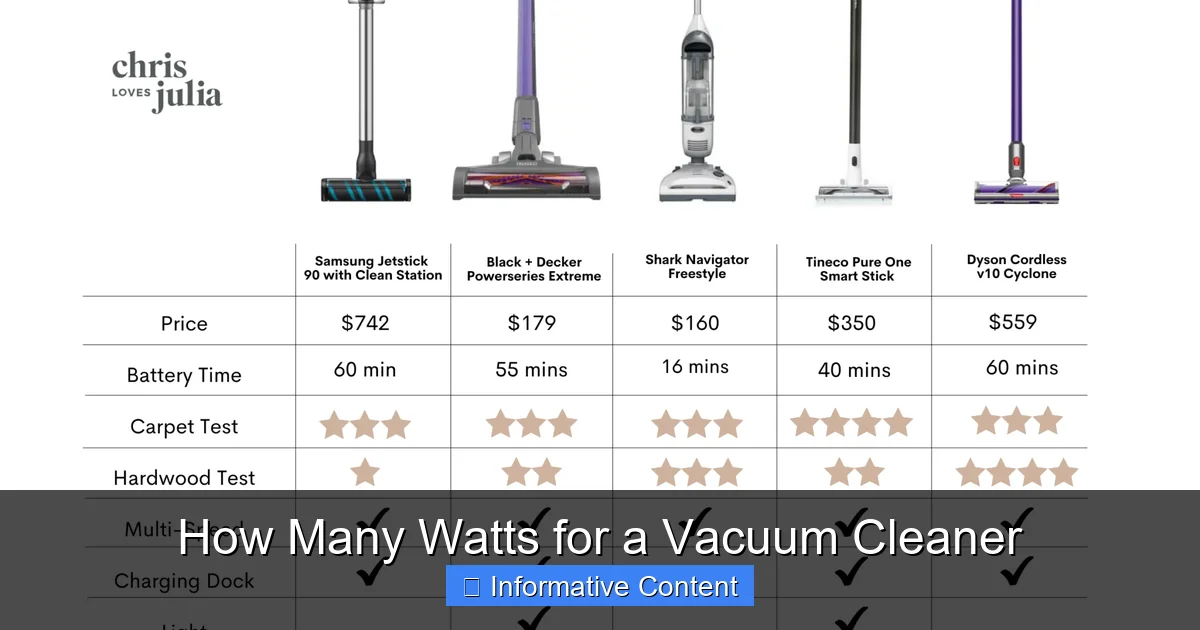
When asking how many watts for a vacuum cleaner, remember that raw wattage isn’t the sole indicator of cleaning power. While it reflects energy consumption, more crucial metrics like air watts, CFM (airflow), and water lift (suction) truly define a vacuum’s effectiveness. Modern, efficient vacuums can deliver superior cleaning performance with lower wattage, thanks to advanced design and motor technology.
Have you ever stood in the vacuum cleaner aisle, staring at labels, and wondered, “Just how many watts for a vacuum cleaner do I really need?” It’s a super common question, and honestly, it’s a bit of a tricky one. We’ve all been taught that higher numbers usually mean better performance, right? More megapixels for a camera, more horsepower for a car, and naturally, more watts for a vacuum cleaner should mean more cleaning power.
But here’s a little secret: when it comes to vacuum cleaners, wattage isn’t the whole story. In fact, focusing *too much* on the raw wattage number can lead you down the wrong path entirely. Think of it this way: a powerful car engine is great, but if it’s connected to worn-out tires and a clunky transmission, it won’t perform its best. The same principle applies here. So, let’s dive deep into understanding what watts actually mean for your vacuum and, more importantly, what really makes a vacuum clean effectively.
This article is designed to be your friendly guide, breaking down the jargon and giving you the real scoop. We’ll explore what wattage truly represents, introduce you to more important metrics like air watts and airflow, and help you understand how to choose the perfect vacuum that cleans your home brilliantly without breaking the bank or wasting energy. Get ready to become a vacuum power expert!
Key Takeaways
- Wattage is Energy Consumption, Not Suction Power: High wattage primarily indicates how much electricity a vacuum uses, not necessarily how strong its suction is. Efficiency and design play a much larger role in actual cleaning performance.
- Focus on Air Watts for True Suction: Air watts are a better indicator of a vacuum’s effective cleaning power, as they measure the combination of airflow and suction pressure at the nozzle.
- CFM (Airflow) and Water Lift (Suction Pressure) are Critical: High CFM means more air moves through the vacuum, picking up debris, while high water lift means stronger suction at the surface, essential for embedded dirt.
- Different Vacuum Types Have Different Wattage Needs: Corded uprights and canisters typically range from 1000-2000 watts, while cordless stick vacuums are lower (150-500 watts), and handhelds even less, due to their power sources and intended use.
- Modern Vacuums Prioritize Efficiency: Many newer models achieve excellent cleaning with lower wattage thanks to optimized motor design, better filtration, and superior brush rolls, leading to lower energy bills.
- Performance is a Holistic Picture: Beyond just wattage and air watts, factors like brush roll design, filtration system, nozzle attachments, and even the vacuum’s overall build quality significantly impact its real-world cleaning effectiveness.
- Match Wattage (and Performance) to Your Needs: Consider your home size, floor types, and specific cleaning challenges (like pet hair) when deciding on a vacuum’s power. A high-wattage vacuum isn’t always necessary for smaller homes or lighter tasks.
Quick Answers to Common Questions
What is a good wattage for a vacuum cleaner?
A good wattage range varies significantly by vacuum type; for corded models, 1000-1500 watts is common, while cordless vacuums might be 150-500 watts. However, focus more on air watts for cleaning effectiveness.
Do more watts mean more suction?
Not necessarily. More watts mean higher electricity consumption. Actual suction power is better measured by air watts, which consider both airflow and suction pressure. An efficient lower-wattage vacuum can outperform an inefficient higher-wattage one.
What are “air watts”?
Air watts are a measurement of a vacuum cleaner’s effective cleaning power, combining both airflow (CFM) and suction pressure (water lift) at the cleaning head. It’s a more accurate indicator of performance than just motor wattage.
Is 100 air watts good for a vacuum cleaner?
100 air watts is generally considered a good level of suction power for many cordless stick vacuums, especially for hard floors and light carpet cleaning. For corded uprights, you might look for 150-200+ air watts for more thorough cleaning.
How can I tell if a vacuum is powerful?
To tell if a vacuum is powerful, look for its air watt rating first. Also, consider its CFM (airflow) and water lift (suction pressure). Check reviews for real-world performance on different floor types and for handling debris like pet hair.
📑 Table of Contents
- Understanding Vacuum Cleaner Wattage: More Than Just a Number
- The True Indicators of Cleaning Power: Air Watts, CFM, and Suction Pressure
- Typical Wattage Ranges for Different Vacuum Cleaner Types
- Energy Efficiency and Your Vacuum Cleaner
- Beyond Watts: What Else Influences Vacuum Performance?
- Choosing the Right Vacuum Cleaner for Your Needs (and Watts)
Understanding Vacuum Cleaner Wattage: More Than Just a Number
When you see a “watts” rating on a vacuum cleaner, it’s easy to assume it directly correlates with how much dirt it can suck up. But that’s not quite right. Let’s clear up this common misconception.
What Does “Wattage” Really Mean?
In simple terms, wattage refers to the amount of electrical power a vacuum cleaner *consumes* when it’s running. It’s a measure of energy input, not energy output in the form of suction. A higher wattage means the motor is drawing more electricity from your wall socket. For example, a vacuum cleaner rated at 1500 watts will use 1.5 kilowatt-hours (kWh) of electricity if it runs for an hour. This is important for your electricity bill, but less so for its cleaning effectiveness.
Think of it like a light bulb. A 100-watt incandescent bulb uses a lot of electricity, but a 15-watt LED bulb can produce the same amount of light, or even more, using far less power. The LED is more *efficient*. The same applies to vacuum cleaners.
Why High Watts Don’t Always Equal High Suction
This is the crucial part. A vacuum cleaner with a very high wattage might *sound* powerful, but if its motor or design isn’t efficient at converting that electrical power into actual suction and airflow, then a lot of that energy is wasted as heat or noise. Older vacuum models often had very high wattage numbers (sometimes 2000+ watts) because their motors weren’t as efficient at creating suction. They needed more power just to achieve a decent level of cleaning.
Modern vacuum cleaner design, however, focuses on efficiency. Manufacturers are constantly improving motor technology, airflow pathways, and nozzle designs to maximize cleaning power while minimizing energy consumption. This means you can often find a newer vacuum with a lower wattage that outperforms an older, higher-wattage model. So, don’t just ask “how many watts for a vacuum cleaner” but rather, “how *efficiently* does this vacuum use its watts?”
The True Indicators of Cleaning Power: Air Watts, CFM, and Suction Pressure
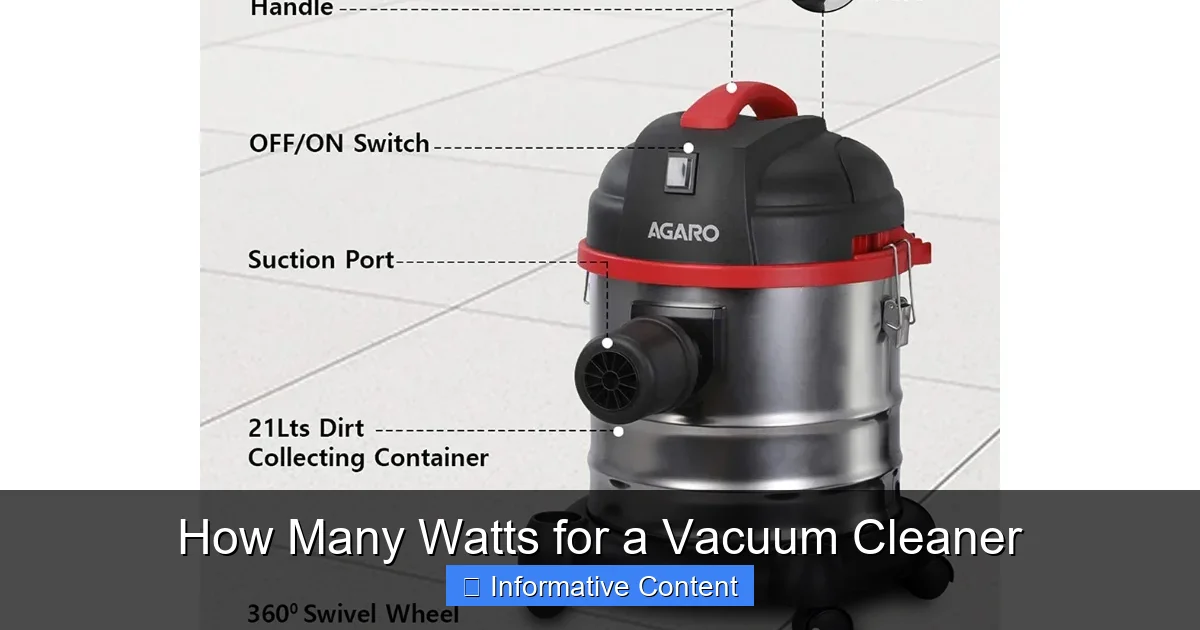
Visual guide about How Many Watts for a Vacuum Cleaner
Image source: drowdry.com
If raw wattage isn’t the best measure, what should you look for? This is where air watts, CFM, and water lift come into play. These metrics provide a much clearer picture of a vacuum’s actual cleaning prowess.
Air Watts: The Gold Standard for Suction Power
If you want to know about a vacuum’s *actual* effective suction power, air watts are your best friend. Air watts measure the power generated by the vacuum at the cleaning head, considering both airflow (how much air it moves) and suction pressure (how strongly it pulls). It’s a combination of these two factors that truly picks up dirt.
* Why it matters: A vacuum might have great suction pressure but low airflow, meaning it can lift a heavy object but won’t effectively pull in scattered dust and debris. Conversely, high airflow but low suction pressure might move a lot of air without lifting embedded dirt. Air watts combine both for a comprehensive measure of cleaning performance.
* What’s a good number?
* Cordless stick vacuums: Often range from 15-150+ air watts. High-end models can reach 200 air watts or more on boost mode.
* Corded upright/canister vacuums: Typically 100-300+ air watts. Premium models for heavy-duty cleaning might exceed 300 air watts.
Generally, for effective everyday cleaning, aim for a vacuum with at least 100-150 air watts for corded models, and 50-100+ air watts for cordless ones (understanding cordless has a power ceiling).
Cubic Feet per Minute (CFM) and Water Lift (Suction Pressure)
These are the two components that make up air watts and are sometimes listed individually, especially for professional or shop vacuums.
* Cubic Feet per Minute (CFM): This measures the volume of air moving through the vacuum’s system per minute. Higher CFM means the vacuum can move more air, which is excellent for picking up lightweight debris, pet hair, and surface dust over a wider area. Think of it as the “sweeping” power. For general home use, a good CFM can range from 50 to 100+, with shop vacs going much higher.
* Water Lift (or Sealed Suction): Measured in inches of water, this indicates the maximum static suction the vacuum can generate. It’s the pulling power at the nozzle, crucial for lifting deeply embedded dirt, sand, and pet hair from carpets, or for vacuuming up heavier items. Think of it as the “pulling” power. For home vacuums, 60-90 inches of water lift is common, with high-performance models going over 100 inches.
How These Metrics Work Together
A truly effective vacuum needs a good balance of both CFM and water lift, which is why air watts are such a useful metric. You need enough airflow to carry debris into the dustbin and enough suction pressure to dislodge stubborn dirt. Without one, the other becomes less effective. So, when considering how many watts for a vacuum cleaner, always prioritize checking for air watt ratings if available.
Typical Wattage Ranges for Different Vacuum Cleaner Types
While we know wattage isn’t the *only* factor, it still gives you a general idea of the power draw and, to some extent, the potential power of different vacuum types. Let’s look at the typical ranges.
Corded Upright and Canister Vacuums
These are your traditional workhorses, designed for powerful, sustained cleaning.
* Wattage: Typically range from 1000 watts to 2000 watts. Some older or commercial models might even exceed this.
* Why this range: They have direct, continuous power from the wall, allowing for larger, more powerful motors that can generate high airflow and suction. This makes them ideal for deep cleaning carpets, large homes, and tackling significant debris.
* Example: A Dyson Ball Animal 3 Extra might use around 1500 watts, while still delivering strong suction. A basic Bissell upright might be around 1200 watts.
Cordless Stick Vacuums
These have become incredibly popular for their convenience and lightweight design.
* Wattage: Significantly lower, usually ranging from 150 watts to 500 watts.
* Why this range: They rely on battery power, which limits the continuous power output. They are designed for quick cleanups, hard floors, and light-to-medium carpet cleaning. While their raw wattage is lower, their efficiency is often very high, with some premium models delivering impressive air watts, especially on boost settings.
* Example: A premium Dyson V15 Detect might list 250 air watts (not wattage) but its motor wattage could be around 500 watts on max power, while a more basic Tineco A11 Hero could be closer to 450 watts.
Handheld and Robotic Vacuums
These are for very specific, often lighter, cleaning tasks.
* Wattage: Handhelds typically range from 50 watts to 200 watts. Robotic vacuums are generally even lower, from 20 watts to 100 watts during active cleaning.
* Why this range: Handhelds are for spot cleaning spills or car interiors, and robots are for daily maintenance. Their small size and battery limitations dictate lower power draw.
* Example: A Black+Decker handheld might be 160 watts, while a Roomba i7 might draw around 30 watts when vacuuming.
Wet/Dry Shop Vacs
These are in a league of their own for heavy-duty tasks.
* Wattage: Can range from 1000 watts to 3000 watts or even more for industrial models.
* Why this range: Designed to pick up large debris, liquids, and handle tough workshop environments. They need enormous power and robust motors.
* Example: A standard Craftsman 6-gallon shop vac might be 1500 watts.
So, when you see a question like “how many watts for a vacuum cleaner,” remember that the answer depends heavily on the *type* of vacuum you’re looking at and its intended use.
Energy Efficiency and Your Vacuum Cleaner
Beyond just cleaning power, your vacuum’s wattage has a direct impact on its energy consumption and, by extension, your electricity bill.
The Cost of Higher Wattage
A vacuum cleaner that runs at 1500 watts for an hour uses 1.5 kWh of electricity. If your electricity costs, say, $0.15 per kWh, that’s $0.225 for an hour of vacuuming. While this might not seem like much for a single use, if you vacuum for several hours a week, it adds up. Over a year, a high-wattage, inefficient vacuum can cost you a noticeable amount more than an efficient one.
Moreover, higher wattage can sometimes lead to more heat generation, and potentially shorten the lifespan of the motor if not properly designed or maintained.
Modern Innovations for Efficient Cleaning
The good news is that vacuum cleaner technology has come a long way. Many manufacturers are now focused on producing highly efficient models that deliver excellent cleaning with lower energy consumption. This is due to:
* Brushless Motors: More efficient, quieter, and last longer than traditional brushed motors.
* Optimized Airflow Paths: Better design reduces resistance, allowing air to move more freely, thus requiring less power to achieve high CFM.
* Advanced Filtration: HEPA filters and multi-stage filtration systems capture more particles, keeping the motor and air paths cleaner, which maintains efficiency.
* Smart Sensors: Some vacuums can detect floor types and adjust suction power automatically, saving energy on less demanding surfaces.
How to Choose an Energy-Efficient Model
When considering how many watts for a vacuum cleaner, look for models that emphasize efficiency.
1. Check Air Watt Ratings: As discussed, this is a better indicator of actual cleaning power per watt consumed.
2. Look for Energy Star Certification (if applicable): While more common for appliances like refrigerators, some regions or specific vacuum types might have energy efficiency labels.
3. Read Reviews: Independent reviews often highlight a vacuum’s real-world cleaning performance and efficiency.
4. Consider Cordless: While lower in absolute power, modern cordless stick vacuums are incredibly efficient for daily tasks and consume very little power during charging.
Beyond Watts: What Else Influences Vacuum Performance?
So, we’ve established that the answer to “how many watts for a vacuum cleaner” is complex. But even beyond air watts, several other crucial factors contribute to how well a vacuum cleans your home.
Motor Design and Filtration
* Motor Quality: The quality and design of the motor are paramount. A well-engineered motor can convert electrical energy into suction and airflow much more effectively than a cheap, inefficient one, even if both have the same wattage rating.
* Filtration System: A good filtration system not only traps dust and allergens, preventing them from being recirculated into the air but also protects the motor. HEPA filters are excellent for allergy sufferers. A clogged or poor filter can drastically reduce suction power, regardless of the motor’s wattage.
Brush Rollers and Attachments
* Brush Roll Design: For carpets, a powerful, well-designed brush roll (or beater bar) is essential. It agitates carpet fibers to dislodge embedded dirt, pet hair, and debris, making it easier for the vacuum to suck them up. Some vacuums have specialized brush rolls for different floor types, or tangle-free designs for pet hair. Without an effective brush roll, even a high-suction vacuum will struggle on carpet.
* Attachments: The right tools for the job make a huge difference. Crevice tools for tight spaces, upholstery tools for furniture, and dusting brushes for delicate surfaces all enhance the vacuum’s versatility and effectiveness in various cleaning scenarios.
Bagged vs. Bagless Systems
Both systems have their pros and cons that can affect perceived performance:
* Bagged Vacuums: Generally maintain more consistent suction as the bag fills (until it’s completely full) because the bag acts as a primary filter. They are also often preferred by allergy sufferers as they minimize dust exposure during emptying.
* Bagless Vacuums: Require regular filter cleaning to maintain suction power, as filters can clog faster. However, they offer the convenience of no ongoing bag purchases and easy visual inspection of collected dirt.
Maintenance and User Technique
Even the best vacuum cleaner won’t perform optimally if not maintained.
* Emptying/Changing Bags: Always empty bagless canisters or change bags before they get too full to ensure maximum airflow and suction.
* Cleaning Filters: Regularly clean or replace filters as recommended by the manufacturer. Clogged filters are the number one cause of reduced suction.
* Clearing Blockages: Hoses, brush rolls, and nozzles can get clogged with hair, lint, or debris. Clear these blockages promptly.
* Brush Roll Care: Keep brush rolls free of tangled hair and strings to ensure they spin effectively and agitate carpets.
Choosing the Right Vacuum Cleaner for Your Needs (and Watts)
Instead of just asking “how many watts for a vacuum cleaner,” shift your focus to “what vacuum is right for my specific home and lifestyle?”
Consider Your Home Size and Floor Types
* Small Apartment/Mostly Hard Floors: A compact, efficient corded canister vacuum or a mid-range cordless stick vacuum (e.g., 200-300 watts, 50-80 air watts) might be perfect. You don’t need excessive power for light tasks.
* Medium-Sized Home with Mixed Flooring: A versatile upright or a powerful cordless stick vacuum with good air watts (e.g., 1000-1500 watts, 150-200+ air watts) would be a good choice. Look for models with adjustable suction and brush rolls that can be turned off for hard floors.
* Large Home with Lots of Carpet or Pets: You’ll likely want a robust corded upright or canister vacuum with high air watts (e.g., 1500-2000 watts, 200-300+ air watts) and an excellent brush roll. These are designed for deep cleaning and sustained power.
Pet Hair and Allergies
If you have pets, you’ll want a vacuum specifically designed to handle pet hair. This often means:
* Stronger Suction/Air Watts: To lift stubborn pet hair from carpets and upholstery.
* Specialized Brush Rolls: Often with stronger bristles or anti-tangle designs.
* HEPA Filtration: Crucial for trapping pet dander and allergens, preventing them from re-entering the air. These features are more important than just raw wattage.
Convenience vs. Raw Power
* Cordless Vacuums: Offer unmatched convenience for quick cleanups and ease of movement. While their battery limits sustained high power, many premium models offer excellent cleaning on boost modes.
* Corded Vacuums: Provide unlimited runtime and often superior raw power for deep cleaning tasks. They are typically heavier and less maneuverable.
Your lifestyle will dictate which balance of convenience and power is best for you.
In conclusion, understanding how many watts for a vacuum cleaner is really just the first step. While wattage tells you about energy consumption, it’s the combination of air watts, CFM, water lift, efficient design, and practical features like brush rolls and filtration that truly define a vacuum’s cleaning prowess. By looking beyond the simple watt number and considering these other factors, you’ll be much better equipped to choose a vacuum that perfectly suits your home and keeps it sparkling clean!
Frequently Asked Questions
What’s the difference between motor watts and air watts?
Motor watts indicate the electrical power consumed by the vacuum cleaner’s motor, essentially how much energy it uses. Air watts, on the other hand, measure the effective cleaning power generated at the nozzle, combining both airflow and suction, giving a more accurate picture of how well it will pick up dirt.
Does wattage affect how loud a vacuum cleaner is?
Higher wattage can sometimes correlate with louder operation, especially in older or less efficient models where a lot of energy is converted into noise and heat. However, modern vacuum designs prioritize noise reduction, so many powerful vacuums now offer relatively quiet operation despite their wattage.
Is a higher wattage vacuum better for pet hair?
Not directly. While high wattage might suggest more raw power, a vacuum’s effectiveness against pet hair depends more on strong air watts, specialized brush rolls that agitate carpet fibers, and efficient filtration to trap dander. Look for “pet” specific models rather than just high watts.
Can a vacuum cleaner use too many watts for a standard home outlet?
Most standard household circuits in North America are 15-amp, which can safely handle devices up to about 1800 watts. Most domestic vacuum cleaners fall within this limit. Industrial-grade shop vacs, however, might exceed this and require a dedicated 20-amp circuit.
Do robot vacuums have wattage ratings?
Yes, robot vacuums do have wattage ratings, though they are typically much lower than traditional upright or canister vacuums due to their smaller size and battery power. Their wattage is often around 20-100 watts during cleaning, with slight variations depending on the cleaning mode.
How does vacuum cleaner wattage affect energy bills?
A vacuum’s wattage directly affects your energy bill; higher wattage means more electricity consumed over time. For example, a 1500-watt vacuum used for an hour consumes 1.5 kilowatt-hours (kWh). Choosing an energy-efficient model with good air watts can save you money in the long run.