
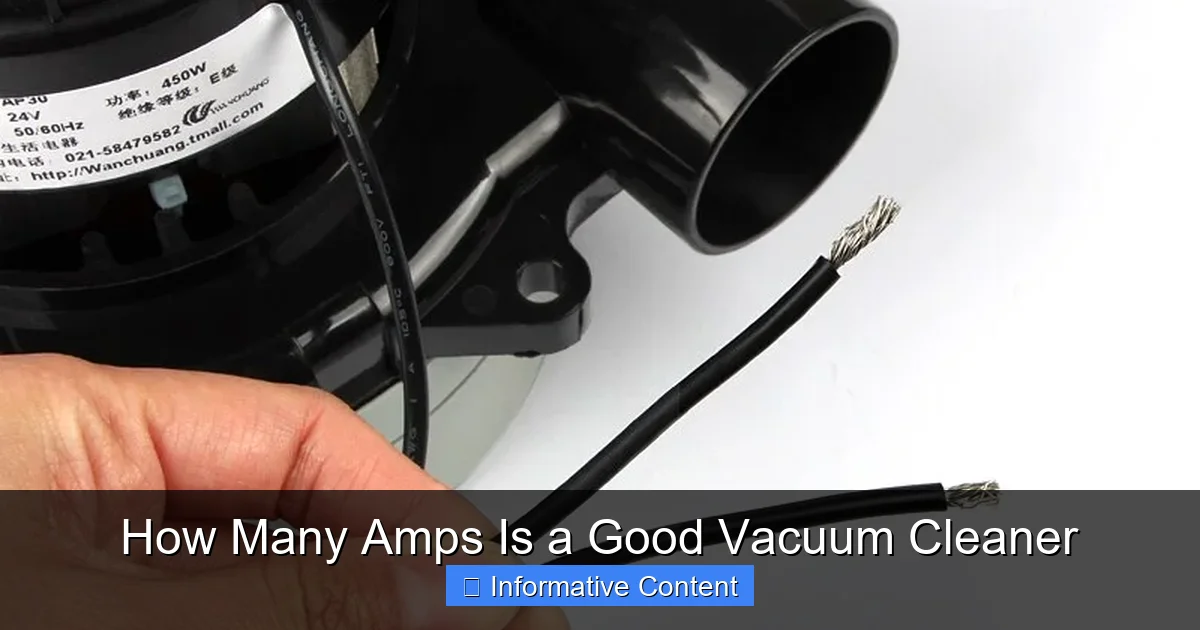
When shopping for a vacuum cleaner, many people wonder, “how many amps is a good vacuum cleaner?” While amps indicate the electrical power consumed by the motor, they don’t directly translate to suction power or cleaning effectiveness. A good vacuum prioritizes factors like motor design, airflow (CFM), suction power (Air Watts), and brush roll technology over just high amperage. Modern, efficient vacuums often achieve superior cleaning with fewer amps by optimizing their entire system.
How Many Amps Is a Good Vacuum Cleaner
Stepping into the world of vacuum cleaner shopping can sometimes feel like diving into a sea of technical jargon. You’ll see numbers like watts, volts, and perhaps most commonly, amps. For many years, the conventional wisdom suggested that “more amps equals more power,” leading countless shoppers to zero in on this one number when trying to decide, “how many amps is a good vacuum cleaner?” It seems logical, doesn’t it? More electricity going into the motor should mean a stronger vacuum, right?
Well, not exactly. While amps certainly play a role in a vacuum cleaner’s electrical profile, they tell only a small part of the story when it comes to actual cleaning performance. In today’s market, with advancements in motor technology, design, and overall efficiency, focusing solely on amperage can actually steer you away from some of the best cleaning machines available. Understanding what amps really mean and, more importantly, what other metrics truly matter, is key to making an informed decision for your home.
This article will demystify vacuum cleaner amperage, break down what contributes to effective cleaning, and help you understand why a “good” vacuum cleaner isn’t just about the number of amps it draws. We’ll explore the range of amps you might see, discuss more relevant performance indicators, and offer practical advice on how to choose a vacuum that truly meets your needs, regardless of its amp rating.
Key Takeaways
- Amps Indicate Power Consumption, Not Necessarily Suction: A vacuum cleaner’s amperage rating tells you how much electricity the motor draws, not how much cleaning power it delivers. Higher amps do not automatically mean better suction.
- Look Beyond Amps for Performance: True vacuum performance is better measured by Air Watts (AW), Cubic Feet per Minute (CFM) of airflow, motor design, and effective brush roll technology.
- Typical Amperage Ranges: Most corded household vacuums range from 6 to 12 amps. Handheld and robotic vacuums typically use much fewer, often measured in watts or volts.
- Higher Amps Can Have Downsides: While some powerful vacuums have higher amps, excessively high amperage can mean more energy consumption, increased heat, noise, and potential tripping of circuit breakers without providing proportional cleaning benefits.
- Efficiency is Key in Modern Vacuums: Advanced vacuum cleaner designs can achieve excellent cleaning results with lower amperage ratings by optimizing airflow paths, motor efficiency, and nozzle design.
- Consider Your Cleaning Needs: The “best” vacuum isn’t defined by amps alone. Consider factors like floor types, pet hair, dust filtration, and maneuverability to find a vacuum that suits your specific home and lifestyle.
Quick Answers to Common Questions
What is the typical amp range for a corded vacuum cleaner?
Most corded household vacuum cleaners fall into a range of 6 to 12 amps, with lighter duty models on the lower end and heavy-duty models on the higher end.
Do higher amps always mean better suction?
No, higher amps do not always mean better suction. Amps measure electrical current draw, but actual suction power depends more on factors like Air Watts, airflow (CFM), and the vacuum’s overall design and efficiency.
What is Air Watts (AW) and why is it important?
Air Watts (AW) is a direct measure of a vacuum’s effective cleaning power, combining airflow and suction pressure. It’s a much better indicator of how well a vacuum will pick up dirt than amps alone.
Why don’t cordless vacuums list amps?
Cordless vacuums run on batteries, so their power is typically indicated by battery voltage (V) or motor wattage (W), rather than the amps drawn from a household outlet.
Can a vacuum with too many amps trip a circuit breaker?
Yes, a vacuum cleaner with a very high amperage rating, especially when used on an older electrical circuit or one with many other appliances, can potentially trip a circuit breaker.
📑 Table of Contents
- What Do Amps Really Mean for Your Vacuum?
- The Amp Spectrum: What’s Typical for Different Vacuum Types?
- Beyond Amps: The True Indicators of Vacuum Performance
- Why Higher Amps Aren’t Always Better
- Choosing the Right Amperage for Your Home
- Tips for Maximizing Your Vacuum’s Performance (Regardless of Amps)
- Conclusion
What Do Amps Really Mean for Your Vacuum?
Let’s start with the basics: what are amps? In simple terms, amperage (or amps) is a unit of electrical current. It measures the volume of electrons flowing through a circuit per second. When you see a vacuum cleaner rated at, say, 10 amps, it means that the vacuum’s motor is designed to draw 10 amps of electrical current from your household outlet.
Amps vs. Watts vs. Volts
It’s easy to get these terms confused, but they each describe a different aspect of electricity:
- Amps (Current): How much electrical current is flowing. Think of it like the width of a water pipe – how much water can flow through.
- Volts (Voltage): The “pressure” or electromotive force that pushes the electrical current. In most homes, this is standardized (e.g., 120 volts in North America). Think of it as the water pressure in the pipe.
- Watts (Power): The actual electrical power consumed, calculated by multiplying volts by amps (Watts = Volts x Amps). This is the total energy being used by the appliance. Think of it as the total amount of water coming out of the tap per second.
So, while amps tell you about the current draw, watts give you a better sense of the total electrical power consumption of the vacuum cleaner. Many modern appliances, especially cordless ones, will list watts or even volts (for battery power) rather than amps as their primary power metric.
Amps and Suction Power: A Loose Connection
Here’s the crucial point: a higher amperage *can* indicate a more powerful motor, as it draws more electricity. However, a powerful motor doesn’t automatically mean superior suction. The efficiency with which that motor converts electrical power into mechanical airflow and suction power varies greatly between different vacuum cleaner designs. Imagine two cars: one with a huge, old, inefficient engine, and another with a smaller, highly optimized modern engine. The smaller engine might use less fuel but produce more usable power at the wheels. The same principle applies to a vacuum cleaner’s motor.
The Amp Spectrum: What’s Typical for Different Vacuum Types?
Visual guide about How Many Amps Is a Good Vacuum Cleaner
Image source: homebeautifully.com
The amperage rating you’ll encounter can vary widely depending on the type and design of the vacuum cleaner.
Corded Upright and Canister Vacuums
Traditional corded upright and canister vacuums are typically where you’ll see amperage ratings listed prominently. Most fall into a range of 6 to 12 amps.
- Lower Amps (6-8 amps): These vacuums are often lighter duty, suitable for smaller homes, apartments, or quick clean-ups on hard floors and low-pile carpets. They are generally more energy-efficient but might struggle with deep cleaning thick carpets or stubborn pet hair.
- Mid-Range Amps (8-10 amps): This is a common sweet spot for many general-purpose household vacuums. They offer a good balance of power for various tasks, including medium-pile carpets and everyday dirt. Many reputable brands deliver excellent cleaning performance in this range.
- Higher Amps (10-12 amps): These vacuums are usually designed for heavy-duty cleaning, larger homes, or homes with pets and thick carpets. While they consume more electricity, the goal is often to provide stronger suction and more vigorous brush roll action. However, simply seeing a 12-amp rating doesn’t guarantee it’s automatically superior to a well-designed 9-amp model.
It’s worth noting that regulatory standards (like those in Europe) have pushed manufacturers to design more efficient vacuums that perform excellently with lower wattage/amperage, often capped at around 9 amps (1000-1200 watts). This demonstrates that high amps aren’t a prerequisite for high performance.
Cordless, Handheld, and Robotic Vacuums
For these types of vacuums, you’ll rarely see an amp rating because they run on batteries. Instead, their power is usually indicated by:
- Volts (V): For cordless stick vacuums, this indicates the battery’s voltage (e.g., 18V, 22V, 25.2V). Higher voltage generally means more potential power and longer runtime, but again, efficiency matters greatly.
- Watts (W): Sometimes, the motor’s power consumption will be listed in watts for battery-powered devices, especially for the brush roll motor.
These types of vacuums are engineered for maximum efficiency, often employing digital motors and aerodynamic designs to achieve strong suction from limited battery power.
Beyond Amps: The True Indicators of Vacuum Performance
So, if amps aren’t the ultimate measure, what should you actually look for when assessing a good vacuum cleaner? Focus on these key metrics and design features:
Air Watts (AW): The Gold Standard for Suction
This is arguably the most important metric for vacuum cleaner performance. Air Watts directly measure the actual power a vacuum creates at the nozzle – how much air it moves and with what force. It accounts for both airflow (CFM) and suction pressure (sealed suction). A higher Air Watt rating generally means better cleaning power.
- Good Range: For a typical household vacuum, aim for at least 100 Air Watts. High-performance models can go up to 200-300+ AW.
Cubic Feet per Minute (CFM) or Airflow: Moving the Dirt
CFM measures the volume of air a vacuum moves per minute. High airflow is crucial for picking up larger debris and efficiently carrying dirt into the dustbin. Think of it as the “volume” of cleaning power. A vacuum might have strong suction pressure (good for pulling dirt out of carpets) but if it doesn’t move enough air, it can’t efficiently transport the dirt.
- Good Range: Quality vacuums typically have CFM ratings between 50 and 100 CFM. Some powerful uprights can exceed this.
Motor Design and Efficiency
Modern vacuum motors are much more sophisticated. Digital motors, often found in cordless stick vacuums, are incredibly efficient at converting electrical energy into mechanical power, allowing them to achieve high suction with less raw power consumption. Brushless DC motors are another example of advanced, efficient motor technology.
Brush Roll (Beater Bar) Design and Power
Especially important for carpets, a powerful and well-designed brush roll agitates carpet fibers, loosening embedded dirt, pet hair, and debris. Some vacuums have separate motors for the brush roll, providing consistent power regardless of suction. Look for:
- Adjustable Height: To accommodate different carpet piles.
- Strong Bristles: For effective agitation without damaging carpets.
- Self-Cleaning Features: To prevent hair tangles.
Sealing and Filtration System
A vacuum’s ability to maintain a strong seal throughout its system (from nozzle to dustbin) prevents suction loss. A good filtration system, especially a HEPA filter, is crucial for trapping fine dust and allergens, ensuring that what goes in, stays in. A poorly sealed vacuum, even with high amps, will lose suction.
Why Higher Amps Aren’t Always Better
While intuitively it might seem that a 12-amp vacuum cleaner must be superior to an 8-amp one, this isn’t always the case due to the factors we’ve discussed. In fact, a higher amp rating can sometimes come with downsides:
Energy Consumption and Environmental Impact
More amps directly translate to more electricity usage. An inefficient 12-amp vacuum will cost more to run over time than an efficient 8-amp vacuum that achieves similar or better cleaning results. For environmentally conscious consumers, lower energy consumption is a clear advantage.
Heat and Noise
Motors drawing more current often generate more heat and noise. Older, less efficient high-amp motors can run hotter, potentially reducing their lifespan. They can also be unpleasantly loud, making vacuuming a chore rather than a quick task. Modern, efficient motors often run cooler and quieter.
Circuit Breaker Issues
In older homes or on circuits with many appliances plugged in, a vacuum cleaner with very high amperage (e.g., 12-15 amps) can sometimes trip a circuit breaker, especially if another high-wattage appliance (like a microwave or hair dryer) is running on the same circuit. This can be a significant inconvenience.
Diminishing Returns on Cleaning Performance
There comes a point where simply adding more amps doesn’t proportionally increase cleaning power. Engineers work to optimize the entire vacuum system – from the motor to the air pathways, filtration, and nozzle design. A well-engineered 9-amp vacuum might outperform a poorly designed 12-amp model because it utilizes its power more effectively. The focus shifts from raw power input to efficient power output and delivery.
Choosing the Right Amperage for Your Home
Instead of fixating on “how many amps is a good vacuum cleaner,” think about your specific cleaning needs and floor types.
For Hardwood Floors and Low-Pile Carpets
You typically don’t need extremely high amperage or suction. A vacuum cleaner in the 6-9 amp range with good airflow (CFM) and soft brush roll options (or a “bare floor” setting) will be perfectly adequate. The focus here should be on preventing scratching and effective dust pickup. Many cordless stick vacuums are excellent for this.
For Medium to High-Pile Carpets and Pet Hair
Here, you’ll benefit from more robust cleaning power. A vacuum cleaner in the 8-12 amp range with strong Air Watts and an effective, motor-driven brush roll is advisable. Pet hair, especially, benefits from good agitation. However, as noted, focus on Air Watts and effective brush design over just amps. Some efficient models in the 8-10 amp range can still deliver excellent results.
For Allergy Sufferers
Focus less on amps and more on filtration. Look for models with a sealed system and a HEPA filter. The goal is to ensure that all the dust and allergens picked up are trapped and not recirculated into the air.
For Large Homes or Heavy-Duty Cleaning
If you have a very large home, multiple floor types, or frequently deal with significant messes, you might gravitate towards the higher end of the traditional corded vacuum cleaner spectrum (10-12 amps). But again, ensure this is coupled with high Air Watts, good CFM, and durable construction for longevity.
Tips for Maximizing Your Vacuum’s Performance (Regardless of Amps)
No matter how many amps your vacuum cleaner has, proper use and maintenance are crucial for optimal performance.
Regularly Empty the Dustbin or Change the Bag
A full dustbin or bag severely restricts airflow and reduces suction power, even in the most powerful vacuum. Empty it frequently!
Clean or Replace Filters
Clogged filters are a major culprit for reduced suction. Check your vacuum’s manual for filter cleaning and replacement schedules. This can dramatically extend the life and effectiveness of your vacuum cleaner.
Clear Brush Roll of Hair and Debris
Hair, strings, and other debris can tangle around the brush roll, preventing it from spinning effectively and agitating carpets. Regularly inspect and clean it.
Check Hoses and Attachments for Blockages
Loss of suction can often be traced to a clog in the hose or one of the attachments. A quick check and clear can restore full power.
Use the Right Attachments
Different attachments are designed for specific tasks (crevice tool for tight spots, upholstery tool for furniture, dusting brush for delicate surfaces). Using the right tool makes cleaning more efficient and effective.
Adjust Settings for Floor Type
If your vacuum has adjustable height settings for the brush roll, make sure it’s set correctly for your carpet pile or hard floor. Too high on carpet won’t agitate, too low on hard floor can scratch or reduce suction.
Conclusion
So, how many amps is a good vacuum cleaner? The truth is, there isn’t a single “good” number. While amperage tells you about the electrical current draw of the motor, it’s a poor standalone indicator of a vacuum cleaner’s actual cleaning prowess. Instead of chasing high amp ratings, astute shoppers should prioritize metrics like Air Watts (AW) and Cubic Feet per Minute (CFM), which directly reflect suction and airflow.
Modern vacuum cleaner technology emphasizes efficiency, motor design, effective brush rolls, and sealed filtration systems. These elements, combined, determine how well a vacuum cleaner lifts dirt, traps allergens, and ultimately cleans your home. By understanding these nuances and considering your specific cleaning needs, you can move beyond the myth of “more amps equals better” and choose a vacuum cleaner that truly delivers a powerful, effective, and satisfying cleaning experience. Happy vacuuming!
Frequently Asked Questions
What’s the difference between amps and watts on a vacuum?
Amps measure the electrical current flowing to the motor, while watts measure the total electrical power consumed by the vacuum. Watts (Volts x Amps) provide a more complete picture of energy usage, though neither directly equates to cleaning performance.
Is an 8-amp vacuum powerful enough for pet hair?
An 8-amp vacuum can be powerful enough for pet hair, but it depends more on the vacuum’s Air Watts, brush roll design, and overall efficiency. Many modern, well-designed 8-amp vacuums can effectively handle pet hair.
Should I worry about vacuum cleaner amps for energy consumption?
Yes, higher amps mean higher electrical consumption. An efficient vacuum with lower amps but high Air Watts can save on electricity bills over time compared to an inefficient high-amp model that doesn’t deliver proportionate cleaning power.
How can I tell if a vacuum cleaner has good suction without knowing its amps?
Look for the Air Watts (AW) rating, which is the best indicator of suction power. Also, consider the Cubic Feet per Minute (CFM) for airflow, and read reviews that discuss its performance on various floor types and debris.
Does a higher amp rating mean a vacuum will last longer?
Not necessarily. While a robust motor is important for longevity, a higher amp rating doesn’t inherently mean a longer lifespan. Efficiency, build quality, and proper maintenance are more significant factors in a vacuum’s durability.
Are there any safety concerns with vacuum cleaner amperage?
The primary safety concern with high-amperage vacuum cleaners is the potential to overload and trip a circuit breaker, especially if you’re using other high-wattage appliances on the same circuit. Always ensure your outlet and circuit can handle the vacuum’s power draw.