
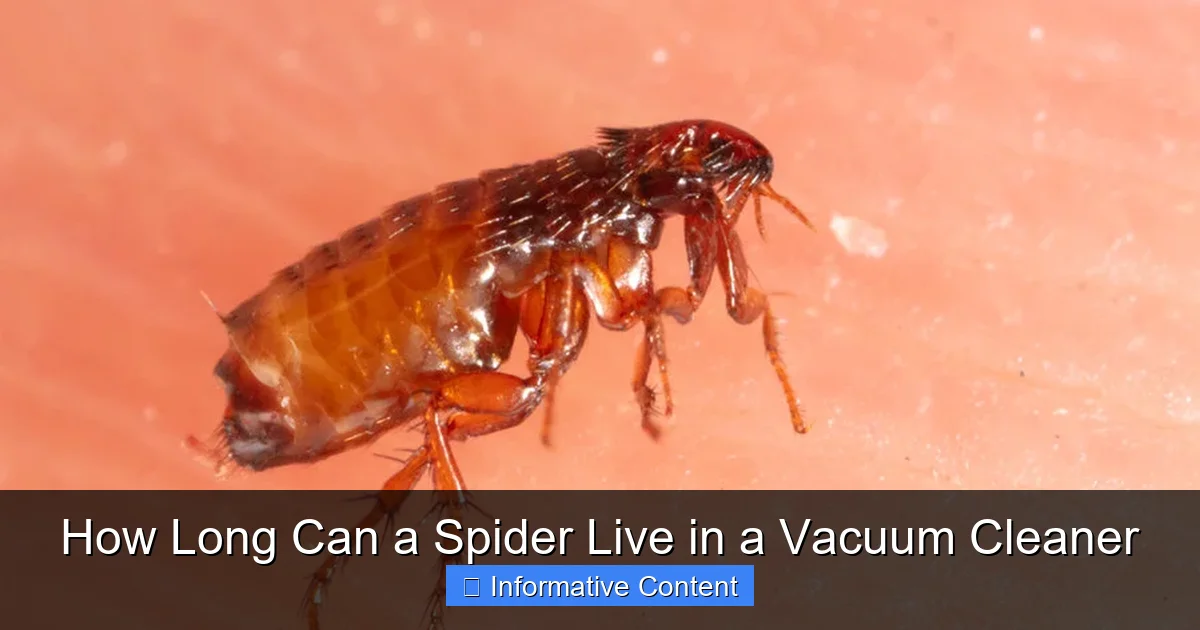
Sucked into a vacuum, a spider’s survival time is generally very short, often mere minutes to a few hours. Physical trauma from the violent suction, desiccation from dry air, and lack of food and water quickly create a lethal environment. While incredibly rare, a very robust spider might, under ideal debris-rich conditions, last a day or two, but ultimately, the vacuum cleaner is an effective death trap.
Have you ever seen a spider skittering across your floor, quickly grabbed your vacuum cleaner, and watched as the little creature disappeared into the nozzle with a satisfying whoosh? It’s a common scene in many households, often followed by a lingering question: Did I actually get rid of it, or is it just waiting in there, planning its escape? The thought of a spider surviving its trip through the vacuum, only to crawl back out later, can be unsettling, to say the least.
This common fear leads us to a fascinating and often-asked question: “How long can a spider live in a vacuum cleaner?” It’s a question that blends our natural aversion to these eight-legged house guests with a curiosity about their resilience. While spiders are known for their ability to adapt and survive in various environments, a vacuum cleaner presents a uniquely challenging set of circumstances that even the toughest arachnid would struggle to overcome.
So, let’s dive deep into the dusty, confined world inside your vacuum cleaner and explore the science behind what happens to a spider once it’s sucked up. We’ll uncover the many dangers they face, compare different types of vacuums, and ultimately, give you a clearer picture of just how long, or rather, how *short* a spider’s life is after encountering your trusty cleaning machine.
Key Takeaways
- Very Short Survival Time: Most spiders die within minutes to a few hours of being vacuumed due to a combination of physical trauma, desiccation, and starvation.
- Hostile Environment: The vacuum cleaner is an extremely inhospitable place, lacking food, water, and stable conditions, while inflicting continuous physical stress.
- Physical Trauma is Key: The sheer force of suction, repeated impacts against vacuum components, and abrasive dust particles are primary causes of death.
- Bagless Vacuums Are Often More Lethal: The cyclonic action and direct impact with hard surfaces in bagless vacuums can be more damaging than the relatively softer landing in a debris-filled vacuum bag.
- Factors Influencing Survival: A spider’s size, species, health, the amount of cushioning debris in the vacuum, and the vacuum’s power all play a role in its brief survival window.
- No Escape: Even if a spider survives the initial ordeal, it’s trapped within the vacuum’s confines, unable to find food, water, or a way out.
- Peace of Mind: Vacuum cleaners are highly effective at eliminating spiders from your home, offering significant peace of mind that they won’t return from the machine.
Quick Answers to Common Questions
Can a spider really survive being vacuumed?
While extremely rare, a very robust spider might survive the initial suction and impact for a short period, but the vacuum cleaner’s environment quickly becomes lethal due to dehydration, starvation, and ongoing physical trauma.
How quickly do spiders die in a vacuum?
Most spiders die within minutes to a few hours of being vacuumed. The combination of intense physical battering, rapid desiccation, and lack of sustenance ensures a swift end.
What kills spiders in a vacuum cleaner?
The primary killers are physical trauma (being battered by impacts and debris), rapid dehydration due to constant airflow, and eventual starvation from the complete lack of food and water.
Do spiders ever crawl out of the vacuum?
It is exceptionally unlikely for a spider to crawl out of a vacuum cleaner. Even if it survives the initial trauma, it’s trapped, disoriented, dehydrated, and weak, making escape virtually impossible.
Is a bagged or bagless vacuum better for killing spiders?
Both types are highly effective at killing spiders. Bagless vacuums with cyclonic action may cause more immediate physical trauma due to constant tumbling, while bagged vacuums offer a slightly softer initial landing but still present the same lethal conditions.
📑 Table of Contents
- The Vacuum Cleaner: A Surprisingly Hostile Environment
- Spider Resilience: What Makes Them Tough (and Not So Tough)
- Bagged vs. Bagless Vacuums: Does It Make a Difference?
- Factors Influencing How Long a Spider Can Live in a Vacuum Cleaner
- The Verdict: What’s the Real Survival Time?
- Ensuring Spider Demise: Tips and Best Practices
- Conclusion
The Vacuum Cleaner: A Surprisingly Hostile Environment
When a spider gets sucked into a vacuum cleaner, it’s not embarking on a gentle ride. Instead, it’s flung into an incredibly violent and hostile environment designed to remove dirt and debris, not preserve life. This journey is fraught with peril from start to finish.
The Initial Impact and Physical Trauma
The very first moments are the most critical. The spider experiences extreme suction force, accelerating rapidly through the narrow nozzle and hose. This alone can cause significant blunt force trauma. Once inside the main canister or bag, it’s not a soft landing. Spiders are typically slammed against hard plastic walls, internal filters, or other collected debris. In a bagless vacuum, the cyclonic action can repeatedly tumble and batter the spider, grinding it against accumulated dust and dirt. Think of it like being caught in a miniature, high-speed tornado filled with abrasive particles. The delicate structure of a spider, despite its exoskeleton, is simply not built to withstand such intense and prolonged physical assault. Its legs can be torn off, its body crushed, and its internal organs ruptured.
Desiccation and Dehydration
One of the most overlooked, yet deadly, factors for a spider in a vacuum is desiccation. Vacuum cleaners constantly pull in and expel air. This creates a very dry, windy environment inside the canister or bag. Spiders, like all living creatures, need water to survive. They lose water through their spiracles (breathing holes) and cuticle. In the constant airflow of a vacuum, this water loss is greatly accelerated. Without access to moisture, a spider will quickly dehydrate. Imagine being in a relentless sandstorm without water – that’s essentially what it’s like for a spider in a vacuum. This process alone can be fatal within hours, sometimes even faster for smaller species.
Starvation and Lack of Resources
Even if a spider miraculously survives the physical trauma and dehydration for a short period, it faces an insurmountable challenge: starvation. A vacuum cleaner is an environment utterly devoid of food. Spiders are predators; they need to hunt insects to survive. Inside a vacuum, there are no flies, no gnats, and certainly no other spiders to prey upon. There’s also no readily available water source. This complete lack of sustenance means that even the most resilient spider will eventually succumb to starvation and thirst. For most spiders, their metabolic rate allows them to survive for some time without food, but the combined stressors of trauma and dehydration drastically shorten this window.
Chemical Exposure
While less common, some vacuum cleaners might retain traces of cleaning chemicals or air fresheners from previous uses, or the dust itself might contain irritants. While not a primary killer, these substances could add to the hostile environment, potentially causing further stress or harm to a spider already fighting for its life.
Spider Resilience: What Makes Them Tough (and Not So Tough)
Visual guide about How Long Can a Spider Live in a Vacuum Cleaner
Image source: be.fresh.com.eg
Spiders are incredible creatures, known for their adaptability and ability to survive in harsh conditions. But even their natural resilience has its limits.
Metabolic Rate and Torpor
Many spiders have relatively low metabolic rates, meaning they don’t need a lot of food to survive for extended periods. Some species can even enter a state of torpor or dormancy, similar to hibernation, to conserve energy when resources are scarce. This allows them to survive weeks or even months without food in certain natural environments. However, the vacuum cleaner environment is anything but natural. The constant physical disturbance and rapid dehydration prevent them from entering a truly calm, energy-saving state. The high-stress environment forces their metabolism to work harder, accelerating resource depletion.
Exoskeletons and Vulnerability
Spiders are invertebrates, meaning they lack an internal skeleton. Instead, they have an exoskeleton – a hard outer shell that provides support and protection. While this exoskeleton offers some defense against predators and minor impacts, it’s not designed for the sustained, high-impact forces inside a vacuum cleaner. A strong enough impact can crack or rupture the exoskeleton, leading to immediate death or fatal internal injuries. The joints and softer parts of their body are particularly vulnerable.
Size Matters
The size of the spider can play a small role in its immediate fate. A very small spider might be more susceptible to dehydration and physical trauma due to its delicate structure. A larger, more robust spider might theoretically withstand initial impacts slightly better, but it will still face the same insurmountable challenges of starvation, dehydration, and continuous physical battering. Ultimately, neither size offers a true advantage for long-term survival in this specific scenario.
Bagged vs. Bagless Vacuums: Does It Make a Difference?
The design of your vacuum cleaner can slightly alter the spider’s journey and immediate fate, but the end result is almost always the same.
The Cyclone Effect in Bagless Systems
Bagless vacuum cleaners often rely on cyclonic technology to separate dirt and debris from the airflow. This involves a swirling vortex of air and particles within a clear collection bin. For a spider, this means a continuous, violent tumble. It’s repeatedly slammed against the hard plastic walls of the canister and bombarded by dust, dirt, and other debris. The cyclonic action is incredibly efficient at breaking down and compacting material, which is highly detrimental to any living organism. The constant motion and abrasion make survival beyond minutes very difficult. The transparent bin also offers no hiding place, exposing the spider to further damage as it’s tumbled.
The Debris Pillow in Bagged Vacuums
In a bagged vacuum, the spider’s journey might be slightly less violent after the initial impact. Once it lands in the dust bag, it might settle amongst a “pillow” of accumulated dirt and debris. This loose material could potentially cushion some of the subsequent impacts from other incoming particles. However, this is a minor difference. The bag still experiences significant airflow, leading to rapid desiccation. The spider is still trapped without food or water, and the environment remains hostile. While the immediate trauma might be marginally reduced compared to the cyclonic action, the other lethal factors remain unchanged. So, while a bagged vacuum might offer a fraction of a percent higher chance of surviving the *initial* impact, it doesn’t extend the overall survival time significantly in the long run.
Factors Influencing How Long a Spider Can Live in a Vacuum Cleaner
While the odds are heavily stacked against them, a few variables can slightly influence the incredibly short timeframe a spider might endure. Understanding these factors helps paint a clearer picture of how long can a spider live in a vacuum cleaner.
Spider Species and Health
Some spider species are inherently more robust than others. Larger, hardier spiders with thicker exoskeletons (like certain tarantulas, though you’re unlikely to vacuum one up!) might theoretically withstand initial impacts better than delicate, small house spiders. A healthy, well-fed spider might also have slightly more reserves to draw upon than a weak or elderly one. However, this offers only a marginal advantage in such an extreme environment. The vacuum cleaner’s environment is so overwhelmingly hostile that species-specific resilience provides little reprieve.
The Amount of Debris and Dust
As mentioned, a vacuum bag already full of debris might offer a slight cushioning effect for an incoming spider. Similarly, if the spider is vacuumed up along with a large clump of dust bunnies, pet hair, or other soft material, this ‘clump’ could temporarily shield it from some of the immediate physical trauma. This isn’t a long-term solution, but it might mean the difference between instantaneous death and surviving for a few minutes longer. In a bagless vacuum, however, this debris often becomes part of the abrasive, cyclonic storm, making things worse.
Vacuum Cleaner Power and Design
A powerful vacuum with high suction will naturally exert more force on the spider, increasing the likelihood of immediate fatal trauma. The design of the internal components – sharp corners, tight turns, fan blades – can also contribute to the physical destruction of the spider. A very old, weak vacuum might give a spider a slightly gentler ride, but again, the fundamental issues of desiccation and starvation persist.
Emptying Frequency
This factor is more about ensuring the spider’s demise than its survival time. If you vacuum a spider and then immediately empty the vacuum cleaner outside, you’ve removed it from the machine. However, if you leave the spider in the vacuum for days or weeks, it will certainly be dead long before you get around to emptying it. The longer the spider remains inside the active vacuum cleaner environment, the more certainty there is of its demise.
The Verdict: What’s the Real Survival Time?
Considering all the factors, let’s get to the crux of the matter: how long can a spider live in a vacuum cleaner?
Minutes to Hours: The Most Common Scenario
For the vast majority of spiders, the answer is *minutes*. The combination of extreme physical trauma (being battered by impacts and other debris), rapid dehydration from constant airflow, and the sheer lack of food or water quickly leads to their demise. Smaller, more delicate spiders, or those caught in powerful, cyclonic vacuums, will likely be killed instantly or within a few minutes. Even for sturdier spiders, surviving beyond an hour is highly improbable given the relentless nature of the vacuum’s internal environment. The question of how long can a spider live in a vacuum cleaner quickly becomes a question of how short.
A Day or Two: Rare, Optimal Conditions
Could a spider survive for a day or two? This is exceedingly rare and would require a perfect storm of unlikely circumstances. It would need to be a relatively large, robust spider (perhaps a wolf spider or a common house spider in peak health), vacuumed into a very full, *bagged* vacuum where it could land softly among a cushioning pile of debris. Even then, it would still be battling severe dehydration and eventual starvation. Without water, even the toughest spider won’t last long, and the constant airflow makes finding moisture impossible. So, while technically possible for a very short period in ideal (for the spider) vacuum conditions, it’s not something you should realistically worry about.
Beyond Two Days? Highly Unlikely
The idea of a spider surviving beyond 48 hours in a vacuum cleaner is effectively a myth. The environmental stressors are simply too great. Without food or water, and under constant threat of physical trauma and desiccation, no spider species can maintain life in such conditions for an extended period. The question of how long can a spider live in a vacuum cleaner almost always has a short, definitive answer: not long at all.
Ensuring Spider Demise: Tips and Best Practices
If you’re among those who want absolute certainty that the spider you vacuumed won’t be returning, here are a few practical tips.
Empty Your Vacuum Regularly
This is probably the most effective way to ensure any vacuumed spiders are truly gone. By emptying the contents of your vacuum (especially bagless canisters) into an outdoor trash can, you remove the spider from your home and its confined death trap. Even if by some incredible chance it was still alive, releasing it outdoors ensures it can’t crawl back into your house. If you have a bagged vacuum, simply remove the bag, seal it, and dispose of it. The constant presence of a “live” environment, even a hostile one, for how long can a spider live in a vacuum cleaner, is entirely negated by removing the contents.
Consider a Bagged Vacuum for Peace of Mind
While both types of vacuums are effective, some people feel more secure with a bagged vacuum. The idea of sealing the spider away in a bag and disposing of it immediately can offer greater peace of mind than seeing it tumble in a clear canister. The bag also physically traps the spider and its remains, preventing any theoretical escape or lingering presence.
The Humane (or More Certain) Alternative
If you’re particularly concerned about animal welfare, or simply want 100% certainty without even a theoretical “how long can a spider live in a vacuum cleaner” question, consider using a humane spider catcher. These devices allow you to gently capture a spider and release it outdoors without harm to either the spider or your peace of mind. For those wanting guaranteed demise without vacuuming, a quick stomp or spray of an insect killer provides immediate results, though it’s less tidy.
Conclusion
The question of “how long can a spider live in a vacuum cleaner” is a natural one, born from a mix of curiosity and perhaps a little bit of arachnophobia. However, the science is clear: a vacuum cleaner is an extremely hostile and lethal environment for spiders. Between the initial violent impact, the rapid dehydration from constant airflow, and the complete lack of food and water, a spider’s survival time is typically measured in minutes, or at best, a few hours.
While a truly extraordinary set of circumstances might allow a particularly robust spider to cling to life for a day or two in a very specific type of vacuum, this is an incredibly rare exception rather than the rule. For all practical purposes, when you vacuum up a spider, you can rest assured that it won’t be crawling out to surprise you later. Your vacuum cleaner is an effective and efficient tool for removing these unwanted guests from your home, offering you true peace of mind.
Frequently Asked Questions
What if I just vacuumed a big spider?
Even a big spider will face the same deadly conditions inside a vacuum cleaner. Its larger size might offer a marginal, temporary resistance to initial impacts, but it will still succumb to dehydration, starvation, and repeated trauma within a short period.
Can spiders lay eggs in a vacuum cleaner?
It is extremely improbable for a spider to lay eggs in a vacuum cleaner. Spiders require a stable, safe, and usually concealed environment for egg-laying, none of which exist inside a constantly moving, dry, and turbulent vacuum.
How long until a spider starves in a vacuum?
While spiders can survive without food for weeks or months in natural conditions, the harsh, dehydrating environment of a vacuum cleaner drastically shortens this. They will die from a combination of trauma and dehydration long before starvation becomes the primary cause, usually within hours.
Does vacuuming kill spider webs?
Yes, vacuuming is highly effective at removing and destroying spider webs. The suction force easily pulls the delicate silk into the vacuum, effectively eliminating the web and any associated egg sacs or spiders.
Should I empty my vacuum immediately after vacuuming a spider?
While not strictly necessary for the spider’s demise (it will likely be dead quickly anyway), emptying your vacuum immediately into an outdoor trash can offers extra peace of mind and prevents any theoretical, though highly unlikely, chance of escape.
Are there any spiders immune to vacuuming?
No, there are no spider species immune to the effects of a vacuum cleaner. The combination of intense physical trauma, rapid dehydration, and lack of resources is universally lethal to all spiders, regardless of species or size.