
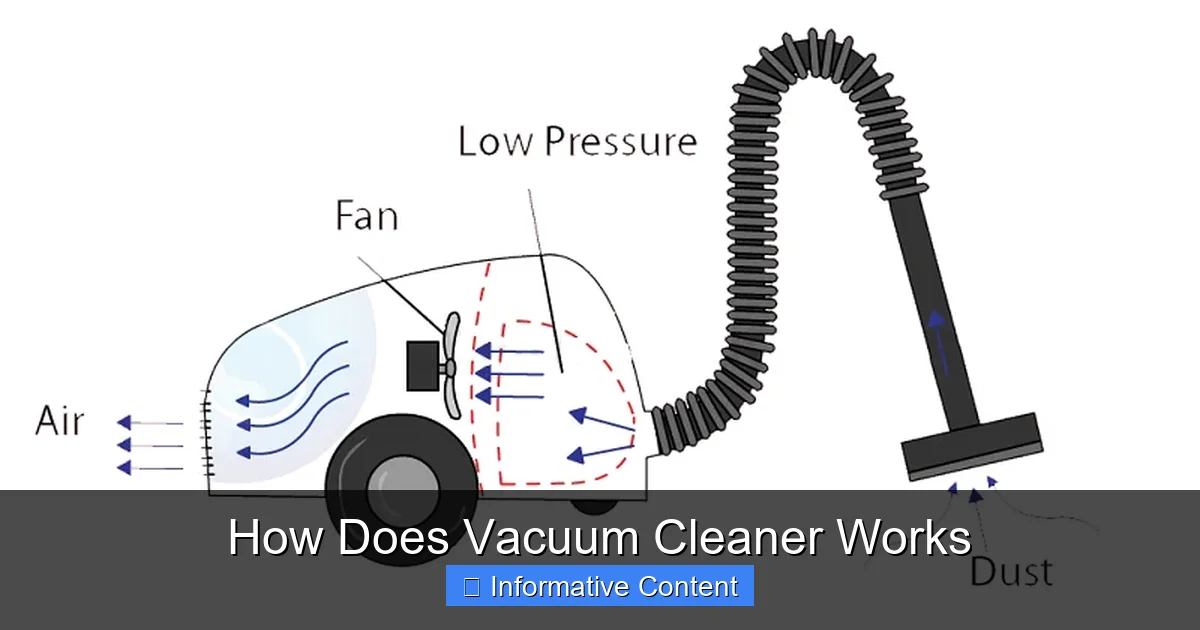
A vacuum cleaner operates by creating a pressure difference: a powerful motor spins a fan, pushing air out of the cleaner and forming a partial vacuum inside. External atmospheric pressure then forces air, along with dirt and debris, into the machine. This air is filtered, trapping particles, before clean air is expelled, leaving your surfaces spotless and your home cleaner.
There’s something incredibly satisfying about watching a vacuum cleaner suck up dust, crumbs, and pet hair with seemingly effortless power. It’s one of those household appliances we often take for granted, a humble workhorse that keeps our living spaces tidy. But have you ever stopped to ponder the science behind this everyday marvel? How does vacuum cleaner works, really?
It’s not magic, nor is it a complex alien technology hidden within its plastic casing. The secret lies in a brilliant application of basic physics, specifically involving air pressure. Understanding how your vacuum functions not only satisfies curiosity but also empowers you to choose the right model for your needs and maintain it for peak performance. So, let’s peel back the layers and discover the fascinating journey of dust from your floor to the vacuum’s collection bin.
From the hum of the motor to the whirring of the brushes, every part plays a crucial role in creating that powerful suction. We’ll delve into each component, explain its contribution, and explore how various vacuum cleaner types adapt this fundamental principle to tackle different cleaning challenges. Get ready to have your perspective on this mundane appliance completely transformed!
Key Takeaways
- The Core Principle: Vacuum cleaners function by creating a low-pressure area (a partial vacuum) inside the machine, causing higher atmospheric pressure from outside to push air, dust, and debris into the cleaner.
- Motor and Fan: These two components are the heart of the vacuum, with the motor spinning the fan at high speeds to displace air and create the necessary pressure differential.
- Airflow Path: Dirt-laden air enters through the nozzle, travels through the hose and collection chamber, passes through filters, and then clean air is exhausted.
- Filtration System: Essential for trapping dust, allergens, and other microscopic particles, ensuring that only clean air is released back into your environment. Different types of filters (e.g., HEPA) offer varying levels of efficiency.
- Dust Collection Methods: Vacuums typically use either disposable bags or bagless cyclonic systems to collect debris, each with its own advantages for convenience and filtration.
- Beyond Suction: Many modern vacuum cleaners incorporate additional features like rotating brush rolls to agitate carpets and loosen embedded dirt, enhancing cleaning effectiveness.
- Maintenance Matters: Regular cleaning or replacement of filters, emptying the dust bin, and checking for clogs are crucial steps to maintain optimal suction power and extend the life of your appliance.
Quick Answers to Common Questions
What is the primary principle behind how a vacuum cleaner works?
The primary principle is creating a pressure difference. A vacuum cleaner uses a fan to push air out, creating a low-pressure area inside. The higher atmospheric pressure outside then pushes air, along with dirt, into the vacuum.
How does a vacuum cleaner separate dirt from the air?
Vacuum cleaners separate dirt from air using a filtration system and/or cyclonic separation. Filters trap particles as air passes through, while cyclonic action spins air rapidly to force heavier dirt particles into a collection bin.
What’s the main difference between bagged and bagless vacuum cleaners?
The main difference lies in their dust collection method. Bagged vacuums use disposable bags that act as a filter, while bagless vacuums use a reusable dirt cup or bin that typically employs cyclonic technology to separate debris.
Can a vacuum cleaner work in outer space?
No, a standard vacuum cleaner cannot work effectively in outer space. Its operation relies on the presence of atmospheric pressure to push dirt into the low-pressure area it creates, and outer space is a near-perfect vacuum itself, lacking external atmospheric pressure.
Why does my vacuum cleaner lose suction?
A vacuum cleaner can lose suction for several reasons, including a full dust bag or bin, clogged filters, blockages in the hose or nozzle, or issues with the brush roll or drive belt, all of which impede proper airflow.
📑 Table of Contents
The Core Principle: Creating a Pressure Difference
At its heart, the way a vacuum cleaner works isn’t about “sucking” in the traditional sense, but rather about “pushing.” This might sound counterintuitive, but it’s a fundamental concept in fluid dynamics. A vacuum cleaner doesn’t pull dirt into itself; instead, it creates a low-pressure environment inside its body. The higher atmospheric pressure outside the vacuum then pushes air, along with any loose debris, into the machine.
Think of it like sipping a drink through a straw. You’re not “sucking” the liquid up. What you’re actually doing is reducing the air pressure inside the straw by drawing air out. The greater atmospheric pressure on the surface of the liquid then pushes the drink up the straw and into your mouth. A vacuum cleaner operates on a much grander scale, but the principle remains exactly the same.
The Role of the Fan and Motor
The entire process begins with the vacuum cleaner’s motor and fan. These are the unsung heroes, the real powerhouses behind that satisfying whoosh. The motor is an electric motor, typically powered by mains electricity or a battery in cordless models. When you flick the switch, the motor springs to life, spinning a fan (often called an impeller) at an incredibly high speed – thousands of revolutions per minute.
Directing the Airflow
The fan is specially designed with blades that are angled to force air in one direction. As these blades spin, they vigorously push air out of the vacuum cleaner’s exhaust port. By rapidly expelling air from within its sealed chamber, the vacuum cleaner effectively reduces the air density, and consequently, the air pressure inside the machine. This creates the “partial vacuum” – an area of lower pressure relative to the air outside.
This pressure differential is the key. The greater the difference in pressure between the inside of the vacuum and the room air, the stronger the force pushing air (and dirt!) into the cleaner’s nozzle. This ingenious use of a simple fan and motor is precisely how a vacuum cleaner works to lift dirt off your floors.
Components Working Together: What’s Inside?
While the motor and fan provide the core suction, a vacuum cleaner is a carefully engineered system of interconnected parts, each contributing to its overall effectiveness. Understanding these components helps demystify how a vacuum cleaner works from start to finish.
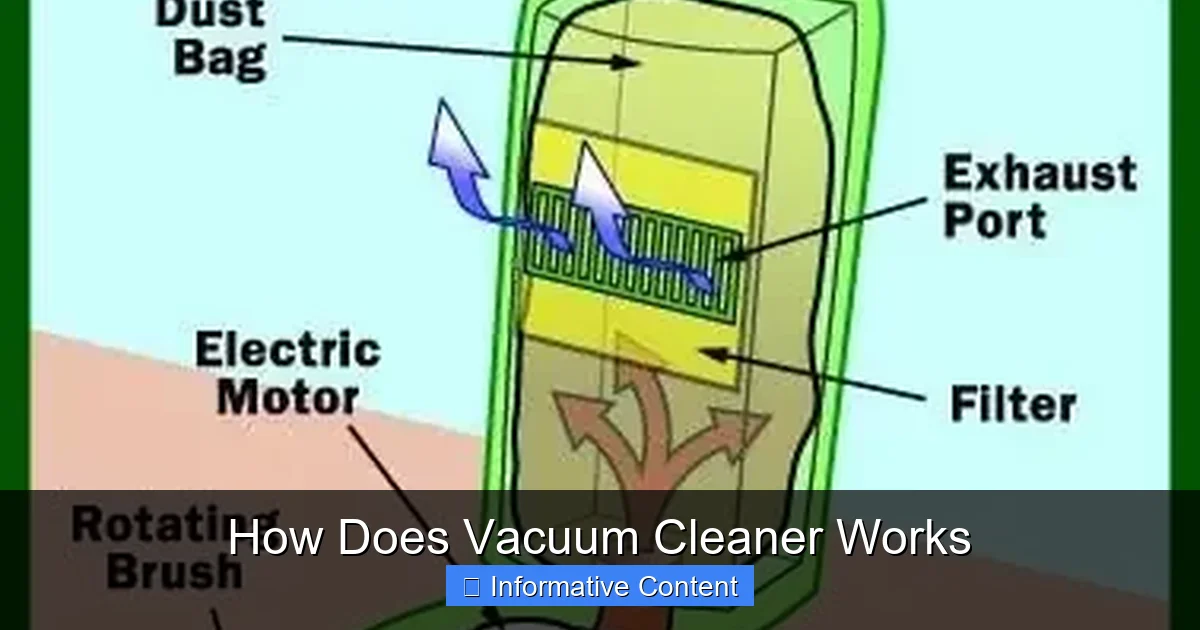
Visual guide about How Does Vacuum Cleaner Works
Image source: familygoody.com
The Motor and Fan: The Heartbeat
As discussed, the electric motor drives the fan. The type and power of the motor directly influence the strength of the suction. Modern motors are designed for efficiency and durability, providing consistent performance. The fan, or impeller, is precisely balanced to spin without excessive vibration, creating a smooth, powerful airflow.
The Filtration System: Trapping the Dust
Once the air, laden with dust and debris, enters the vacuum, it needs to be cleaned before being expelled back into the room. This is where the filtration system comes into play. Filters are crucial for trapping microscopic particles, preventing them from recirculating into your home’s air.
- Pre-Motor Filters: These are often the first line of defense, designed to capture larger particles and protect the motor from damage. They are typically washable or replaceable.
- Post-Motor Filters: Located after the motor, these filters clean the air before it exits the vacuum. Many vacuums feature advanced filters here.
- HEPA Filters: High-Efficiency Particulate Air (HEPA) filters are a gold standard. They are designed to capture at least 99.97% of airborne particles 0.3 micrometers in diameter. This includes pollen, pet dander, dust mites, and smoke particles, making them excellent for allergy sufferers.
Without an effective filtration system, a vacuum cleaner would simply redistribute fine dust and allergens, making the air quality worse rather than better.
The Dust Collection System: Bagged vs. Bagless
After filtration, the collected dirt and debris need a place to go. Vacuum cleaners primarily use one of two collection systems:
- Bagged Vacuums: These traditional systems use a disposable bag to collect dust. The bag itself acts as an additional filter, trapping particles as air passes through. When the bag is full, you simply remove and discard it, minimizing contact with dust.
- Bagless (Cyclonic) Vacuums: These systems use a reusable dirt cup or bin. Instead of a bag, they employ cyclonic technology. As air enters the dirt cup, it’s spun rapidly in a vortex. Centrifugal force separates heavier dirt and debris from the air, flinging them against the walls of the bin and letting them fall to the bottom. The cleaner air then passes through filters before being exhausted. Bagless vacuums offer the convenience of not needing to buy replacement bags and allow you to see how much dirt you’ve collected.
The Hose and Attachments: Reaching Every Corner
The flexible hose and various attachments are essential for directing the suction to different surfaces and hard-to-reach areas. The nozzle is where the primary interaction with the cleaning surface occurs. Different attachments – like crevice tools for tight spaces, upholstery tools for furniture, or dusting brushes – allow the vacuum to adapt its cleaning power to diverse situations. Some nozzles also feature a rotating brush roll, especially for carpets, which agitates the fibers to loosen embedded dirt before the suction lifts it away.
The Suction Process: Step-by-Step
Let’s walk through the entire process, illustrating precisely how a vacuum cleaner works from the moment you switch it on to the clean air being expelled.
Step 1: The Motor Powers Up
You press the power button, and electricity flows to the motor. The motor instantly springs into action, typically running at speeds upwards of 20,000 RPM (revolutions per minute).
Step 2: Air is Pushed Out
Attached to the motor shaft, the fan (impeller) begins to spin rapidly. Its precisely angled blades grab the air inside the vacuum’s sealed internal chamber and forcefully push it towards the exhaust port. This creates a powerful outward airflow.
Step 3: A Partial Vacuum Forms
As air is constantly pushed out of the machine’s exhaust, the amount of air inside the vacuum cleaner’s main body (specifically the area between the nozzle and the fan) decreases significantly. This reduction in air volume and density results in a corresponding drop in air pressure, creating a partial vacuum.
Step 4: Atmospheric Pressure Pushes Dirt In
Now for the critical part. The air pressure outside the vacuum cleaner – the normal atmospheric pressure in your room – is much higher than the pressure inside the vacuum’s nozzle. Nature abhors a vacuum, so it tries to equalize this pressure difference. The higher external pressure pushes air (and any dirt, dust, pet hair, or crumbs in its path) into the vacuum cleaner’s nozzle, through the hose, and into the collection chamber.
Step 5: Filtration and Collection
Once inside, the dirt-laden air passes through the collection system. In bagged vacuums, the dirt is trapped by the bag’s filter material. In bagless cyclonic systems, the air spins rapidly, separating dirt into the collection bin. After the solid debris is removed, the remaining air continues its journey through the various filters (pre-motor, post-motor, HEPA, etc.) to capture fine particles and allergens. Finally, clean, filtered air is expelled back into the room through the exhaust port, completing the cycle.
This continuous cycle of creating low pressure, allowing atmospheric pressure to push dirty air in, and then filtering and expelling clean air is exactly how a vacuum cleaner works to achieve spotless results.
Types of Vacuum Cleaners and Their Mechanics
While the fundamental principle of creating a pressure differential remains consistent, vacuum cleaners come in various shapes and sizes, each designed to optimize performance for specific cleaning tasks. Let’s explore how the core mechanism is applied across different types.
Upright Vacuums
These are perhaps the most common type, recognized by their tall, standalone design. They house the motor, fan, and collection system within a single unit, which is pushed across the floor. Uprights often feature a rotating brush roll (also called a beater bar) in the head, especially beneficial for carpets. This brush agitates carpet fibers, loosening embedded dirt, which the suction then lifts away. The air path is usually shorter, offering robust suction directly at the floor level.
Canister Vacuums
Canister vacuums separate the motor and collection unit (the “canister”) from the cleaning head. The canister rolls on wheels, and a flexible hose connects it to a wand and cleaning nozzle. This design offers greater maneuverability, making it easier to clean under furniture, stairs, and delicate surfaces with various attachments. The separation allows for a larger motor and dustbin in the canister, while the lighter cleaning head reduces fatigue.
Handheld Vacuums
Compact and often cordless, handheld vacuums are designed for quick clean-ups, spills, and reaching tight spots. They use smaller motors and fans, resulting in less suction power than their larger counterparts, but their portability is unmatched. Their internal mechanics are a scaled-down version of a larger vacuum, focused on efficiency in a small package.
Robotic Vacuums
These autonomous cleaners are the epitome of convenience. They navigate your home using sensors and mapping technology, cleaning on a schedule. Robotic vacuums employ small, efficient motors and fans, combined with brushes (often side brushes to sweep debris into the path of the main brush) to pick up surface dirt. While their suction isn’t as powerful as full-sized vacuums, their consistent, frequent cleaning helps maintain cleanliness. They typically use bagless collection bins and multi-stage filtration.
Wet/Dry Vacuums (Shop Vacs)
Unlike standard household vacuums designed only for dry debris, wet/dry vacuums are built for tougher jobs, including liquid spills. They feature a more robust motor and a large collection tank. For wet pickup, a foam filter is often used instead of paper or cloth filters to prevent damage from moisture. The internal components are sealed to prevent electrical hazards from water, demonstrating a specialized application of the core suction principle.
Maintaining Your Vacuum for Optimal Performance
Understanding how does vacuum cleaner works is only half the battle; proper maintenance is crucial to ensure it continues to work effectively. A well-maintained vacuum cleaner will provide stronger suction, filter air better, and last longer.
Cleaning Filters Regularly
Filters are your vacuum’s lungs. Over time, they become clogged with fine dust and debris, restricting airflow. This directly reduces suction power because the fan struggles to push air out, making it harder to create that vital pressure differential. Check your vacuum’s manual for filter cleaning or replacement schedules. Many filters are washable, while others need to be replaced periodically.
Practical Tip: If your washable filter looks gray or black and you can’t easily see light through it, it’s definitely time for a wash!
Emptying the Dust Bin or Bag
A full dust bag or a maxed-out dirt bin significantly impedes airflow. Just like a clogged filter, a full collection system means less space for air to move, which in turn reduces suction power. Empty bagless bins after every use, or when the “full” line is reached. Replace bags when they are two-thirds to three-quarters full, rather than waiting until they are bursting.
Practical Tip: Don’t wait until your vacuum stops picking up before emptying it. Regular emptying prevents strain on the motor and maintains consistent suction.
Checking for Clogs
Clogs are notorious suction killers. Hoses, wands, and nozzles can become blocked by large pieces of debris like socks, toys, or excessive hair. If you notice a sudden drop in suction, a clog is often the culprit. Disconnect the hose and attachments and visually inspect them. You may need to use a broom handle or a long stick to dislodge stubborn blockages carefully.
Practical Tip: Always unplug your vacuum before checking for clogs to prevent accidental activation of rotating parts.
Inspecting Brushes and Belts
For upright vacuums or those with power nozzles, the brush roll is essential for agitating carpets. Hair, strings, and fibers can wrap around the brush, preventing it from spinning effectively. Regularly clean hair and debris from the brush roll. Also, check the drive belt that connects the motor to the brush roll. If it’s stretched, broken, or worn, the brush won’t spin, severely impacting carpet cleaning performance. Belts typically need replacement every 6-12 months, depending on usage.
Practical Tip: Use scissors or a seam ripper to carefully cut and remove tangled hair from the brush roll without damaging the bristles.
Conclusion
So, there you have it – the ingenious yet straightforward physics behind how a vacuum cleaner works. It’s not a mysterious force pulling dirt from your floors, but rather a clever manipulation of air pressure, orchestrated by a powerful motor and fan. This creates a low-pressure zone that allows the higher atmospheric pressure of your room to push dust and debris into the machine’s waiting maw.
From its humble beginnings, the vacuum cleaner has evolved into a diverse range of appliances, each tailored to specific cleaning needs, yet all relying on the same fundamental principle. Whether you’re using a traditional upright, a versatile canister, or a futuristic robotic cleaner, the underlying mechanism of creating a pressure differential remains constant.
The next time you hear that familiar hum and watch your floors transform from dusty to dazzling, take a moment to appreciate the simple brilliance at play. Understanding how does vacuum cleaner works not only makes you a more informed consumer but also empowers you to keep your trusty cleaning companion running efficiently, ensuring a cleaner, healthier home for years to come.
Frequently Asked Questions
Is a HEPA filter really better for allergies?
Yes, HEPA filters are significantly better for allergy sufferers. They are certified to capture at least 99.97% of airborne particles 0.3 micrometers in diameter, which includes common allergens like pollen, pet dander, dust mites, and mold spores, preventing them from being recirculated into the air you breathe.
How often should I clean or replace my vacuum filter?
The frequency depends on your vacuum model, usage, and whether you have pets or allergies. As a general rule, washable filters should be cleaned every 1-3 months, and replaceable filters should be changed every 6-12 months. Always check your vacuum’s manual for specific recommendations.
Why do some vacuums have rotating brush rolls, and are they necessary?
Rotating brush rolls (or beater bars) are common in upright and some canister vacuums, especially for carpet cleaning. They agitate carpet fibers to loosen embedded dirt, pet hair, and debris that suction alone might miss. While not strictly “necessary” for hard floors, they are highly effective for deep carpet cleaning.
Can I use a regular household vacuum cleaner to pick up wet spills?
No, you should never use a regular household vacuum cleaner for wet spills. Standard vacuums are designed only for dry materials, and attempting to vacuum liquids can damage the motor, electrical components, and pose a severe risk of electric shock. Only use vacuums specifically designed for wet/dry operation.
What is “airflow” (CFM) and why is it important in a vacuum?
Airflow, often measured in Cubic Feet per Minute (CFM), refers to the volume of air the vacuum cleaner moves. It’s a key indicator of a vacuum’s cleaning efficiency, especially for picking up larger debris or when cleaning surfaces like carpets. Higher CFM generally means faster and more effective cleaning, as more air is moved to carry dirt into the machine.
How does a robotic vacuum cleaner know where to go and avoid obstacles?
Robotic vacuum cleaners use an array of sensors, including infrared, ultrasonic, and sometimes laser sensors, to navigate. These sensors help them detect obstacles, drop-offs (like stairs), and walls. Advanced models also use cameras and mapping technology to build a layout of your home, allowing for more efficient cleaning paths and area recognition.