Have you ever watched an automatic vacuum cleaner effortlessly glide across your floor, sucking up dirt, and wondered just how it does it? These ingenious devices combine advanced navigation systems, powerful suction, and intelligent software to clean your home autonomously. From mapping your living space to avoiding obstacles and returning to charge, they leverage a fascinating array of sensors and algorithms to keep your floors spotless, freeing up your time for more important things.
How Does Automatic Vacuum Cleaner Work
Picture this: You’re out for the day, maybe at work or enjoying a coffee with friends. Meanwhile, back at your place, a silent, diligent helper is gliding across your floors, scooping up every crumb, every speck of dust, and every stray pet hair. By the time you get home, your floors are sparkling, and you haven’t lifted a finger. No, this isn’t a scene from a futuristic sci-fi movie; it’s the everyday reality for millions who own an automatic vacuum cleaner.
These little robotic marvels have truly revolutionized the way we think about home cleaning. They’ve moved from being niche gadgets to household staples, offering unparalleled convenience and efficiency. But have you ever stopped to wonder, “How on earth does an automatic vacuum cleaner actually work?” What intricate dance of technology allows it to navigate your home, avoid obstacles, clean effectively, and even find its way back to its charging dock? Well, you’re in for a treat because we’re about to pull back the curtain and explore the fascinating inner workings of these incredible cleaning machines.
Let’s dive deep into the world of robotic cleaners, breaking down the sophisticated systems and clever engineering that make an automatic vacuum cleaner so much more than just a moving dustbin. From its navigation brain to its powerful suction heart, we’ll uncover all the secrets. Get ready to understand the magic behind your favorite robot companion!
Key Takeaways
- Advanced Navigation: Automatic vacuum cleaners use sophisticated mapping technologies like LiDAR, cameras, and gyroscopes, combined with various sensors (cliff, obstacle, wall), to understand their environment and navigate efficiently.
- Effective Cleaning Mechanisms: They employ a combination of powerful suction motors, main brushes (bristle or rubber), and side brushes to effectively lift and capture dirt, dust, and debris from various floor types.
- Smart Power Management: These robots are powered by rechargeable batteries, often lithium-ion, and feature auto-docking technology, allowing them to return to their charging station automatically when power is low or cleaning is complete.
- Connectivity and Control: Many modern automatic vacuum cleaners offer Wi-Fi connectivity, enabling control via smartphone apps, voice assistants, and providing features like scheduling, zone cleaning, and real-time status updates.
- Specialized Features: High-end models include advanced capabilities such as mopping functions, automatic dirt disposal systems (self-emptying bins), precise object recognition, and multi-floor mapping for enhanced convenience.
- Maintenance is Key: Regular maintenance, including cleaning brushes, emptying dustbins, and wiping sensors, is crucial for ensuring the optimal performance and longevity of your automatic vacuum cleaner.
Quick Answers to Common Questions
How does an automatic vacuum cleaner navigate a room?
An automatic vacuum cleaner navigates using a combination of sensors (infrared, ultrasonic, bump) and mapping technologies like LiDAR or cameras, which allow it to build a digital map of your home and track its position within it.
Can an automatic vacuum cleaner fall down stairs?
No, modern automatic vacuum cleaners are equipped with cliff sensors (usually infrared) that detect drop-offs like stairs, causing the robot to turn away and avoid falling.
How does an automatic vacuum cleaner find its charging station?
When its battery is low or cleaning is complete, the automatic vacuum cleaner uses infrared beacons emitted by its charging dock and its internal navigation systems to locate and dock itself automatically for recharging.
Are automatic vacuum cleaners good for pet hair?
Yes, many automatic vacuum cleaners are specifically designed with powerful suction and specialized brushes (often rubber or silicone) to effectively pick up pet hair from both hard floors and carpets.
Do automatic vacuum cleaners work on all floor types?
Most automatic vacuum cleaners are versatile and work well on various floor types, including hardwood, tile, laminate, and low- to medium-pile carpets. Some models also include mopping functions for hard floors.
📑 Table of Contents
The Brains Behind the Bots: Navigation and Mapping
The ability of an automatic vacuum cleaner to move around your home without constant human intervention is perhaps its most impressive trick. This isn’t just random bumping; it’s a sophisticated interplay of sensors, software, and mapping technology, essentially giving the robot a “brain” to understand its surroundings.
Early Navigation: The “Bump-and-Go” Era
In the early days, robotic vacuums were a bit like bumper cars. They relied primarily on “bump sensors.” When the robot encountered an obstacle, it would register the impact, back up, turn a random angle, and continue moving. This method, while functional, wasn’t very efficient. It often missed spots and took a long time to cover an area, resembling a drunk bumblebee more than a strategic cleaner. While some basic models still use this, modern automatic vacuum cleaners have moved far beyond it.
Advanced Sensors for Smarter Movement
Today’s automatic vacuum cleaner uses a whole suite of sensors to perceive its environment:
- Infrared Cliff Sensors: These downward-facing sensors emit infrared light and measure the reflection. If no reflection is detected (meaning a drop-off like stairs), the robot knows to turn away, preventing a tumble.
- Bumper and Obstacle Sensors: While still having physical bumpers, many robots also use infrared or ultrasonic sensors to detect objects before making contact. This allows for softer approaches and better obstacle avoidance, protecting both the robot and your furniture.
- Wall-Following Sensors: These specialized infrared sensors help the robot detect walls and follow them closely, ensuring thorough cleaning along edges and in corners.
- Wheel Speed Sensors: By monitoring the rotation of its wheels, the robot can track how far it has traveled and in what direction, contributing to its internal mapping and localization.
Mapping Technologies: Giving the Robot a “Map” of Your Home
True intelligence in an automatic vacuum cleaner comes from its ability to map your home. This allows for systematic cleaning patterns, efficient coverage, and advanced features:
- Simultaneous Localization and Mapping (SLAM): This is the fundamental algorithm that allows a robot to build a map of an unknown environment while simultaneously keeping track of its own location within that map. It’s like drawing a map and figuring out where you are on it at the same time.
- LiDAR (Light Detection and Ranging): Many high-end automatic vacuum cleaners feature a spinning turret on top that emits laser beams. By measuring the time it takes for these beams to bounce back, the robot creates a highly accurate, real-time 3D map of its surroundings. This is incredibly precise for navigation, even in low light.
- Cameras: Some robots use upward-facing cameras (vSLAM – visual SLAM) to take snapshots of the ceiling and surroundings, using unique features as reference points for navigation and mapping. Others use front-facing cameras for object recognition.
- Gyroscopes and Accelerometers: These internal sensors help the automatic vacuum cleaner maintain its orientation, detect changes in direction, and understand its own movement, further refining its location within the map.
Virtual Walls and No-Go Zones
Once a map is created, many advanced automatic vacuum cleaners allow you to set “virtual walls” or “no-go zones” within the app. This is incredibly practical. For instance, you can tell your robot to avoid a specific area with delicate items, a pet’s food bowls, or a messy play area without physically blocking it. The robot simply knows, via its internal map, not to cross that invisible line.
The Heart of the Clean: Suction and Brushing Mechanisms
Navigation is crucial for an automatic vacuum cleaner, but the primary job is, of course, cleaning! This involves a powerful combination of suction, brushes, and filtration.
Visual guide about How Does Automatic Vacuum Cleaner Work
Image source: mozaweb.com
The Vacuum Motor and Suction Power
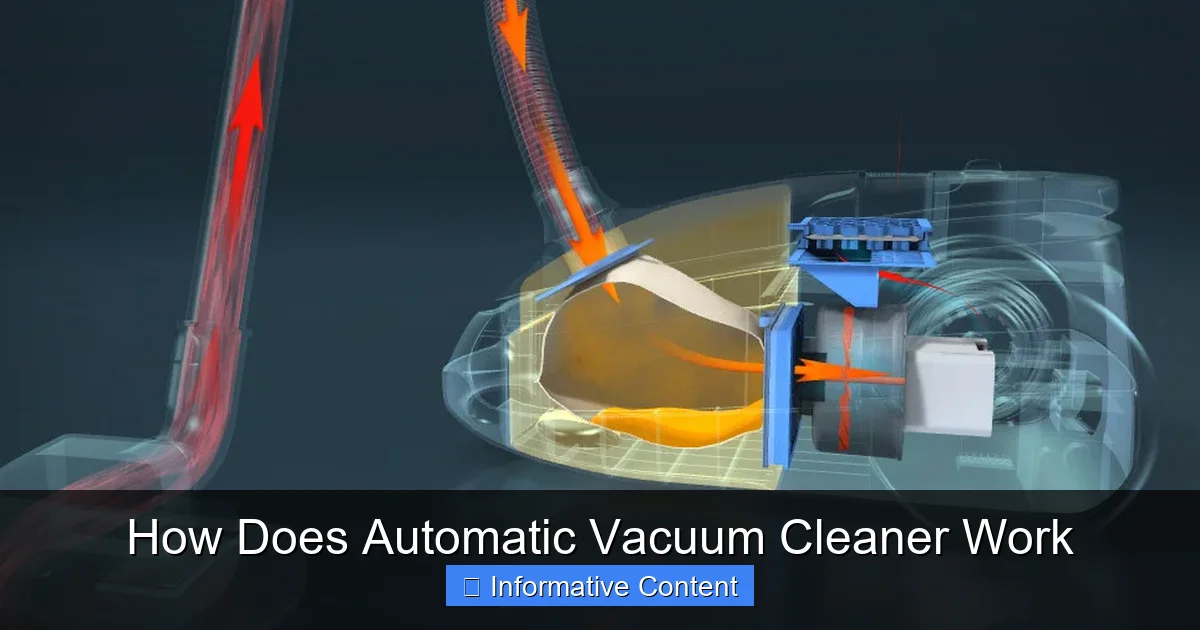
At the core of any vacuum, robotic or traditional, is the motor that generates suction. Modern automatic vacuum cleaners use compact yet powerful motors that create a strong airflow to lift dirt and debris from your floors. Manufacturers often specify suction power in Pascals (Pa), with higher numbers indicating stronger suction. This power is essential for picking up everything from fine dust to larger crumbs and pet hair.
Main Brushes: The Workhorses
Most automatic vacuum cleaners feature one or two main brushes located underneath the unit, directly in the path of suction. These brushes serve several critical functions:
- Agitation: The brushes spin rapidly, agitating carpets and dislodging dirt embedded deep within the fibers. On hard floors, they sweep debris into the suction path.
- Collection: As they spin, the brushes help to scoop up larger particles and direct them towards the vacuum inlet.
- Types of Brushes:
- Bristle Brushes: Traditional brushes with bristles, effective on both carpets and hard floors, but can sometimes tangle with hair.
- Rubber/Silicone Brushes: Often found in pairs, these “tangle-free” brushes are excellent at picking up pet hair and are easier to clean. They’re also very effective on hard floors.
Side Brushes for Edges and Corners
You’ll notice most automatic vacuum cleaners have one or two small, spinning brushes extending from their sides. These are called side brushes or edge-sweeping brushes. Their purpose is simple yet vital: to sweep dirt, dust, and debris from along walls, baseboards, and out of corners, directing it into the main cleaning path where the powerful suction and main brushes can take over. Without them, those tricky edges would remain untouched.
Filtration Systems: Trapping Allergens and Dust
Once the dirt is sucked up, it needs to be contained. Automatic vacuum cleaners use filtration systems to prevent dust and allergens from being expelled back into the air. Most come with:
- Mesh Pre-filters: To catch larger debris before it reaches finer filters.
- Foam Filters: Provide an additional layer of filtration.
- HEPA-style Filters: High-Efficiency Particulate Air (HEPA) filters are particularly good at trapping tiny particles like pet dander, pollen, and dust mites, making them ideal for allergy sufferers. Many robot vacuum filters are washable, which is a great convenience.
Powering the Progress: Batteries and Charging
For an automatic vacuum cleaner to be truly autonomous, it needs to manage its own power. This means having a reliable battery and the intelligence to recharge itself.
Types of Batteries
Almost all modern automatic vacuum cleaners use Lithium-ion (Li-ion) batteries. These batteries are preferred for several reasons:
- High Energy Density: They pack a lot of power into a relatively small and light package.
- No Memory Effect: Unlike older battery types, Li-ion batteries don’t “remember” partial charges, so you can charge them whenever without reducing their overall capacity over time.
- Long Lifespan: With proper care, Li-ion batteries can provide many years of service.
Battery capacity, measured in milliamp-hours (mAh), directly relates to the robot’s runtime. A larger mAh generally means longer cleaning sessions before needing a recharge.
Auto-Docking and Recharging
This is where the robot’s navigation prowess truly shines. When the battery level drops below a certain threshold, or when a cleaning cycle is complete, the automatic vacuum cleaner will automatically stop cleaning and initiate a search for its charging dock. Using infrared beacons emitted by the dock and its own internal sensors, the robot meticulously navigates itself back to the charging contacts. It’s a sophisticated “parking” maneuver that ensures the robot is always ready for its next cleaning task. This seamless process means you rarely have to intervene to plug it in.
Battery Life and Runtime
An average automatic vacuum cleaner can run for anywhere from 60 to 180 minutes on a single charge, depending on the model, battery capacity, and cleaning mode (e.g., max suction uses more power). If a robot runs low on power in the middle of a large cleaning job, many smart models will recharge and then resume cleaning exactly where they left off, ensuring your entire home gets covered.
The Connected Cleaner: Smart Features and Control
The “automatic” aspect of these cleaners goes beyond just moving around. Modern automatic vacuum cleaners are increasingly connected and smart, offering a wealth of features that enhance user experience and convenience.
Wi-Fi Connectivity and App Control
Most mid-range to high-end automatic vacuum cleaners come with Wi-Fi connectivity. This allows you to connect your robot to your home network and control it via a dedicated smartphone app. The app typically offers:
- Remote Control: Start, pause, or stop cleaning from anywhere in the world.
- Scheduling: Set specific times for your robot to clean, e.g., every weekday at 10 AM.
- Map Management: View the robot’s cleaning map, define specific rooms, create no-go zones, or send the robot to clean a particular spot (zone cleaning).
- Cleaning History: See where and when your robot has cleaned.
- Status Updates: Check battery level, dustbin status, and any error messages.
This level of control makes owning an automatic vacuum cleaner incredibly user-friendly and customizable to your lifestyle.
Voice Assistant Integration
Imagine telling your smart speaker, “Hey Google, tell the robot to start cleaning,” or “Alexa, vacuum the living room.” Many automatic vacuum cleaners integrate seamlessly with popular voice assistants like Amazon Alexa and Google Assistant. This hands-free control adds another layer of convenience, allowing you to initiate cleaning commands with just your voice.
Scheduling and Customization
Beyond basic scheduling, modern apps often allow for highly customizable cleaning routines. You can specify which rooms to clean, in what order, and even what suction power to use for different areas (e.g., higher suction for carpets, quieter mode for hard floors during certain hours). This level of personalization ensures your automatic vacuum cleaner cleans exactly how and when you want it to.
Software Updates
Just like your smartphone, many automatic vacuum cleaners receive over-the-air (OTA) software updates. These updates can introduce new features, improve navigation algorithms, enhance cleaning efficiency, or fix bugs, ensuring your robot gets smarter and more capable over time without needing a hardware upgrade.
Beyond Basic Cleaning: Specialized Features
As the automatic vacuum cleaner market has matured, manufacturers have introduced a host of specialized features to make these robots even more versatile and effective.
Mopping Functionality (2-in-1 Robots)
Many robots now offer a “2-in-1” or “hybrid” design, combining vacuuming with mopping capabilities. These models typically have a small water tank and an attachable microfiber pad. After vacuuming, the robot can dispense water onto the pad, gently wiping hard floors to remove fine dust and light stains. Some advanced models even offer vibrating mop pads or pressurized scrubbing for a deeper clean. It’s a fantastic way to tackle both dry and wet floor cleaning with one device.
Automatic Dirt Disposal (Self-Emptying Bins)
One of the biggest conveniences in recent years is the introduction of automatic dirt disposal stations. These larger charging docks have an integrated vacuum that automatically sucks the dirt from the robot’s dustbin into a larger, sealed bag within the dock. This means you only need to empty the main station bag every few weeks or even months, dramatically reducing how often you interact with the robot’s dusty interior. It’s a game-changer for cleanliness and convenience, especially for allergy sufferers.
Object Recognition and Avoidance
While basic robots can detect obstacles, advanced models use AI-powered cameras and processing to identify specific objects like shoes, cables, pet waste, or even socks. Instead of just bumping into them, these smart automatic vacuum cleaners can actively avoid these items, preventing entanglement and potential messes. This feature significantly reduces the need for “pre-cleaning” your floors before sending the robot out.
Multi-Floor Mapping
For homes with multiple levels, some high-end automatic vacuum cleaners can store several different floor plans in their memory. This means you can pick up the robot, move it to another floor, and it will automatically recognize its location and clean according to that floor’s specific map, complete with designated rooms and no-go zones. No need to remap or confuse the robot.
Keeping Your Robot Buddy Happy: Maintenance and Tips
Even the smartest automatic vacuum cleaner needs a little love and care to perform at its best. Regular maintenance is key to ensuring longevity and efficient cleaning.
Regular Cleaning of Brushes and Filters
The main brushes and side brushes can get tangled with hair, threads, and fibers. It’s a good idea to remove and clean them regularly, often once a week or every few cleaning cycles. Many robots come with a small cleaning tool for this purpose. Similarly, the filters will accumulate dust and debris, reducing suction efficiency. Tap them out, brush them off, or wash them (if they’re washable) frequently. Replacing filters every few months is also recommended for optimal performance and air quality.
Emptying the Dustbin
Unless you have a self-emptying station, the robot’s dustbin needs to be emptied after every 1-3 cleaning cycles, depending on the size of your home and how dirty your floors get. A full dustbin will reduce suction power and the robot’s ability to pick up new dirt.
Sensor Care
The robot’s navigation relies heavily on its sensors. Dust and grime can accumulate on cliff sensors, bumper sensors, and charging contacts, impairing their function. Periodically wipe these sensors clean with a dry, soft cloth to ensure accurate navigation and reliable charging.
Software Updates and Troubleshooting
Always keep your robot’s software up to date via the app. If you encounter issues, consult the robot’s manual or the app’s troubleshooting section. Many common problems, like navigation errors or connectivity issues, can often be resolved with simple steps or a quick reset.
Conclusion
From simple “bump-and-go” devices to sophisticated, AI-powered cleaning companions, the automatic vacuum cleaner has come a long way. These devices are a marvel of modern engineering, seamlessly integrating advanced navigation, powerful cleaning mechanisms, intelligent power management, and smart connectivity. They use an array of sensors to map your home, brushes and suction to lift dirt, and smart charging to stay ready for action.
The convenience offered by an automatic vacuum cleaner is undeniable. It frees up your time, maintains a consistently clean home, and tackles a chore that many of us dread. As technology continues to evolve, we can expect even more intelligent features, more efficient cleaning, and even greater integration into our smart homes. So, the next time your little robot helper silently glides by, remember the intricate dance of technology happening within, all working to make your life a little easier and your floors a lot cleaner!
Frequently Asked Questions
How often do I need to empty the dustbin of an automatic vacuum cleaner?
For most models without self-emptying docks, you should empty the dustbin after every 1-3 cleaning cycles, depending on the size of your home and the amount of debris. If you have pets or a very dusty environment, more frequent emptying will be necessary.
Can an automatic vacuum cleaner replace a traditional vacuum?
While an automatic vacuum cleaner offers excellent daily maintenance and convenience, it generally complements rather than fully replaces a traditional vacuum. For deep cleaning, heavy-duty messes, or reaching tight spots, a powerful upright or canister vacuum might still be needed.
What’s the difference between LiDAR and camera navigation?
LiDAR (Light Detection and Ranging) uses lasers to create precise 3D maps, offering excellent navigation in all lighting conditions. Camera-based navigation (vSLAM) uses visual cues from the ceiling or surroundings to map, which can be less effective in very dark rooms or complex environments.
Can I use an automatic vacuum cleaner with a smart home system?
Yes, many modern automatic vacuum cleaners feature Wi-Fi connectivity and can integrate with smart home ecosystems like Amazon Alexa or Google Assistant. This allows for voice control and often app-based scheduling and remote operation.
How do automatic vacuum cleaners avoid getting stuck on obstacles?
Automatic vacuum cleaners use a combination of obstacle sensors (infrared, ultrasonic), physical bumpers, and advanced mapping algorithms. These allow them to detect and either navigate around objects or gently bump into them, learning to avoid them in future cleaning sessions.
Is it worth getting an automatic vacuum cleaner with a mopping function?
If you have hard floors and want light daily maintenance for spills and dust, a mopping function can be very convenient. However, it’s typically for light mopping and may not replace a deep, manual scrub for stubborn stains.