
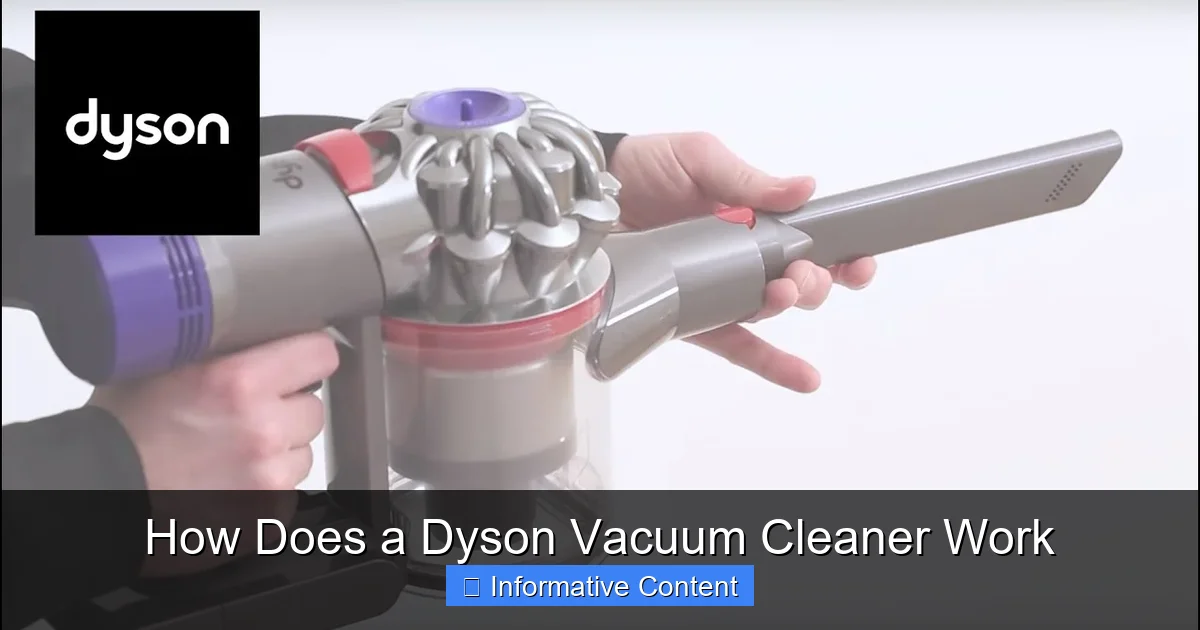
Ever wondered how a Dyson vacuum cleaner works its magic? It all boils down to groundbreaking cyclonic technology that efficiently separates dust from air without clogging filters, preventing suction loss. Coupled with powerful digital motors and advanced whole-machine filtration, Dyson vacuums deliver consistently strong cleaning performance, trapping microscopic particles and expelling cleaner air back into your home.
How Does a Dyson Vacuum Cleaner Work
Have you ever found yourself wondering what makes a Dyson vacuum cleaner so special? Is it just the sleek design, or is there some serious engineering magic happening under the hood? Many of us grew up with traditional vacuums that often started strong but quickly lost their oomph as the dust bag filled or the filter clogged. It was a frustrating dance of emptying bags, cleaning filters, and still never quite getting that “brand new” suction feeling back.
Then came Dyson, promising “no loss of suction.” This wasn’t just a marketing slogan; it was a fundamental shift in how a vacuum cleaner operates. James Dyson, the brand’s visionary founder, spent years refining a technology that would revolutionize home cleaning. He envisioned a vacuum that could separate dust and dirt from the airflow efficiently, keeping the motor and filters clear, thereby maintaining consistent, powerful suction throughout the cleaning process.
So, how does a Dyson vacuum cleaner work to achieve this seemingly impossible feat? It’s a fascinating blend of aerodynamic principles, powerful digital motors, and meticulous engineering. Let’s pull back the curtain and explore the core technologies that make Dyson machines stand out, from their iconic cyclonic separation to their advanced filtration systems and intelligent design. Get ready to dive deep into the science behind your spotless floors!
Key Takeaways
- Cyclonic Separation: Dyson vacuums use high-speed cyclones to spin dust and debris out of the airflow, preventing clogs and maintaining consistent suction, unlike traditional bagged vacuums.
- No Loss of Suction: This core technology eliminates the need for bags and traditional filters that can clog, ensuring powerful cleaning from start to finish.
- Digital Motors: Dyson’s compact, powerful digital motors (like the Hyperdymium motor) spin at incredibly high RPMs to generate immense suction while being energy-efficient and lightweight.
- Whole-Machine Filtration: Advanced sealed systems, often combined with HEPA-level filters, capture 99.97% of microscopic particles and allergens, expelling cleaner air than the room air you breathe.
- Engineered Airflow: Every component, from the cleaner head to the dust bin, is meticulously designed and sealed to optimize airflow, maximizing efficiency and suction power throughout the machine.
- Smart Technology & Ergonomics: Modern Dyson models incorporate smart features like LCD screens, particle counting (Piezo sensor), and automatic suction adjustment, alongside ergonomic designs for user comfort and versatility.
- Bagless Convenience: The cyclonic system makes vacuum bags obsolete, offering a more hygienic and cost-effective solution with easy, “point and shoot” bin emptying.
Quick Answers to Common Questions
What is the main technology behind Dyson’s “no loss of suction”?
The main technology is cyclonic separation. Dyson vacuums use high-speed cyclones to spin dust and debris out of the airflow, preventing filters from clogging and thus maintaining consistent suction power.
Do Dyson vacuums use bags?
No, Dyson vacuums are bagless. They utilize a transparent dust bin where dirt and debris are collected after being separated by cyclonic force, making them more hygienic and environmentally friendly.
What type of motor does a Dyson vacuum cleaner use?
Dyson vacuums use powerful, compact digital motors, such as the Hyperdymium motor, which can spin at extremely high RPMs (up to 125,000 RPM) to generate immense suction while remaining lightweight and energy-efficient.
How does a Dyson vacuum cleaner improve air quality?
Dyson vacuums feature whole-machine filtration with a fully sealed system, often including HEPA-level filters. This setup captures 99.97% of microscopic particles and allergens, ensuring that the air expelled from the vacuum is cleaner than the air it took in.
What is the purpose of the laser on some Dyson cleaner heads?
On models like the Fluffy Optic cleaner head, an integrated green laser illuminates microscopic dust particles on hard floors. This makes invisible dust visible to the naked eye, allowing users to see exactly where they need to clean for a thorough job.
📑 Table of Contents
The Revolutionary Core: Cyclonic Separation Technology
At the very heart of every Dyson vacuum cleaner lies its signature cyclonic technology. This is the secret sauce that differentiates it from conventional vacuums and allows it to maintain consistent suction power.
How Traditional Vacuums Lose Suction
To understand Dyson’s innovation, let’s briefly look at traditional vacuums. Most older models rely on bags or simple filters to trap dust. As air containing dirt and debris is pulled into the vacuum, it passes through these permeable barriers. Over time, these bags and filters become coated with fine dust particles. This coating restricts airflow, causing the motor to work harder and, crucially, leading to a significant drop in suction power. You might notice your vacuum struggling, getting louder, or leaving behind bits of dirt – all because of clogged pathways.
James Dyson’s Breakthrough
James Dyson first observed industrial cyclone separators, used in sawmills to remove sawdust from the air, and wondered if this principle could be scaled down for home use. After thousands of prototypes, he perfected a system that uses centrifugal force to separate dust and dirt from the air *before* it reaches the motor or fine filters. This is precisely how a Dyson vacuum cleaner works to prevent the very problem of clogging that plagues traditional models.
The Cyclonic Process Explained
When you switch on a Dyson vacuum, a powerful motor creates a strong airflow, drawing in dust, dirt, and air from your floors. Instead of heading straight for a bag or filter, this dirty air is directed into a conical chamber. Inside this chamber, the air is spun at incredibly high speeds – often exceeding 100 miles per hour – creating a miniature, powerful vortex, much like a tornado.
*
Root Cyclone & Radial Root Cyclone
Early Dyson models featured what was called Root Cyclone technology. As the air spins, the heavier dust and dirt particles are flung outwards against the walls of the cone due to centrifugal force. They then lose momentum and fall into the transparent dust bin at the bottom, while the cleaner air continues upwards. Dyson later refined this with Radial Root Cyclone technology, arranging multiple cyclones in two parallel tiers to generate even stronger centrifugal forces, capturing more microscopic dust.
*
Cinetic Science Technology
For some of its most advanced upright and canister models, Dyson introduced Cinetic Science. This is an evolution of cyclonic technology where flexible, oscillating cyclone tips prevent microscopic dust from building up and clogging the cyclones themselves. This means that these models require *no* filter maintenance or washing – a true testament to how efficiently a Dyson vacuum cleaner works without traditional obstructions. The kinetic energy generated by the oscillating tips stops even the most minute dust from sticking, maintaining absolute air flow.
The key takeaway here is that because the vast majority of dirt is separated cyclonically, the subsequent filters (which we’ll discuss next) are protected from rapid clogging. This protection is fundamental to Dyson’s “no loss of suction” promise and explains why a Dyson vacuum cleaner works so consistently.
Powering the Vortex: Dyson’s Digital Motors

Visual guide about How Does a Dyson Vacuum Cleaner Work
Image source: 4.bp.blogspot.com
While cyclonic technology handles the separation, it’s the motor that provides the sheer power to create that incredible airflow and suction. Dyson didn’t just stop at reinventing the vacuum’s airflow path; they also revolutionized the motor itself.
Beyond Traditional Motors
Historically, vacuum motors were often bulky, heavy, and less efficient. Dyson, however, invested heavily in developing its own compact, lightweight, and incredibly powerful digital motors. These aren’t your average electric motors.
*
The Dyson Digital Motor (DDM) & Hyperdymium
Dyson’s motors, such as the Dyson Digital Motor (DDM) and its newer, more advanced iteration, the Hyperdymium motor, are engineered to spin at astonishing speeds. The Hyperdymium motor, for example, can rotate at up to 125,000 RPM (revolutions per minute) – that’s roughly 20 times faster than a Formula 1 car engine! This immense speed allows them to generate incredibly strong suction power from a relatively small and lightweight package. This miniaturization is crucial, especially for cordless stick vacuums, enabling powerful cleaning without the bulk.
Efficiency and Longevity
These digital motors are also incredibly energy-efficient. They use sophisticated electronic controls to optimize power consumption, extending battery life in cordless models and reducing energy use in corded machines. Furthermore, being digitally controlled and having fewer moving parts subject to wear and tear than older brushed motors, they are designed for greater durability and longevity. This powerful, efficient heart is another key reason how a Dyson vacuum cleaner works so effectively and reliably over time.
Breathing Clean: Advanced Whole-Machine Filtration
Even after the powerful cyclonic forces have done their work, there are still microscopic particles, allergens, and pollutants floating in the air. This is where Dyson’s whole-machine filtration system comes into play, ensuring that the air expelled from the vacuum is significantly cleaner than the air it took in.
The Importance of a Sealed System
Many conventional vacuums, even those with HEPA filters, can leak dusty air back into the room through tiny gaps in their construction. Dyson vacuums are engineered with a fully sealed system. This means that once dust and air are sucked into the machine, they follow a carefully controlled path through the cyclones and filters, with no opportunities for unfiltered air to escape back into your home. This sealed design is critical to how a Dyson vacuum cleaner works to deliver truly clean exhaust air.
Multi-Stage Filtration
Dyson vacuums employ multiple layers of filtration:
*
Pre-Motor Filters
These typically capture larger particles that might have escaped the initial cyclonic separation but are still too big for the finer filters. These are often washable, helping to maintain performance and reduce waste.
*
Post-Motor Filters (HEPA-Level)
The final and most crucial stage involves advanced filters, often meeting or exceeding HEPA (High-Efficiency Particulate Air) standards. These filters are capable of trapping 99.97% of microscopic particles as small as 0.3 microns. To put that into perspective, common allergens like pollen, pet dander, dust mite feces, and even some bacteria and viruses are within this size range.
Benefits for Allergy Sufferers
For people with allergies or asthma, this level of filtration is a game-changer. By trapping these tiny irritants within the machine and expelling cleaner air, Dyson vacuums don’t just clean your floors; they contribute to a healthier home environment. It’s a testament to how a Dyson vacuum cleaner works not just on visible dirt, but on invisible pollutants too. Many filters are also washable, which is a practical tip for maintaining peak performance without constant replacement costs. Always ensure the filter is completely dry before reinserting it.
From Floor to Bin: Engineered Airflow and Cleaner Heads
The journey of dirt and debris through a Dyson vacuum is a meticulously planned affair, starting from the moment it leaves your floor. Every component is designed to optimize airflow and cleaning performance.
The Complete Airflow Path
The effectiveness of how a Dyson vacuum cleaner works relies heavily on its ability to create and maintain a consistent, high-velocity airflow from the cleaner head all the way to the dust bin and out through the filter. Any leaks or obstructions along this path would compromise suction. Dyson engineers spend countless hours designing and sealing these pathways to ensure maximum efficiency.
Innovative Cleaner Head Designs
The part of the vacuum that touches your floor is just as crucial as the motor and cyclones. Dyson has developed a range of intelligent cleaner heads, each designed for specific cleaning challenges:
*
High Torque Cleaner Head
Often found on more powerful cordless and upright models, this head intelligently adapts its suction power and brush bar speed across different floor types (carpets, hard floors) to optimize cleaning. It typically features stiff nylon bristles for agitating carpet fibers and soft carbon fiber filaments for capturing fine dust from hard floors.
*
Fluffy Optic Cleaner Head
Exclusive to some cordless models, this innovative head is designed specifically for hard floors. It features soft woven nylon and anti-static carbon fiber filaments, which protect delicate floors while picking up large debris and fine dust. The “Optic” part refers to an integrated green laser that illuminates microscopic dust particles on hard floors, making them visible to the naked eye – a clever visual aid that shows exactly how a Dyson vacuum cleaner works to remove even invisible dirt.
*
Motorbar™ Cleaner Head
This design is found across various models and is particularly effective at detangling hair. Polycarbonate vanes automatically clear hair from the brush bar as you clean, preventing frustrating tangles and maintaining consistent performance. This is a huge benefit for pet owners.
Seals and Gaskets
Throughout the machine, high-quality seals and gaskets ensure that no air escapes or enters the system unintentionally. This sealed environment is vital for directing all the suction power to where it’s needed most – the cleaner head – and for ensuring that all captured particles pass through the filtration system, not around it. The precision engineering of these components is a silent hero in how a Dyson vacuum cleaner works so effectively.
Hygienic Dust Bin Emptying
Once the dirt has been separated, it collects in a transparent dust bin. Dyson has engineered these bins for hygienic, “point and shoot” emptying. With the press of a button, the base of the bin opens, and a collar slides down to push out the accumulated dirt directly into your trash can, minimizing contact with dust and allergens. This clever design detail completes the bagless convenience that Dyson pioneered.
Beyond the Basics: Smart Features and Ergonomics
Dyson continues to innovate, moving beyond just core suction and filtration to integrate smart technology and user-friendly design elements that enhance the overall cleaning experience.
Intelligent Sensing and Displays
Newer Dyson cordless vacuums, like the Gen5Detect, feature integrated LCD screens that provide real-time information to the user. This includes:
*
Particle Counting
Some models incorporate a Piezo sensor that continuously counts and sizes dust particles as they enter the vacuum. This data is displayed on the LCD screen, providing scientific proof of a deep clean. It’s incredibly satisfying to see the number of particles decrease as you clean a seemingly clean floor, truly demonstrating how a Dyson vacuum cleaner works on a microscopic level.
*
Run Time and Power Modes
The screen also displays remaining run time down to the second, allowing you to plan your cleaning efficiently. You can easily switch between power modes (Eco, Auto, Boost) depending on the cleaning task, optimizing both power and battery life.
Battery Technology and Management
For cordless models, the battery is paramount. Dyson designs its own advanced battery packs, often with multiple cells, to provide consistent power throughout the run time. Intelligent battery management systems ensure efficient power delivery and extend battery longevity. Many cordless models also feature click-in battery packs, allowing you to quickly swap out a depleted battery for a fully charged one to extend cleaning sessions.
Ergonomics and Maneuverability
Dyson vacuums are known for their distinctive designs, which are not just aesthetic but also highly ergonomic. The balance of cordless stick vacuums, with the motor often positioned near the handle, makes them feel lightweight and easy to maneuver for cleaning high, low, and in-between spaces. The ball technology in their uprights allows for effortless steering around furniture. These design considerations are integral to the overall user experience of how a Dyson vacuum cleaner works in your home.
Versatile Attachments
No Dyson vacuum would be complete without a suite of attachments designed for every nook, cranny, and surface. From crevice tools for tight spots to mini motorized tools for pet hair on upholstery, and soft dusting brushes for delicate surfaces, these tools extend the versatility of the vacuum, making it an all-encompassing cleaning solution for your entire home and even your car.
Conclusion
So, how does a Dyson vacuum cleaner work? It’s far more than just a powerful motor and a fancy appearance. It’s a meticulously engineered system built upon the foundational principle of cyclonic separation, designed to deliver consistent, uncompromising suction. James Dyson’s initial frustration with traditional vacuums losing power led to an innovation that transformed the industry.
From the relentless efficiency of its digital motors to the microscopic precision of its whole-machine filtration, and the intuitive design of its cleaner heads and smart features, every aspect of a Dyson vacuum cleaner is optimized for performance. It’s a testament to continuous innovation, focusing on solving real-world cleaning problems with cutting-edge technology.
The next time you effortlessly glide your Dyson across your floors, remember the intricate dance of engineering happening inside – the cyclones spinning at incredible speeds, the motor generating immense power, and the filters diligently trapping unseen particles. It’s this commitment to science and design that ensures your Dyson doesn’t just clean your home; it fundamentally changes the way you experience cleaning, proving that a truly innovative vacuum cleaner can indeed deliver on its promise of “no loss of suction.”
Frequently Asked Questions
How often should I clean my Dyson filter?
Most Dyson washable filters should be cleaned at least once a month, though some advanced models like those with Cinetic Science may not require filter maintenance. Always refer to your specific model’s manual for precise instructions, and ensure the filter is completely dry before reinserting to avoid motor damage.
Can Dyson vacuums pick up pet hair effectively?
Yes, Dyson vacuums are highly effective at picking up pet hair. Many models feature specialized cleaner heads like the Motorbar™ that automatically detangle hair from the brush bar, preventing frustrating clogs and maintaining strong performance, even in homes with multiple pets.
Are Dyson cordless vacuums as powerful as corded ones?
Modern Dyson cordless vacuums, especially recent generations like the V15 Detect or Gen5Detect, are incredibly powerful and often rival or even surpass the suction power of many corded vacuums. Their high-speed digital motors and advanced battery technology deliver consistent and strong cleaning performance across various surfaces.
What does “whole-machine filtration” mean for Dyson?
Whole-machine filtration means that the entire vacuum system is sealed, ensuring that all air drawn into the machine passes through the filtration system without leaks. This prevents allergens and dust from escaping back into the room before being fully captured by the filters, resulting in cleaner exhaust air.
Is it worth investing in a Dyson vacuum cleaner?
For many users, the consistent powerful suction, advanced filtration for cleaner air, bagless convenience, and innovative features make Dyson vacuums a worthwhile investment. While they can be more expensive upfront, their durability, performance, and long-term benefits often justify the cost for those seeking a premium cleaning experience.
How do I empty the dust bin on a Dyson vacuum?
Dyson dust bins are designed for hygienic, “point and shoot” emptying. Simply hold the vacuum over a trash can, press the designated release button, and the bin base will open, while a shroud pushes out the dirt and debris. This minimizes contact with dust and allergens, making the process quick and clean.