
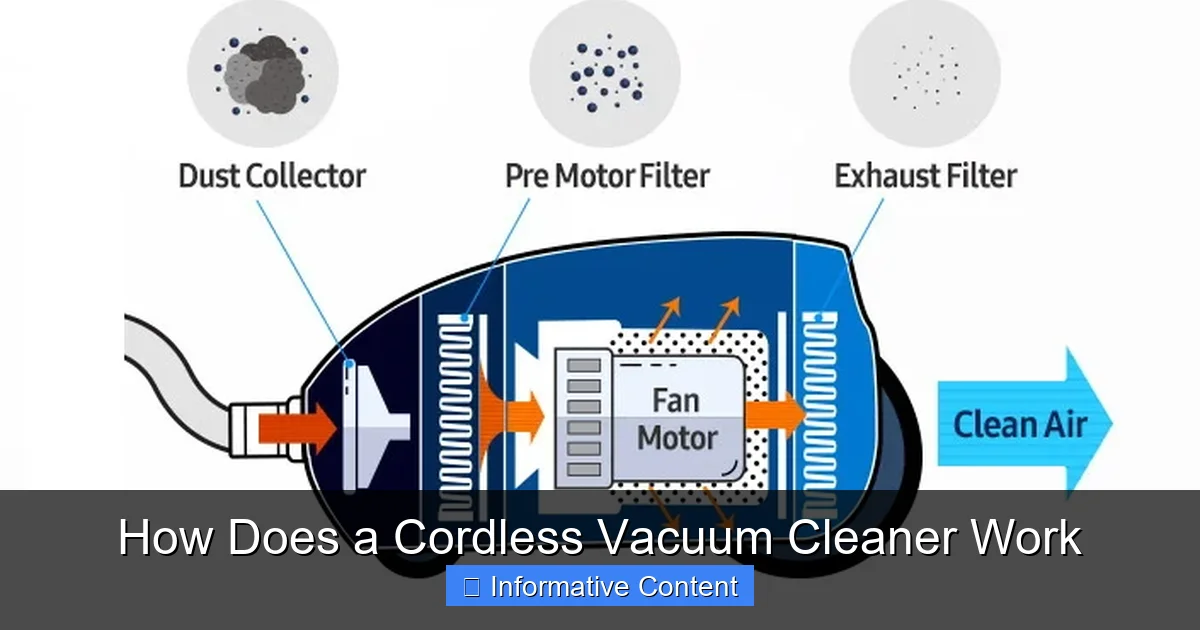
Gone are the days of tangled cords! Cordless vacuum cleaners offer unparalleled freedom, using a powerful battery to drive a high-speed motor that creates suction. This suction, combined with cyclonic airflow, separates dirt, which is then trapped by advanced filtration systems, ensuring a clean home and easy movement. Understanding these core components helps maximize your cleaning efficiency and extend your vacuum’s life.
How Does a Cordless Vacuum Cleaner Work?
Remember the days of dragging a heavy vacuum around, constantly searching for outlets and battling tangled cords? It wasn’t exactly a zen experience, was it? Then, like a superhero swooping in, the cordless vacuum cleaner arrived, changing the way we clean our homes forever. Suddenly, tidying up became less of a chore and more of a quick, agile task. But have you ever stopped to wonder, “How does a cordless vacuum cleaner work its magic?”
It might seem like a simple piece of technology – press a button, and dirt disappears. Yet, beneath its sleek exterior lies a sophisticated blend of engineering, physics, and smart design. From powerful batteries to high-speed motors, advanced filtration systems, and innovative cleaning heads, every component plays a crucial role in giving you that effortless, cord-free cleaning experience we’ve all come to love. Understanding these inner workings isn’t just for tech enthusiasts; it empowers you to choose the right model, use it effectively, and maintain it for years of peak performance.
So, let’s pull back the curtain and explore the fascinating journey of dust and debris from your floor into the bin. We’re going to break down each key element, explaining in simple terms exactly how this modern marvel operates, step by step. Get ready to discover the science behind your clean floors and appreciate the clever engineering in your trusty cordless vacuum cleaner!
Key Takeaways
- Battery Power is Key: Lithium-ion batteries provide the essential power for the motor and electronics, with voltage and amp-hours determining the vacuum’s power and run time.
- High-Speed Motors Create Suction: Modern cordless vacuums use compact, powerful brushless DC motors that spin impellers at incredible speeds, generating the low-pressure zone necessary to pull in dirt.
- Cyclonic Separation Protects Filters: Instead of relying solely on filters, centrifugal force created by cyclonic airflow separates larger debris from the air, preventing filters from clogging quickly and maintaining strong suction.
- Advanced Filtration Ensures Clean Air: Multi-stage filtration, often including HEPA filters, captures microscopic particles like dust mites and allergens, releasing cleaner air back into your home.
- Motorized Brush Rolls Agitate and Lift: The cleaning head’s rotating brush roll is crucial for effectively loosening dirt from carpets and sweeping debris from hard floors into the vacuum’s airflow.
- Regular Maintenance is Crucial: To ensure your cordless vacuum cleaner continues to perform at its best, regular emptying of the dustbin, cleaning/replacing filters, and clearing the brush roll are essential.
Quick Answers to Common Questions
What is the typical battery life for a cordless vacuum cleaner?
Battery life varies greatly depending on the model, power mode used, and battery capacity. Most cordless vacuums offer 20-60 minutes on a standard or eco mode, with powerful boost modes typically lasting 8-20 minutes.
How is the suction power of a cordless vacuum measured?
Suction power is often measured in Air Watts (AW), Pascals (Pa), or Kilopascals (kPa). Higher numbers generally indicate stronger suction. However, effective cleaning also depends on brush roll design and airflow efficiency.
Do all cordless vacuums have HEPA filters?
No, not all cordless vacuum cleaners include HEPA filters. While many premium models do, it’s important to check the product specifications if HEPA filtration is a priority for you, especially if you have allergies.
How often should I clean the filters in my cordless vacuum?
It’s generally recommended to clean your cordless vacuum’s filters once a month, or more frequently if you use it often or have pets. Always ensure they are completely dry before reinserting to prevent damage.
How long does it take to fully charge a cordless vacuum battery?
Charging times can range from 2.5 to 5 hours for most cordless vacuum cleaner batteries, depending on the model and battery capacity. Some quick-charge docks might offer faster charging.
📑 Table of Contents
The Heart of the Machine: Power and Suction
At its core, a cordless vacuum cleaner needs two main things to do its job: power to run and suction to pick up dirt. These two elements are deeply intertwined and form the fundamental basis of how these convenient devices operate.
The Battery: Fueling Freedom
The first and most defining feature of a cordless vacuum cleaner is, of course, its battery. Gone are the days of plugging into a wall; instead, a powerful rechargeable battery supplies all the energy needed. Most modern cordless vacuums use lithium-ion (Li-ion) batteries, similar to those found in your smartphone or laptop. These batteries are chosen for their high energy density, meaning they can store a lot of power in a relatively small and light package, and their ability to be recharged many times without significant degradation.
The battery’s specifications – primarily its voltage (V) and amp-hours (Ah) – tell you a lot about the vacuum’s potential. Higher voltage typically means more power delivered to the motor, translating into stronger suction. More amp-hours usually mean a longer run time on a single charge. For instance, a 25.2V battery with 3.0Ah will offer a robust cleaning experience and a decent run time, allowing you to tackle multiple rooms without needing to recharge. Understanding your battery is crucial for getting the most out of your cordless vacuum.
The Motor: Creating the Whirlwind
Once the battery provides the juice, it energizes the motor. Modern cordless vacuum cleaners predominantly use high-efficiency digital motors, often referred to as brushless DC (BLDC) motors. These are a significant advancement over older, brushed motors because they are smaller, lighter, more powerful, more energy-efficient, and much more durable. Instead of physical carbon brushes, they use electronic controls, leading to less friction, less heat, and ultimately, a longer lifespan for your vacuum.
When you switch on your cordless vacuum, this motor springs to life, spinning a fan-like component called an impeller at incredibly high speeds – sometimes over 100,000 revolutions per minute (RPM)! This rapid rotation creates a powerful vacuum, or an area of very low pressure, just below the cleaning head. The higher atmospheric pressure outside the vacuum then rushes in to fill this void, carrying dirt, dust, and debris with it, up through the cleaning head, and into the vacuum’s body. It’s the classic principle of suction at work, powered by cutting-edge motor technology.
Airflow and Cyclonic Separation
Once the air, along with all the collected grime, enters the main body of the cordless vacuum cleaner, it doesn’t immediately hit a filter. That would clog the filter too quickly and diminish suction. Instead, many modern cordless vacuums employ a clever system called cyclonic separation. This is one of the most ingenious parts of how a cordless vacuum cleaner works.
The incoming air is channeled into one or more conical chambers at extremely high speeds, creating a miniature tornado or vortex. The centrifugal force generated by this swirling motion causes heavier particles – like dust, dirt, and pet hair – to be flung outwards against the walls of the chamber. As they lose momentum, gravity pulls these heavier particles down into the dustbin, while the cleaner air continues its journey towards the filters. This process effectively pre-separates the majority of the debris, ensuring that only the finest dust reaches the filters, which helps maintain consistent suction power and prolongs the filter’s life. Think of it like a playground merry-go-round: the faster it spins, the harder it pushes you outwards.
Capturing the Dirt: Filtration Systems
After the cyclonic separation has done its job of removing larger debris, the air isn’t quite ready to be released back into your home. It still contains microscopic particles, allergens, and other invisible pollutants. This is where the sophisticated filtration system of your cordless vacuum cleaner steps in to ensure that the air it expels is as clean as possible.
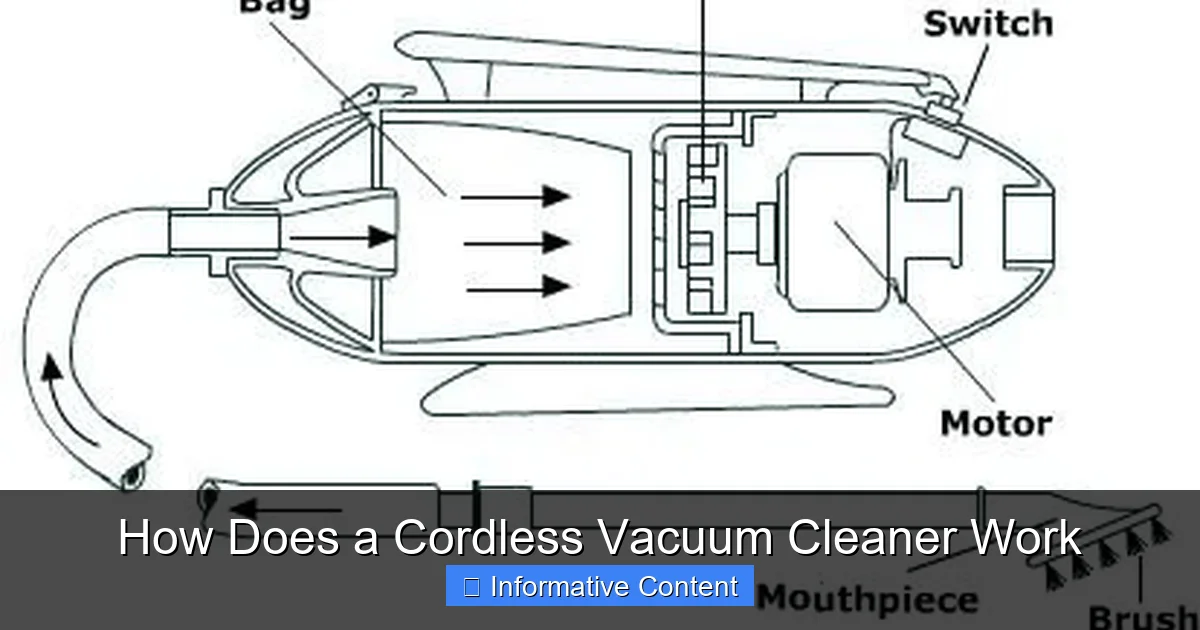
Visual guide about How Does a Cordless Vacuum Cleaner Work
Image source: 1.bp.blogspot.com
Pre-Filters and Main Filters
Most cordless vacuum cleaners feature a multi-stage filtration system. The first line of defense, often after cyclonic separation, involves pre-filters. These can be simple mesh screens or foam filters designed to catch any remaining larger dust particles that might have escaped the cyclone. Their job is to protect the finer, more critical filters downstream. Following this, there’s usually a main filter, often made of pleated paper or synthetic materials, which traps a significant amount of the remaining fine dust. These filters are essential for general household cleaning, ensuring that everyday dust is effectively contained within the vacuum.
HEPA Filters: Breathing Easier
For those concerned about indoor air quality, especially allergy sufferers or pet owners, the presence of a HEPA (High-Efficiency Particulate Air) filter is a major plus. A true HEPA filter is a medical-grade filter capable of trapping 99.97% of airborne particles with a size of 0.3 micrometers (microns) or larger. To give you some perspective, a human hair is about 50-70 microns thick. These tiny particles include common allergens like pollen, pet dander, dust mites, mold spores, and even some bacteria and viruses. When a cordless vacuum cleaner boasts a “sealed system” with a HEPA filter, it means the air path is designed to ensure all air passes through the filter before being exhausted, preventing any unfiltered air from leaking out. This creates a much healthier home environment for everyone.
Filter Maintenance Tips
Filters are crucial, and like any hardworking component, they need care. Over time, even with cyclonic separation, filters will accumulate fine dust and become clogged. A clogged filter restricts airflow, which directly reduces the suction power of your cordless vacuum. Most modern filters are washable; you can usually rinse them under cool running water. It’s incredibly important to let them air dry completely, for at least 24 hours, before putting them back into your vacuum. Inserting a damp filter can lead to mold growth or damage to the motor. Always check your user manual for specific cleaning instructions and recommended replacement schedules. Generally, main filters should be cleaned monthly and replaced every 6-12 months, depending on usage.
The Cleaning Head: Where Rubber Meets the Road
While the internal mechanisms of a cordless vacuum cleaner generate the powerful suction, it’s the cleaning head that makes direct contact with your floors and ultimately determines how effectively dirt is dislodged and collected. This is where the physical work of cleaning truly begins.
Brush Rolls: Agitating and Lifting
The star of most cordless vacuum cleaning heads is the motorized brush roll (sometimes called a beater bar). This is a cylindrical brush that spins at high speed, driven by its own small motor or geared from the main motor. Its primary purpose is agitation. On carpets, the bristles delve deep into the fibers, dislodging embedded dirt, pet hair, and crumbs that suction alone might miss. On hard floors, the brush roll sweeps loose debris, dust, and larger particles directly into the vacuum’s airflow. Different types of brush rolls are designed for specific tasks: stiff nylon bristles are excellent for deep cleaning carpets, while softer, often carbon-fiber, brush rolls are gentle on hard floors and effective at picking up fine dust without scratching. Some advanced cordless vacuums even feature “anti-tangle” brush rolls with comb-like structures or specialized bristle patterns to prevent hair from wrapping around them, making maintenance much easier.
Specialized Attachments
Beyond the main cleaning head, a good cordless vacuum cleaner often comes with an array of specialized attachments designed to tackle specific cleaning challenges, significantly enhancing its versatility. These attachments allow you to extend the reach and functionality of your cordless vacuum far beyond just floor cleaning:
- Crevice Tool: A long, thin nozzle perfect for reaching into tight corners, between sofa cushions, or along skirting boards where dust and debris love to hide.
- Dusting Brush: Typically a small brush with soft bristles, ideal for gently cleaning delicate surfaces like bookshelves, lamp shades, keyboards, or intricate moldings without scratching them.
- Upholstery Tool: Often wider with a flat opening, sometimes with fabric strips, designed to clean fabric surfaces such as sofas, chairs, curtains, and car interiors, effectively lifting pet hair and lint.
- Mini-Motorized Tool: A smaller version of the main cleaning head, this attachment has its own motorized brush roll. It’s invaluable for deep cleaning pet beds, car seats, or stairs, as it provides powerful agitation in a compact size.
Using the right attachment for the job not only makes cleaning more effective but also protects your surfaces and helps preserve the lifespan of your cordless vacuum. For example, using a crevice tool to get into tight spaces prevents you from forcing the main head where it doesn’t fit, potentially damaging the vacuum or your furniture.
Smart Features and User Experience
Modern cordless vacuum cleaners aren’t just about raw power; they also incorporate a host of smart features and ergonomic designs that enhance the overall user experience, making cleaning even more convenient and efficient.
Power Modes and Battery Indicators
To optimize performance and battery life, most cordless vacuums offer different power modes. You’ll typically find an “Eco” or “Standard” mode for lighter cleaning tasks and extended run time, and a “Boost” or “Max” mode for tackling stubborn dirt and deep-pile carpets, albeit with a shorter battery life. Switching between these modes allows you to tailor the vacuum’s power to the task at hand, conserving battery when full power isn’t needed. Many models also feature clear LED displays or indicator lights that show the current power mode, remaining battery life, or even an estimated run time. Some advanced cordless vacuum cleaners boast “adaptive suction technology,” which automatically detects the floor type (e.g., hard floor to carpet) and adjusts the suction power accordingly, ensuring optimal cleaning without manual intervention and further maximizing battery efficiency.
Ergonomics and Design
Because you’re carrying the entire unit, the physical design of a cordless vacuum cleaner is incredibly important. Manufacturers focus heavily on ergonomics, striving for a lightweight, well-balanced design that minimizes user fatigue. The placement of the motor and battery often contributes to this balance, making the vacuum feel lighter in the hand even if its overall weight isn’t exceptionally low. Comfortable handles, easy-to-reach controls, and the ability to convert into a handheld unit for versatility are all common design considerations. Many cordless vacuums also come with wall-mounted docking stations that conveniently store the vacuum upright while simultaneously charging it, keeping it out of the way and always ready for its next cleaning session.
Smart Technology Integration
The cutting edge of cordless vacuum technology sees the integration of smart features that go beyond basic cleaning. Some high-end models now include LCD screens that display real-time information, such as suction mode, remaining battery life, and even maintenance alerts. A few take it a step further with Bluetooth or Wi-Fi connectivity, allowing you to link your cordless vacuum to a smartphone app. These apps can provide detailed performance statistics, register your product, offer troubleshooting tips, or even send reminders for filter cleaning or replacement. While not essential for basic cleaning, these smart integrations can offer a more informed and streamlined user experience for tech-savvy individuals.
Maintenance for Lasting Performance
Understanding how a cordless vacuum cleaner works is only half the battle; the other half is knowing how to care for it. Regular maintenance is not just about keeping your vacuum clean; it’s about preserving its suction power, extending its lifespan, and ensuring it always performs at its best. Neglecting maintenance can quickly lead to diminished performance, reduced battery life, and even costly repairs.
Emptying the Dustbin
This might seem obvious, but it’s the most fundamental maintenance task for any cordless vacuum cleaner. The dustbin should ideally be emptied after every use, or certainly before it reaches its “max fill” line. An overfilled dustbin will restrict airflow, immediately reducing suction power and putting unnecessary strain on the motor. Most cordless vacuums feature a simple, one-touch mechanism for emptying the bin directly into a trash can, making it a quick and hygienic process. Make sure to tap out any residual dust or debris that might cling to the inside of the bin.
Cleaning Filters
As discussed earlier, filters are vital for capturing fine particles and protecting your motor. Refer to your user manual for specific instructions on how to remove and clean your filters. Most pre-filters and main filters are washable; gently tap them to dislodge loose dust, then rinse under cool running water until the water runs clear. Allow them to air dry completely – this means 24 hours or more – before reinserting them. Never use a damp filter, as it can damage the motor and promote mold growth. If your vacuum has a HEPA filter, it might not be washable and will need to be replaced periodically (typically annually or biannually, depending on usage and manufacturer recommendations). Regular filter cleaning is paramount to maintaining strong, consistent suction and preventing motor overheating.
Brush Roll Care
The brush roll is constantly in contact with your floors, so it inevitably picks up hair (both human and pet), string, and other fibers that can wrap around it. Over time, these tangles can impede the brush roll’s rotation, reducing its effectiveness and putting stress on its motor. Many cordless vacuum cleaners have a removable brush roll for easy access. Periodically, you should remove the brush roll and use scissors or a utility knife (carefully!) to cut away any wrapped hair or tangled debris. Make sure the brush roll spins freely by hand once you’ve cleaned it. Also, check for any wear and tear on the bristles themselves; worn bristles will be less effective at agitation.
Battery Best Practices
The battery is the lifeline of your cordless vacuum. To maximize its lifespan, avoid completely discharging the battery every time. Modern lithium-ion batteries prefer to be topped up rather than run from full to empty repeatedly. Most manufacturers recommend storing the vacuum in a cool, dry place and keeping it charged, often on its wall-mounted dock. Avoid exposing the battery to extreme temperatures, both hot and cold, as these can degrade battery health over time. If you plan to store your cordless vacuum for an extended period, it’s generally best to leave the battery charged to around 50-60% capacity rather than fully charged or completely drained.
Conclusion
The cordless vacuum cleaner has truly revolutionized how we approach household cleaning, offering a blend of power, convenience, and flexibility that was once unimaginable. Its ability to effortlessly glide across floors, reach into tight spaces, and quickly tackle unexpected messes is thanks to a clever interplay of advanced technologies.
From the powerful lithium-ion battery providing cord-free energy to the high-speed brushless motor generating incredible suction, every component works in harmony. The sophisticated cyclonic separation system efficiently separates debris, while multi-stage filters, including crucial HEPA filters, ensure that only clean air is released back into your home. Add to that the effective agitation of the motorized brush roll and the versatility of specialized attachments, and you have a cleaning powerhouse in a remarkably compact and agile form factor.
Understanding how your cordless vacuum cleaner works isn’t just an interesting bit of knowledge; it’s empowering. It helps you appreciate the engineering, guides you in making smart purchasing decisions, and most importantly, equips you with the knowledge to maintain your device properly. By regularly emptying the dustbin, cleaning filters, and maintaining the brush roll, you ensure that your cordless vacuum continues to perform at its peak, making your cleaning routine faster, more efficient, and undeniably more enjoyable. So, next time you effortlessly zip around your home with your cordless vacuum, you’ll know exactly the ingenious science making your floors sparkle!
Frequently Asked Questions
How do cordless vacuums differ from traditional corded vacuums?
The primary difference is the power source: cordless vacuums use a rechargeable battery for unrestricted movement, while corded vacuums plug into an electrical outlet for continuous power. Cordless models typically offer more convenience and maneuverability, though corded models often provide consistent, higher suction for longer periods.
Can I replace the battery in my cordless vacuum cleaner?
Yes, many cordless vacuum cleaner models are designed with removable and replaceable batteries. This allows you to extend the vacuum’s lifespan or purchase an extra battery for longer cleaning sessions. However, some models have integrated batteries that require professional service for replacement.
Are cordless vacuums as powerful as corded ones?
While historically less powerful, modern cordless vacuum cleaners have significantly closed the gap, with high-end models offering comparable suction to many corded uprights, especially on their boost settings. The key difference remains consistent, unlimited power versus limited battery runtime.
How often should I empty the dustbin on my cordless vacuum?
It’s best practice to empty the dustbin of your cordless vacuum cleaner after every use, or whenever the debris reaches the maximum fill line. This prevents a buildup of dirt that can restrict airflow, reduce suction power, and put strain on the motor.
Can a cordless vacuum pick up liquids or wet messes?
No, standard cordless vacuum cleaners are designed for dry debris only and should never be used to pick up liquids or wet messes. Doing so can cause severe damage to the motor, battery, and electronic components, and may also pose a safety hazard. There are specialized wet/dry vacuums for this purpose.
What is the typical lifespan of a cordless vacuum cleaner?
The average lifespan of a good quality cordless vacuum cleaner is typically between 3 to 5 years, though some well-maintained models can last longer. Key factors influencing lifespan include battery care, regular filter cleaning, proper brush roll maintenance, and overall usage frequency.