Why Did Hubert Booth Invent the Vacuum Cleaner
Long before our modern uprights and robots, domestic cleanliness was a back-breaking chore, often involving dusty, ineffective methods. Hubert Booth, an English engineer, revolutionized this world in 1901 by inventing the vacuum cleaner, a device born from a moment of pure inspiration and a deep understanding of suction power. His invention, though initially a cumbersome affair, laid the foundational principles for every vacuum cleaner that followed, forever changing how we tackle dirt and dust.
Why Did Hubert Booth Invent the Vacuum Cleaner?
Imagine a world where keeping your home clean was an epic struggle, a never-ending battle against dust and grime that felt almost impossible to win. A world where instead of vacuuming, you might beat rugs outdoors, sweep floors with brooms that kicked up more dust than they collected, or rely on complex, manual contraptions that promised cleanliness but delivered only frustration. This was the reality for households and businesses alike before a pivotal moment at the turn of the 20th century. It was a time ripe for innovation, particularly in the domestic sphere, where the drudgery of housework was a significant burden, and health concerns about dust were beginning to gain traction.
Into this dusty landscape stepped Hubert Cecil Booth, an English civil engineer with a keen mind and an eye for solving practical problems. Booth wasn’t initially focused on household cleaning; his earlier work ranged from designing Ferris wheels to bridges. Yet, a chance observation and a flash of insight would completely pivot his career and forever change the way we approach cleanliness. His invention would become one of the most indispensable tools in homes and public spaces worldwide, revolutionizing hygiene and making the once- Herculean task of dust removal significantly more manageable.
So, what exactly spurred this brilliant engineer to dive headfirst into the world of dirt and dust? Why did Hubert Booth invent the vacuum cleaner, and what was the journey like from a spark of an idea to a practical, albeit enormous, cleaning machine? Let’s take a fascinating trip back in time to uncover the story behind one of the most impactful inventions in modern domestic life.
Key Takeaways
- The Pre-Vacuum Problem: Before Hubert Booth invented the vacuum cleaner, cleaning methods were largely inefficient, labor-intensive, and often redistributed dust rather than removing it, posing health risks.
- A Serendipitous Inspiration: Booth’s “aha!” moment came during a demonstration of a carpet-cleaning machine that *blew* dust away. He realized that *suction* was the key to truly removing dirt.
- The Core Innovation: Booth’s genius lay in developing a system that used a powerful air pump to create a vacuum, drawing dust and dirt into a filter, a fundamental principle still used today.
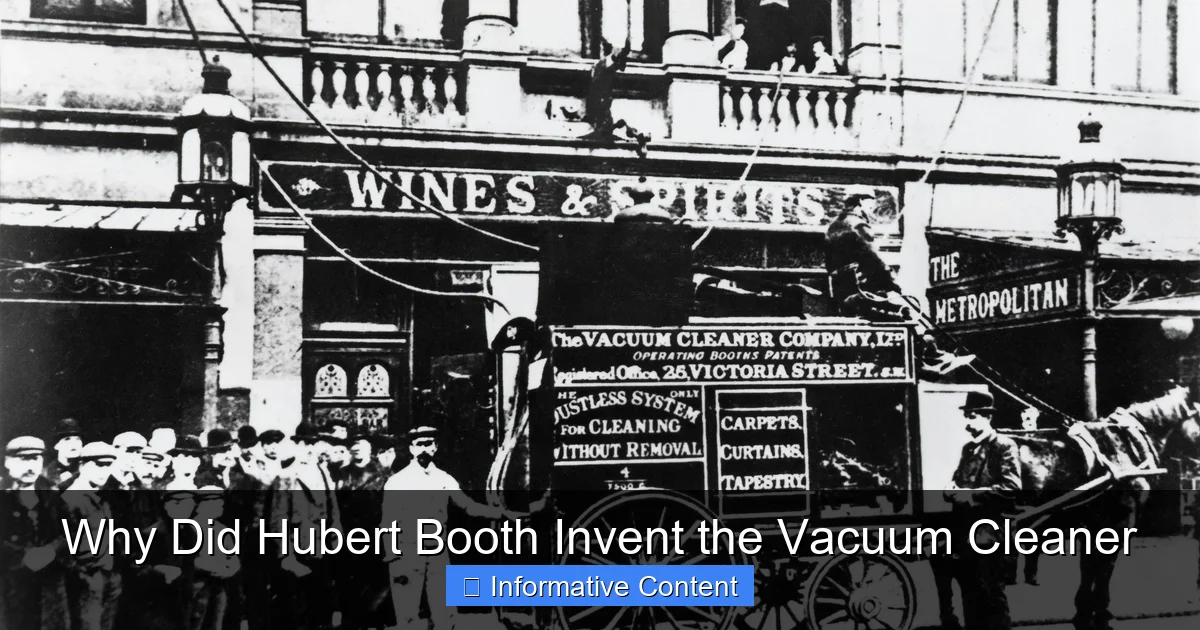
- The “Puffing Billy”: His first commercial vacuum cleaner was a massive, horse-drawn, petrol-powered machine that sat outside buildings, extending long hoses through windows to clean interiors.
- Overcoming Early Challenges: Booth faced skepticism, technical hurdles, and the need to educate the public on the superiority of suction cleaning over traditional methods.
- Transformative Impact: The invention of the vacuum cleaner drastically improved hygiene standards in homes, public buildings, and even factories, making environments healthier and cleaning more efficient.
- Laying the Foundation: Booth’s patent and subsequent designs became the bedrock for all future vacuum cleaner developments, from smaller electric models to the diverse range we see today.
Quick Answers to Common Questions
Who invented the first vacuum cleaner based on suction?
Hubert Cecil Booth, an English engineer, invented the first motorized vacuum cleaner that used suction to remove dust and dirt in 1901.
What inspired Hubert Booth to invent the vacuum cleaner?
Booth was inspired after attending a demonstration of a carpet cleaning machine that blew dust away. He realized that suction, not blowing, was the more effective method to truly remove dirt.
What was the name of Hubert Booth’s first commercial vacuum cleaner?
His first commercial vacuum cleaner was affectionately dubbed the “Puffing Billy” due to its large size and noisy petrol engine.
How did Hubert Booth test his idea of suction cleaning?
He famously tested his theory by placing a handkerchief on a dusty chair and sucking on it, observing the dust collected on the underside of the handkerchief.
How did Hubert Booth’s invention initially operate?
The “Puffing Billy” was a large, horse-drawn, petrol-powered machine that remained outside buildings, extending long hoses through windows to clean interiors.
📑 Table of Contents
The Problem with Dust: A Pre-Vacuum World
To truly appreciate why Hubert Booth invented the vacuum cleaner, we first need to understand the state of affairs before its existence. Dust wasn’t just an annoyance; it was a pervasive problem, often linked to disease and poor indoor air quality. Traditional cleaning methods were rudimentary, laborious, and often ineffective.
Ineffective Cleaning Methods of Yesteryear
Before the advent of the vacuum cleaner, cleaning involved a range of methods that sound almost archaic to us today. People would sweep floors with brooms, often just pushing dust from one spot to another, or into the air, where it would eventually settle again. Carpets, a luxury item becoming more common in homes, were a particular challenge. They were typically cleaned by hanging them outdoors and beating them vigorously with rug beaters, a process that was exhausting, time-consuming, and created massive clouds of dust, simply displacing the problem.
For interiors, some early “cleaners” existed, but they were far from what we recognize today. Many of these machines operated on the principle of blowing air to dislodge dust, much like a bellows. While they might move surface dirt, they often propelled fine dust particles deeper into carpets or into the air, where they could be inhaled or settle elsewhere. This left homes feeling superficially clean but still harboring significant amounts of dust and allergens. The health implications of constantly stirring up and breathing in dust were becoming more apparent, making the need for a truly effective cleaning solution increasingly urgent.
The Health and Societal Impact of Dust
In the late 19th and early 20th centuries, understanding of germ theory and hygiene was rapidly advancing. Public health officials and doctors were increasingly aware of the links between dirt, dust, and the spread of disease. Dust was recognized not just as visible grime but as a carrier of microscopic pathogens, pollen, and irritants. In homes, schools, hospitals, and public buildings, the accumulation of dust was a serious concern.
The sheer labor involved in traditional cleaning also had a significant societal impact. Keeping a large home clean required a retinue of domestic staff, whose work was physically demanding and often considered low-status. For those without staff, the burden on housewives was immense. There was a clear demand for a cleaner, more efficient, and less strenuous way to maintain hygiene, which explains why Hubert Booth’s eventual invention would be so well-received.
The Inspiration: A Demonstration Gone Wrong
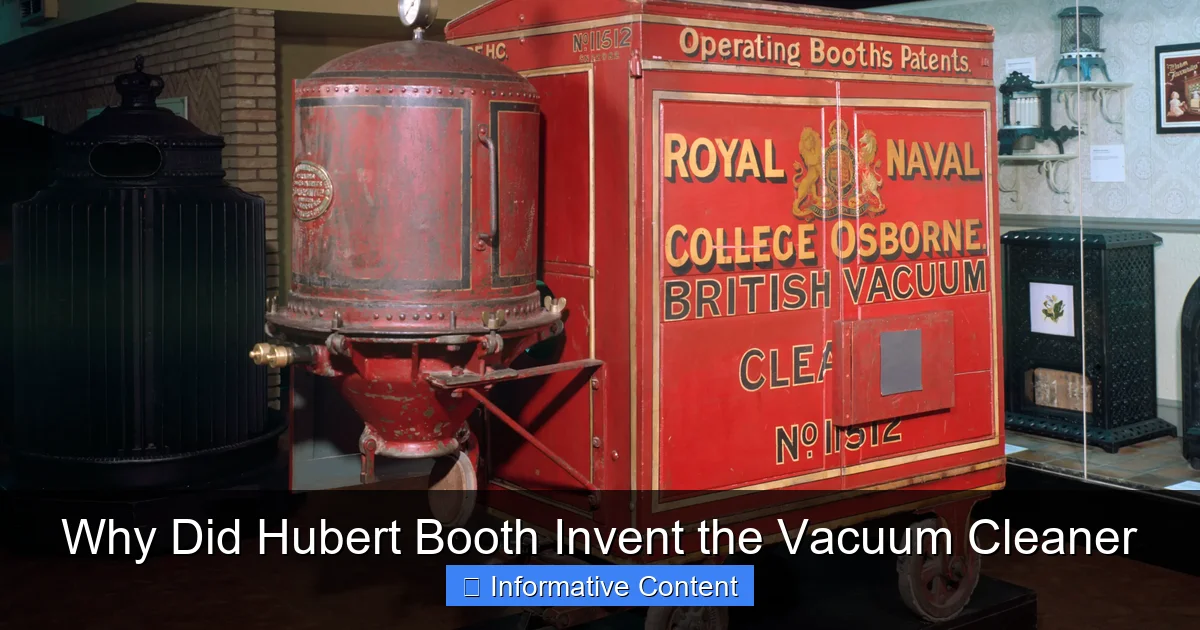
Visual guide about Why Did Hubert Booth Invent the Vacuum Cleaner
Image source: api.time.com
Hubert Booth’s groundbreaking idea didn’t come from a deliberate research project into cleaning appliances. Instead, it was born from a moment of serendipity, observation, and a powerful “what if” question. The turning point occurred in 1901 when Booth attended a demonstration of a new carpet cleaning machine at London’s Empire Music Hall.
A Puff of Dust, Not a Solution
The machine being demonstrated was designed to clean railway carriages, and its method was to blow compressed air onto the carpets. The idea was that this blast of air would dislodge the dirt and dust, making the carpets cleaner. Booth, ever the engineer, watched intently. He quickly noticed a critical flaw in the design and execution. While the machine certainly dislodged dirt, it didn’t *remove* it. Instead, it created a massive, visible cloud of dust that billowed into the air, settling back down on the seats, walls, and even the clothes of the spectators.
It was a demonstration that highlighted the problem rather than solved it. The dirt wasn’t gone; it had merely been displaced, making the air quality worse and eventually returning to the surfaces from which it had just been “cleaned.” Booth reportedly witnessed a similar machine being demonstrated at a restaurant, attempting to clean velvet upholstery by blowing air. Again, the result was a flurry of dust, circulating around the room.
The “Aha!” Moment: Suction is the Key
As Booth observed this dusty debacle, a profound realization struck him: “Why blow dust away when you can suck it up?” This simple but revolutionary thought was the genesis of the modern vacuum cleaner. He recognized that the fundamental principle was flawed. Instead of forcing dirt *away* from a surface, which just moved the problem, the solution was to draw it *into* a container, effectively removing it from the environment entirely.
To test his hypothesis, Booth conducted a rather unscientific but highly effective experiment. He reportedly went home, laid a handkerchief on the seat of a chair, put his mouth to the handkerchief, and tried to suck up as much dust as he could from the chair. He noticed that the handkerchief on the underside was coated with dirt, which confirmed his theory: suction worked. This simple act of putting his mouth to a dusty chair was the critical moment that ignited his pursuit of a truly effective cleaning machine. This pivotal insight is precisely why Hubert Booth invented the vacuum cleaner – to provide a genuine, rather than superficial, cleaning solution.
Hubert Booth’s Vision: Suction, Not Blowing
Armed with his “aha!” moment, Hubert Booth set about turning his theoretical insight into a tangible invention. His vision was clear: a machine that would create a powerful vacuum, drawing in dust and dirt through a nozzle and capturing it in a filter. This was a radical departure from all existing cleaning methods.
Developing the Fundamental Principles
Booth’s approach was rooted in sound engineering principles. He understood that to create effective suction, he needed a powerful air pump to generate a partial vacuum within a sealed system. This vacuum would then draw air, along with any loose particles like dust and dirt, into the system. The incoming air would then pass through a filter, trapping the solid particles while allowing the clean air to be expelled.
This might sound straightforward now, but at the time, it was a complex engineering challenge. Booth had to design a pump capable of creating sufficient suction, durable hoses that wouldn’t collapse, and effective filter systems to prevent the dust from simply being blown out the other side. He patented his invention on August 30, 1901, describing a large, motor-driven apparatus designed to create suction. His patent specifically detailed the use of cloth filters and the collection of dust, marking the birth of the vacuum cleaner as we know it.
Booth’s “Puffing Billy”: The First Commercial Vacuum Cleaner
The first commercial manifestation of Booth’s invention was far removed from the portable devices we use today. Dubbed the “Puffing Billy” (or sometimes “Booth’s Portable Vacuum Cleaner,” though “portable” might be a stretch!), it was an enormous, horse-drawn, petrol-powered machine. This gargantuan device was too large to enter homes or buildings. Instead, it would stop outside, much like a modern-day street sweeper or a service truck.
Long hoses would then be threaded through windows or doors of the building that needed cleaning. Operators inside would guide the nozzles over carpets, curtains, and upholstery, while the massive engine outside hummed, roared, and “puffed” (hence the nickname), generating the powerful suction needed to extract the dirt. The noise and size of the “Puffing Billy” were quite something, often drawing crowds of curious onlookers. Despite its size and complexity, the results were undeniable. For the first time, dirt and dust were truly *removed* from interiors, rather than just moved around. This impressive demonstration of its efficacy is a core reason why Hubert Booth invented the vacuum cleaner and proved it worked.
Early Challenges and the Path to Success
Bringing such a revolutionary and physically imposing invention to market was fraught with challenges. Hubert Booth faced skepticism, technical hurdles, and the need to educate a public accustomed to traditional, less effective cleaning methods.
Overcoming Skepticism and Practical Hurdles
Initially, many found the idea of a giant, noisy machine outside their premises, with hoses snaking indoors, quite peculiar. Booth had to actively demonstrate the superiority of his suction method. He offered his cleaning services to hotels, theaters, department stores, and even the British Royal Mint. The visible evidence of dirt trapped in his machines, which had been invisible to the naked eye, slowly convinced people.
Technical challenges were also significant. Early machines were prone to breakdowns, the petrol engines required constant maintenance, and the filtering system needed refinement to prevent dust from escaping. Booth and his company, the British Vacuum Cleaner Company (BVCC), continually worked to improve the design, making it more robust and efficient. Another surprising hurdle was the sheer scale of the operation. Cleaning a single building with the Puffing Billy was an elaborate affair, requiring a team of operators and significant logistical planning.
Royal Endorsement and Public Acceptance
A major turning point came when Booth’s vacuum cleaner was used to clean Westminster Abbey for the coronation of King Edward VII in 1902. The successful cleaning of such a prestigious and historically significant building garnered significant publicity and royal approval. Soon, fashionable London society began to adopt Booth’s service, finding it a novel and highly effective way to maintain their opulent homes. They even hosted “vacuum tea parties,” where guests would gather to watch the hoses snake into their homes and witness the miraculous removal of dust.
This early adoption by the upper classes helped to popularize the concept. Gradually, people began to understand that paying for Booth’s service was a worthwhile investment in hygiene and cleanliness. This growing acceptance solidified why Hubert Booth invented the vacuum cleaner and why it was such a necessary innovation.
Revolutionizing Cleanliness: Impact and Legacy
Hubert Booth’s invention didn’t just introduce a new gadget; it sparked a fundamental shift in how cleanliness was perceived and achieved. Its impact resonated across homes, public health, and even industrial practices.
A New Standard of Hygiene
The most immediate and profound impact of Booth’s vacuum cleaner was the establishment of a new, higher standard of hygiene. For the first time, it was possible to genuinely remove dust and its associated allergens and pathogens from environments, rather than just moving them around. This was particularly crucial in an era when infectious diseases were a major concern. Hospitals and sanatoriums quickly recognized the health benefits of vacuum cleaning, adopting the technology to maintain sterile environments.
In homes, the ability to deep-clean carpets, upholstery, and curtains meant that living spaces became significantly healthier. The visible reduction in dust and the feeling of truly clean air made a tangible difference to people’s quality of life. This elevated standard of cleanliness, directly attributable to the principles why Hubert Booth invented the vacuum cleaner, laid the groundwork for modern expectations of hygiene.
Paving the Way for Domestic Appliances
While Booth’s initial machine was a commercial service, his patent and the undeniable success of his method paved the way for smaller, more portable versions. Engineers and inventors across the globe began to adapt his suction principle into more manageable devices. American inventor James Murray Spangler, and later the Hoover company, would refine the design, introducing electric motors and making vacuum cleaners accessible for individual home ownership.
Booth’s invention ignited an entire industry dedicated to home cleaning appliances. From uprights and cannister vacuums to robotic cleaners and handheld devices, every single one owes its fundamental operational principle to Booth’s initial insight: the power of suction. The British Vacuum Cleaner Company itself would go on to produce various models, including early domestic electric vacuums, ensuring Booth’s legacy continued to evolve.
Beyond Booth: The Evolution of the Vacuum Cleaner
Hubert Booth laid the critical groundwork, but the journey of the vacuum cleaner didn’t end with his “Puffing Billy.” The evolution from a horse-drawn behemoth to the sleek, smart devices of today is a testament to ongoing innovation building upon Booth’s foundational idea.
From Gigantic to Portable
The transition from Booth’s massive commercial cleaners to truly domestic, portable machines was a significant leap. Early electric models were still heavy and cumbersome, but they represented a shift towards personal ownership. Manufacturers like Hoover in the United States and Electrolux in Europe played crucial roles in refining designs, making them lighter, more efficient, and more affordable for the average household. The introduction of the flexible hose, different attachments for various surfaces, and eventually, the disposable dust bag, all contributed to making vacuuming a routine, manageable chore.
Modern Innovations and the Future
Today, the vacuum cleaner continues to evolve. We have bagless cyclonic systems, advanced HEPA filters for allergy sufferers, cordless designs for ultimate portability, and robotic vacuums that clean autonomously. Smart technology allows vacuums to map homes, connect to Wi-Fi, and be controlled remotely. Despite all these advancements, the core principle remains exactly what Booth discovered: powerful suction to remove dust and dirt.
The story of why Hubert Booth invented the vacuum cleaner is a classic tale of a brilliant mind observing a problem, questioning conventional wisdom, and applying sound engineering to create a truly transformative solution. His invention not only cleaned carpets more effectively but also significantly improved public health and laid the foundation for an entire category of domestic appliances that we now take for granted. So, the next time you effortlessly glide your vacuum cleaner across your floor, spare a thought for Hubert Booth and his groundbreaking insight into the power of suction.
🎥 Related Video: How was the Vacuum cleaner created
📺 Invention Insider
Learn the history of the vacuum cleaner in this informative video. From its early beginnings in the 17th century with Denis Papin’s …
Frequently Asked Questions
What was cleaning like before Hubert Booth invented the vacuum cleaner?
Before Booth’s invention, cleaning methods were largely manual and inefficient. People swept floors, beat rugs outdoors, or used machines that blew dust around, often spreading rather than removing dirt and allergens.
How did Hubert Booth’s vacuum cleaner differ from previous cleaning machines?
Booth’s vacuum cleaner was revolutionary because it was the first to use the principle of suction. Earlier machines often used bellows to blow air, which simply displaced dust, whereas Booth’s invention actively drew dirt into a filtered container, truly removing it from the environment.
Was Hubert Booth’s original vacuum cleaner a household appliance?
No, Booth’s first commercial vacuum cleaner, the “Puffing Billy,” was a massive, horse-drawn, petrol-powered machine designed for commercial cleaning services. It was too large to enter buildings, so hoses were fed from the machine outside into the premises.
How did Hubert Booth’s invention gain popularity?
Booth’s vacuum cleaner gained popularity through effective demonstrations and services provided to prestigious clients like Westminster Abbey for King Edward VII’s coronation. Its clear ability to remove dust, often visibly collected in the machine, convinced customers of its superiority.
What impact did the invention of the vacuum cleaner have on society?
The vacuum cleaner drastically improved hygiene standards in homes and public spaces, reducing dust-related health issues and making cleaning more efficient. It also laid the foundation for the development of modern domestic appliances and an entire industry focused on floor care.
Did Hubert Booth profit from his invention?
Yes, Hubert Booth founded the British Vacuum Cleaner Company (BVCC) in 1903, which successfully offered cleaning services and later manufactured vacuum cleaners. His company continued to thrive and evolve, adapting to the demand for smaller, more accessible domestic models.