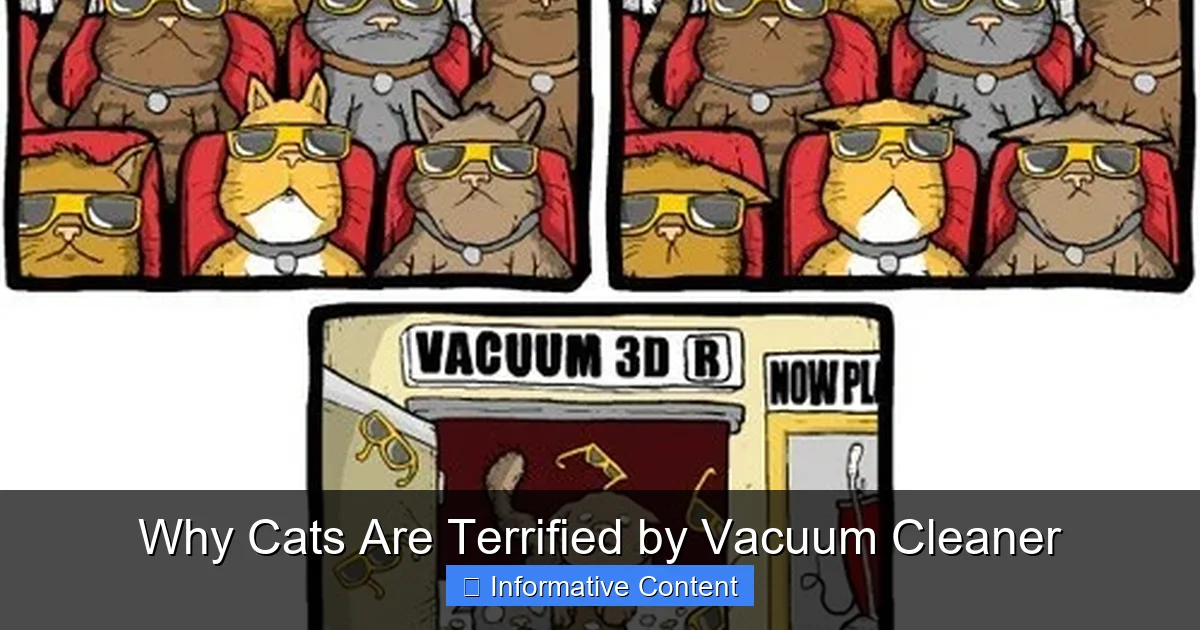
Why Cats Are Terrified by Vacuum Cleaner
For cats, the sudden appearance and loud noise of a vacuum cleaner aren’t just annoying; they represent a significant threat. Their highly sensitive hearing picks up frequencies humans often miss, turning a mundane cleaning tool into a terrifying, unpredictable predator. This sensory overload, combined with a vacuum’s erratic movement and invasive nature, triggers their innate fight-or-flight response, leading to genuine fear and stress.
Have you ever wondered why your calm, confident cat suddenly transforms into a furry ninja, darting under the nearest furniture or scaling the highest bookshelf the moment the vacuum cleaner roars to life? You’re definitely not alone. It’s a classic feline reaction that puzzles many cat parents. We might see a harmless cleaning tool, but our cats often perceive something far more menacing.
Understanding this common fear isn’t just about curiosity; it’s about empathy for our beloved companions. Cats are complex creatures with finely tuned senses and ancient instincts that often clash with the modern world we share. The loud, buzzing behemoth we use to keep our homes tidy is, to them, an inexplicable monster. Let’s dive deep into the fascinating, albeit terrifying from a feline perspective, reasons why cats are terrified by vacuum cleaners. We’ll explore everything from their super-sensitive senses to their primal survival instincts, and even offer some practical tips to help your furry friend feel a little less terrorized.
Key Takeaways
- Sensory Overload: Cats have incredibly sensitive hearing, making the vacuum cleaner’s loud noise, high-pitched whine, and vibrations overwhelming and painful, far beyond what humans perceive.
- Perceived Predator Threat: A vacuum’s sudden appearance, erratic movement, and aggressive “hunting” of dust bunnies mimic the actions of a large, unknown predator, triggering their primal fear response.
- Territorial Invasion: Cats view their home as their territory. A vacuum cleaner moving erratically through their space feels like an invasion by a noisy, unpredictable, and uncontrollable entity, causing stress.
- Novelty and Unpredictability: The vacuum is not a natural part of their environment. Its sudden and infrequent appearance, combined with its unpredictable movements, makes it a scary, unknown object.
- Disruption of Routine and Safety: Cats thrive on routine and feeling safe. The vacuum disrupts this sense of security, forcing them to flee their comfort zones and seek refuge.
- Learned Negative Associations: Even if not initially terrifying, a cat can develop a strong aversion to the vacuum cleaner due to repeated stressful encounters or startling moments.
- Empathetic Solutions: Understanding their fear allows owners to implement strategies like desensitization, positive reinforcement, and providing safe havens to help their cats cope.
Quick Answers to Common Questions
Why do cats hate vacuum cleaners so much?
Cats hate vacuum cleaners primarily due to their extremely sensitive hearing, which makes the loud noise and high-frequency sounds overwhelming and painful. Their primal instincts also perceive the vacuum’s erratic movements and sudden appearance as a threat or territorial invasion.
Do all cats get scared by vacuum cleaners?
While a large percentage of cats do show fear or aversion to vacuum cleaners, not all cats are equally scared. Some might tolerate them better, especially if introduced early or if they have a naturally more confident temperament, but it’s rare for a cat to be completely unfazed.
Can a cat get used to a vacuum cleaner?
Yes, with patience and proper techniques like desensitization and positive reinforcement, many cats can learn to tolerate a vacuum cleaner, or at least be less terrified by it. It’s a gradual process focused on changing their negative associations.
What’s the best way to introduce a cat to a vacuum cleaner?
The best way is to start with desensitization: leave the unplugged vacuum out, then slowly introduce the sound at low levels and from a distance, always rewarding your cat for calm behavior with treats. Provide a safe retreat for them during the process.
Should I pick up my cat if they’re scared of the vacuum?
It’s generally not recommended to pick up a scared cat during vacuuming. This can prevent them from fleeing to a safe spot, escalate their anxiety, and make them feel trapped, potentially worsening their fear of the vacuum cleaner.
📑 Table of Contents
The Sensory Overload: A World of Noise and Vibration
To truly grasp why cats are terrified by vacuum cleaners, we need to consider how they experience the world, primarily through their incredibly acute senses. What’s a manageable hum for us is a cacophony for them.
A Symphony of Painful Sounds
The most obvious reason for a cat’s fear of a vacuum cleaner is the noise. Cats have a far superior hearing range compared to humans. While our hearing tops out around 20,000 Hz, cats can hear sounds up to 64,000 Hz – that’s almost three times our limit! This means the vacuum cleaner isn’t just loud; it’s also emitting high-frequency sounds that are completely imperceptible to us but might be incredibly harsh, even painful, to a cat’s ears.
Imagine going to a concert where the music is so loud it physically hurts your ears, and there are high-pitched squeals only you can hear. That’s a bit like what a vacuum cleaner might sound like to your cat. Different types of vacuum cleaners produce varying noise levels and frequencies, but for a cat, almost any model can be an assault on their auditory system. This intense sensory input triggers a natural aversion.
Vibrations and Air Currents
It’s not just the sound. Vacuum cleaners also create significant vibrations, especially across hard floors, and generate strong air currents. Cats are highly sensitive to vibrations through their paws and whiskers. They can detect subtle changes in their environment that we often miss. The rumbling vibrations of a vacuum cleaner moving across the floor can be deeply unsettling, signaling instability or the approach of something large and disruptive.
Furthermore, the expulsion of air can create unexpected drafts or even stir up dust and odors that a cat finds offensive. These subtle cues, combined with the overwhelming noise, paint a complete picture of an intrusive and unpleasant experience for your cat.
The Predator Instinct: When a Vacuum Becomes a Threat
Visual guide about Why Cats Are Terrified by Vacuum Cleaner
Image source: i.imgur.com
Long before cats became our pampered housemates, they were wild predators and prey animals. These ancient instincts are still very much alive, and a vacuum cleaner can inadvertently trigger them.
Sudden Appearance and Erratic Movement
Cats are creatures of habit and predictability. A vacuum cleaner, typically stored away in a closet, makes a sudden and often unannounced appearance. This unexpected intrusion into their safe space immediately puts them on high alert. Compounding this is the vacuum’s movement. It’s not smooth or predictable like a person walking. It moves erratically, back and forth, turning suddenly, often bumping into furniture.
To a cat, especially one observing from a distance, this erratic movement can mimic the behavior of a large, unfamiliar animal – perhaps a predator or a rival. Their instinct tells them to flee or hide from anything that moves unpredictably and aggressively invades their territory. It’s a classic fight-or-flight response.
The “Hunting” Behavior
Think about what a vacuum cleaner does: it “chases” dirt and debris, sucking it up with a loud roar. From a cat’s perspective, this might look like a large, noisy entity hunting small, unseen prey (the dust bunnies). This ‘hunting’ behavior, combined with the sheer size and noise, can be incredibly intimidating. Cats themselves are hunters, and they understand predatory cues. A vacuum cleaner, with its relentless pursuit of floor grime, can easily be misinterpreted as a threat to their own safety or the safety of their resources.
Territory Invasion and Unpredictability: Disruption to Their Safe Haven
Your home is your cat’s entire world. They’ve meticulously mapped out their safe spots, escape routes, and prime napping locations. The vacuum cleaner shatters this sense of security.
Disrupting Their Territory
Cats are highly territorial animals. They mark their territory with scent glands and feel most secure when their environment is stable and predictable. The vacuum cleaner, by moving through every part of their home – even under furniture and into their favorite hiding spots – is a direct invasion of their perceived territory. It pushes them out of their comfort zones, forcing them to abandon their established safe havens. This territorial disruption causes significant stress and anxiety.
Imagine someone moving a giant, loud, unknown machine into your bedroom and pushing it into every corner, making you feel unsafe in your own bed. That’s a similar feeling for your cat.
Lack of Control and Predictability
Cats, like many animals, crave a sense of control over their environment. When the vacuum cleaner is on, they have absolutely no control over its movements, its noise, or when it will stop. This lack of control, coupled with the unpredictability of when it will appear and where it will go, is profoundly unsettling.
This unpredictability prevents them from assessing the threat accurately. They can’t reason with it, can’t predict its next move, and can’t scare it away. The only options left are to flee or hide, which are ingrained survival responses to uncontrollable threats.
Learned Behavior and Negative Associations
Sometimes, a cat’s fear isn’t just instinctive; it can also be a result of past experiences or learned associations.
Past Traumatic Encounters
A single startling encounter with a vacuum cleaner can be enough to instill a lasting fear. Perhaps the vacuum cleaner unexpectedly turned on right next to them, or they got too close and were startled by the suction or a sudden bump. These isolated incidents can create a strong negative association, teaching the cat that the vacuum cleaner is something to be feared and avoided at all costs. This learned fear can be difficult to undo.
The Owner’s Behavior
Interestingly, an owner’s behavior can also unintentionally reinforce a cat’s fear. If you, as the owner, seem stressed or rushed when vacuuming, your cat might pick up on your anxiety. Sometimes, owners might even try to “reassure” a scared cat by picking them up or holding them close to the vacuum, which can actually make the experience more terrifying by preventing the cat from escaping and escalating their sense of helplessness. Consistency in your own calm behavior during vacuuming can help, but it’s often more effective to simply let them find their own safe space.
Practical Tips for Helping Your Cat Cope
While you can’t stop vacuuming entirely, there are plenty of ways to make the experience less terrifying for your feline friend. Empathy and patience are key.
Establish a Safe Zone
Before you even turn on the vacuum cleaner, make sure your cat has a designated “safe zone” – a quiet room, a high shelf, or a cozy carrier where they can retreat and feel secure. Ensure this space is far away from the area you plan to vacuum and that they have access to water, food, and a litter box. Often, simply knowing they have a secure place to go can reduce their anxiety significantly.
Desensitization and Counter-Conditioning
This is a gradual process that aims to change your cat’s negative association with the vacuum cleaner.
- Phase 1 (Visual): Start by leaving the unplugged vacuum cleaner out in a visible but non-threatening area for a few days. Don’t turn it on. Let your cat get used to its presence. Reward them with treats or praise whenever they are calm near it.
- Phase 2 (Sound – Low Level): Once they are comfortable with its presence, move it to an adjacent room. Briefly turn it on for just a second or two, then immediately turn it off. Give your cat a high-value treat. Repeat this over several sessions, gradually increasing the duration and moving the vacuum slightly closer, always stopping before your cat shows signs of panic and rewarding calm behavior.
- Phase 3 (Sound – Active): Once they are okay with the vacuum running briefly in another room, you can start vacuuming a distant room while they are in their safe zone. Gradually, over many sessions, work your way closer to their area, always ensuring they have an escape route and rewarding calm behavior.
This process can take weeks or even months, so be patient and never force your cat to interact with the vacuum cleaner.
Positive Reinforcement
Always associate the vacuum cleaner, or its presence, with positive experiences. This means giving treats, playing with their favorite toy, or offering praise when they are calm during or after the vacuuming process. Never scold or punish your cat for being scared; it will only worsen their anxiety.
Consider Quieter Options or Alternatives
If possible, consider investing in a quieter vacuum cleaner model. Some modern vacuums are designed to be much less noisy. Robot vacuums, while still making noise, can sometimes be less startling due to their smaller size and more consistent, less aggressive movements. However, even with robot vacuums, careful introduction is still necessary. For very specific areas, a lint roller or a quiet hand duster can be a temporary substitute for the loud machine.
Timing is Everything
Try to vacuum when your cat is relaxed or even asleep in another part of the house. If your cat often hides in a specific spot, vacuum that area last, allowing them maximum time to adjust or retreat further. Giving them advance warning by picking up the vacuum can sometimes help them prepare to find their safe spot.
Conclusion
The fear cats have of vacuum cleaners is a perfectly understandable and natural reaction rooted in their evolutionary history and heightened sensory perception. What seems like a trivial household chore to us is a frightening encounter with a loud, unpredictable, territorial invader for our feline friends.
By understanding the “why,” we can approach this situation with greater empathy and patience. Implementing strategies like creating safe zones, gradual desensitization, and positive reinforcement won’t eliminate vacuuming from your life, but it can significantly reduce your cat’s stress and make your home a more peaceful place for everyone – especially your beloved furry companion. Remember, a little understanding goes a long way in strengthening the bond you share.
🎥 Related Video: Why are cats afraid of vacuum cleaners? 😸🐈
📺 Curious Paw
Ever wondered why your feline friend runs for cover whenever you turn on the vacuum cleaner? It’s not just the loud noise that’s …
Frequently Asked Questions
Is the vacuum’s noise painful for cats?
Yes, the vacuum’s noise can indeed be physically painful for cats. Their hearing is far more acute than ours, picking up higher frequencies and decibel levels that can be overwhelming and contribute to their strong fear response.
Does the vacuum cleaner remind cats of a predator?
Absolutely. The vacuum cleaner’s sudden appearance, large size, erratic movements, and loud, aggressive “hunting” sounds can trigger a cat’s primal instincts, making it perceive the machine as a potential predator or a dangerous, unknown entity.
Why do cats run and hide when the vacuum comes out?
Cats run and hide as a natural fight-or-flight response to what they perceive as a threat. The vacuum cleaner causes sensory overload, disrupts their safe territory, and represents an unpredictable danger, making hiding their primary survival strategy.
Can the smell of the vacuum cleaner scare cats?
While less common than sound and movement, the smell can also contribute to a cat’s unease. The vacuum cleaner might carry the scent of previous dust, dirt, or cleaning solutions, which could be unpleasant or unfamiliar to a cat’s sensitive nose.
Are robot vacuums less scary for cats?
Robot vacuums can sometimes be less startling for cats due to their smaller size and generally quieter, more predictable movements compared to traditional uprights. However, every cat is different, and some may still find robot vacuums frightening, requiring similar desensitization efforts.
How can I make vacuuming less stressful for my cat?
To reduce stress, always ensure your cat has a safe, quiet room to retreat to during vacuuming. Introduce the vacuum cleaner gradually through desensitization, use positive reinforcement, and consider investing in a quieter model if possible.