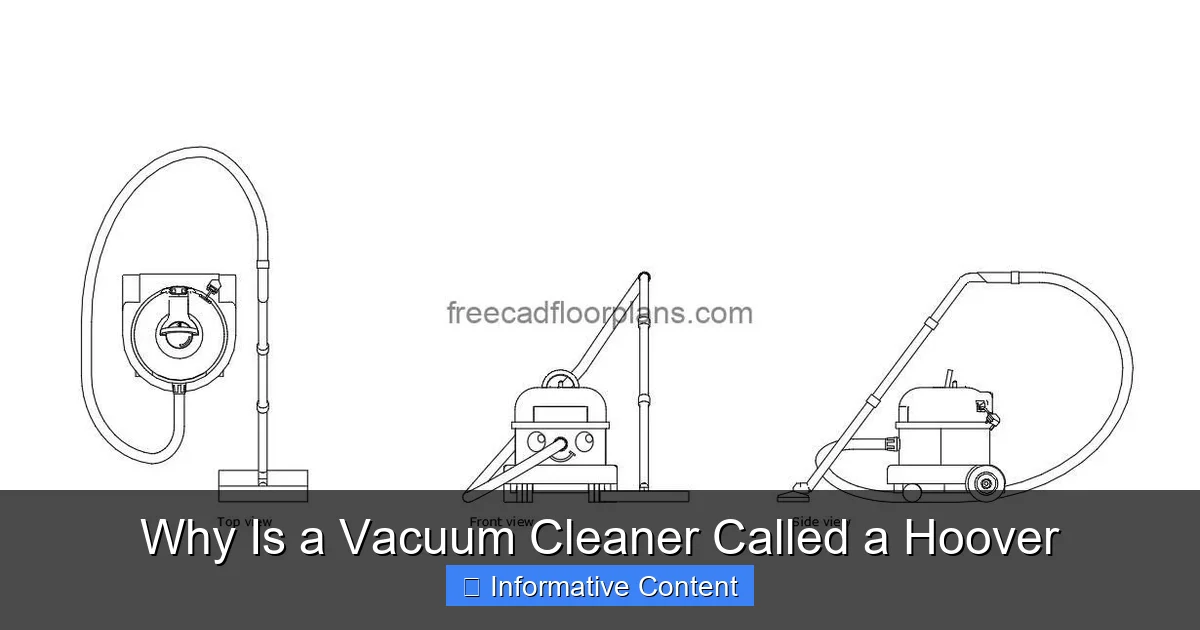
Why Is a Vacuum Cleaner Called a Hoover
Ever wondered why many people call every vacuum cleaner a “Hoover”? It’s a classic example of a brand name becoming a generic term due to early market dominance, innovative marketing, and widespread adoption. The Hoover Company, founded on Murray Spangler’s invention, revolutionized home cleaning, cementing its name in our everyday language and forever changing how we refer to floor-cleaning appliances.
Have you ever found yourself saying, “I need to hoover the living room,” even though your trusty cleaning machine proudly bears the label of another brand entirely? It’s a common linguistic quirk, one that often sparks a moment of bemusement. The word “Hoover” has transcended its origins as a mere brand name to become a generic term, synonymous with “vacuum cleaner” itself, particularly in the UK, Ireland, and Australia. This phenomenon isn’t unique – think of “Kleenex” for tissues or “Band-Aid” for adhesive bandages – but the story behind the Hoover Company’s rise to such linguistic dominance is a fascinating journey through American ingenuity, astute business strategy, and a touch of marketing brilliance.
It’s more than just a name; it’s a piece of history embedded in our everyday language. For many, the word “Hoover” conjures images of powerful suction, gleaming floors, and the satisfying hum of a machine tackling dust and dirt. But how did one company manage to capture the imagination – and the vocabulary – of an entire generation, making its name the go-to term for an essential household appliance? Let’s delve into the rich tapestry of innovation, entrepreneurship, and cultural impact that led to a vacuum cleaner being called a Hoover.
Key Takeaways
- Brand Genericide: The term “Hoover” for a vacuum cleaner is an example of “genericide,” where a brand name becomes a common noun due to its overwhelming market presence and early adoption.
- Murray Spangler’s Invention: The original electric suction sweeper was invented by Murray Spangler in 1907 to alleviate his asthma, using a fan, a box, and a pillowcase.
- W.H. Hoover’s Business Acumen: William Henry Hoover, a successful leather goods manufacturer, bought the patent from Spangler in 1908 and transformed the invention into a marketable, mass-produced product.
- Innovative Marketing: Hoover pioneered door-to-door demonstrations, allowing customers to try the product in their own homes, which was a revolutionary sales tactic for the era.
- Technological Superiority: Early Hoover vacuum cleaners, especially with the introduction of the “beater bar,” offered superior cleaning capabilities compared to their competitors, further solidifying their reputation.
- Cultural Dominance: Particularly in the UK and Ireland, the brand became so pervasive that “to hoover” became a verb meaning “to vacuum,” highlighting its deep linguistic and cultural penetration.
- Enduring Legacy: Despite countless vacuum cleaner brands today, the name “Hoover” remains a testament to a company that didn’t just sell a product, but defined an entire category of home appliance.
Quick Answers to Common Questions
Who invented the first portable electric vacuum cleaner?
The first portable electric vacuum cleaner was invented by James Murray Spangler in 1907.
When was The Hoover Suction Sweeper Company founded?
The Hoover Suction Sweeper Company was founded in 1908 by William Henry Hoover, who bought the patent rights from Murray Spangler.
What unique marketing strategy did Hoover use?
Hoover pioneered door-to-door sales demonstrations, allowing customers to try the vacuum cleaner in their own homes before buying.
What is the “beater bar” known for?
The “beater bar” is a rotating brush innovation by Hoover that beats, sweeps, and cleans carpets, loosening embedded dirt for more effective suction.
What does it mean for a brand name to become genericized, like “Hoover”?
Genericide means a brand name becomes so widely used that it becomes a common noun or verb for the product category itself, losing its specific trademark distinctiveness.
📑 Table of Contents
- The Dusty Dawn: Life Before the Vacuum Cleaner
- A Custodian’s Ingenuity: Murray Spangler’s Breakthrough
- The Business Acumen: W.H. Hoover Enters the Scene
- Revolutionizing the Home: Hoover’s Marketing and Innovation
- From Brand Name to Generic Term: The Genericide Phenomenon
- The Legacy of Hoover and Modern Vacuuming
The Dusty Dawn: Life Before the Vacuum Cleaner
Before the advent of the vacuum cleaner, keeping homes clean was an arduous and often dusty affair. Imagine a time when the primary tools for floor cleaning were brooms, brushes, and dustpans. Carpets, once a luxury, quickly became reservoirs for dirt, dust mites, and grime, requiring immense manual effort to keep even remotely presentable.
Manual Labor and Tedious Tasks
For centuries, cleaning involved sweeping, beating rugs outdoors with heavy carpet beaters, and meticulous scrubbing. These methods were not only physically demanding but also highly inefficient. Beating rugs created massive clouds of dust, simply relocating the problem rather than removing it. Indoor sweeping stirred up dust, which would then settle elsewhere, often exacerbating respiratory issues for those susceptible. The very act of cleaning often made the air quality worse before it got better.
Early Attempts at Mechanization
The late 19th century saw the birth of various mechanical carpet sweepers, often hand-pushed devices with rotating brushes that collected surface debris into a small receptacle. While a step up from a broom, they lacked suction and couldn’t deep clean carpets. True “vacuum” technology, leveraging air pressure differences, began to emerge, but early models were often gargantuan, noisy, expensive, and required multiple operators. They were certainly not household items. The stage was set for a more practical, affordable, and user-friendly solution that could truly revolutionize domestic cleaning. The need for a truly effective and convenient “vacuum cleaner” was palpable.
A Custodian’s Ingenuity: Murray Spangler’s Breakthrough
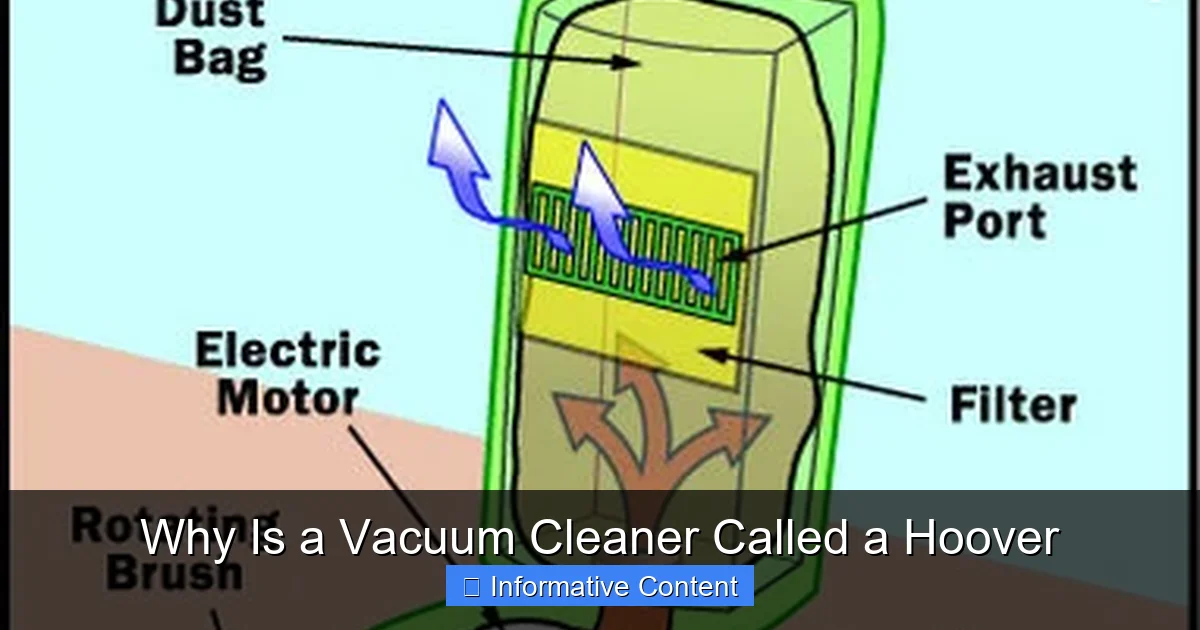
Visual guide about Why Is a Vacuum Cleaner Called a Hoover
Image source: thermodynamicsofvacuumcleaner.weebly.com
The story of the Hoover vacuum cleaner truly begins not in a corporate boardroom, but in the dusty corridors of a department store, with a night watchman suffering from asthma. This man was James Murray Spangler, and his personal struggle would ignite a revolution in home cleaning.
Spangler’s Personal Quest for Relief
Murray Spangler worked as a custodian at the Folwell building, a department store in Canton, Ohio, in the early 20th century. He suffered terribly from asthma, and his job, which involved constantly sweeping dusty carpets, only aggravated his condition. Frustrated by the clouds of dust and the inefficiency of traditional cleaning methods, Spangler began to tinker with ways to capture the dust rather than just move it around. He needed a “vacuum cleaner” for his own health.
The Eureka Moment: A Fan, a Box, and a Pillowcase
In 1907, Spangler had his breakthrough. He jury-rigged a crude but effective device using components he found lying around: an electric fan motor, a soap box, and a broom handle. The genius part was attaching a pillowcase to the fan to collect the dust it sucked up. This contraption, although cumbersome and primitive by today’s standards, was the very first portable electric “suction sweeper.” It didn’t just push dirt; it pulled it in, containing it, and offering genuine relief to Spangler’s asthmatic lungs. It was an innovative vacuum cleaner, even if still rough around the edges.
From Invention to Patent
Spangler quickly realized he had something revolutionary on his hands, something far more effective than any existing “vacuum cleaner.” He refined his design, adding a revolving brush to dislodge stubborn dirt before the suction lifted it, a feature that would become a hallmark of future Hoover models. On June 2, 1908, he was granted a patent for his “Electric Suction Sweeper,” a device that would ultimately become known globally simply as a Hoover. However, Spangler, while an brilliant inventor, lacked the business acumen and capital to mass-produce and market his invention. He needed a partner to truly make his vacuum cleaner a household name.
The Business Acumen: W.H. Hoover Enters the Scene
Murray Spangler had created a groundbreaking “vacuum cleaner,” but it was William Henry Hoover, a shrewd businessman with a background in leather goods manufacturing, who truly transformed it into an industrial phenomenon and cemented its name in history.
Spangler’s Dilemma and the Family Connection
Despite his brilliant invention, Spangler faced a common challenge for many inventors: how to turn a prototype into a marketable product. He was making a few of his “electric suction sweepers” by hand in his Canton workshop, but the process was slow and expensive. He couldn’t scale production or reach a wide audience on his own. Fortunately for him, his cousin’s wife, Susan Hoover, was one of the first to buy and use his machine. Impressed by its effectiveness and convenience, she showed it to her husband, William Henry Hoover.
William Henry Hoover’s Vision
W.H. Hoover, a prosperous entrepreneur who owned a successful saddle and leather goods manufacturing company, immediately recognized the immense potential of Spangler’s invention. The timing was perfect; with the rise of automobiles, the demand for horse saddles was declining, and Hoover was looking for a new venture. He saw beyond the crude appearance of Spangler’s vacuum cleaner and envisioned a powerful, reliable appliance that could revolutionize home cleaning.
In 1908, Hoover bought the patent rights from Spangler and founded The Hoover Suction Sweeper Company. Spangler was given a position in the new company as superintendent, continuing to contribute his inventive genius to improve the vacuum cleaner’s design. This pivotal partnership marked the true beginning of the Hoover brand’s journey from a niche invention to a global powerhouse. From this point forward, the company would be known simply as “Hoover,” and its product, “the Hoover vacuum cleaner.”
Revolutionizing the Home: Hoover’s Marketing and Innovation
The Hoover Company didn’t just build a better “vacuum cleaner”; it built an empire through continuous innovation and pioneering marketing strategies that made its name synonymous with home cleanliness.
The Power of Demonstration: Door-to-Door Sales
One of Hoover’s most brilliant marketing moves was the implementation of a door-to-door sales model, combined with an unheard-of home trial program. In an era when most goods were bought in stores, Hoover’s salesmen would arrive at homes, demonstrate the vacuum cleaner’s effectiveness on the spot, and even leave the machine for a free trial period. This allowed customers to experience firsthand how much dirt their old methods missed, proving the value of a Hoover vacuum cleaner directly in their own living rooms. This direct engagement built trust and showcased the product’s superiority, creating a legion of loyal customers.
Engineering Excellence and the “Beater Bar”
Hoover didn’t rest on Spangler’s initial design. The company continuously invested in research and development, refining the vacuum cleaner’s functionality and user experience. A significant innovation was the “beater bar,” a rotating brush that not only swept up surface debris but also vibrated and beat the carpet, loosening embedded dirt for the powerful suction to lift away. This unique “It beats as it sweeps as it cleans” slogan became synonymous with the brand and offered a level of deep cleaning that competitors struggled to match. The Hoover vacuum cleaner truly stood out.
Building a Brand Identity and Global Expansion
The Hoover Company meticulously built a brand image of quality, reliability, and innovation. Their “vacuum cleaner” became a symbol of modern domesticity and efficiency. As the company grew, it expanded its operations internationally, establishing a significant presence in the United Kingdom by 1909 and setting up its first European factory in Perivale, Middlesex, England, in 1932. The term “Hoover” quickly became ingrained in British culture, becoming not just a brand, but the very word for the appliance itself, and “to hoover” becoming a verb for the act of vacuuming. The success of the Hoover vacuum cleaner was undeniable.
From Brand Name to Generic Term: The Genericide Phenomenon
The transformation of “Hoover” from a specific brand name to a generic term for all “vacuum cleaners” is a classic example of a linguistic phenomenon known as “genericide.” This occurs when a trademark becomes so commonly used that it loses its distinctiveness and enters the public domain as a common noun.
What is Genericide?
Genericide is a powerful testament to a brand’s dominance and cultural impact. Other examples include “Xerox” for photocopies, “Kleenex” for facial tissues, “Band-Aid” for adhesive bandages, and, historically, “aspirin” and “thermos.” For a company, it’s a double-edged sword: immense brand recognition but also the risk of losing trademark protection if the term becomes too generic. While the Hoover Company fiercely defended its trademark, the sheer ubiquity of their “vacuum cleaner” made the generic use of the term almost inevitable.
Why Hoover? Market Dominance and Cultural Penetration
Several factors contributed to “Hoover’s” genericide:
- First Mover Advantage: Hoover was one of the earliest and most successful manufacturers of electric vacuum cleaners suitable for widespread household use. They defined the product category for many consumers.
- Superior Technology: The “beater bar” and consistent improvements ensured that Hoover vacuum cleaners often outperformed competitors, building a reputation for effectiveness.
- Aggressive Marketing: The door-to-door demonstrations and memorable slogans (“It beats as it sweeps as it cleans”) were incredibly effective in educating and converting consumers.
- High Market Share: For decades, Hoover commanded a significant, often dominant, share of the vacuum cleaner market, especially in the UK. This meant that for many households, their first, and perhaps only, experience with a “vacuum cleaner” was with a Hoover machine.
- Linguistic Convenience: “Hoover” is a short, memorable, and pronounceable word, making it easy to adopt as a generic term compared to the slightly more cumbersome “vacuum cleaner.” The transition to a verb (“to hoover”) further cemented its place in everyday language.
The British Anomaly
While “Hoover” is understood globally, its generic use is particularly prevalent in the United Kingdom, Ireland, and Australia. In these regions, “hoover” is commonly used as both a noun for any vacuum cleaner and a verb (“to hoover”) for the act of cleaning with one. This regional emphasis highlights the profound impact the Hoover Company had on British domestic life and lexicon, becoming a household name in the truest sense.
The Legacy of Hoover and Modern Vacuuming
The legacy of the Hoover Company extends far beyond its name becoming a generic term for “vacuum cleaner.” It established standards, drove innovation, and fundamentally changed how we approach home cleanliness.
Enduring Influence on the Industry
Hoover’s innovations, particularly the portable electric upright “vacuum cleaner” with a rotating brush, set the blueprint for countless models that followed. The company continually pushed boundaries, introducing features like disposable bags, headlights, and lighter, more maneuverable designs. They weren’t just selling a product; they were shaping an entire industry and establishing expectations for what a good “vacuum cleaner” should be.
Evolution of Vacuum Technology
Today, the landscape of “vacuum cleaners” is incredibly diverse, a testament to the foundation laid by pioneers like Hoover. We have:
- Bagless Vacuum Cleaners: Eliminating the need for disposable bags, these use cyclonic separation to collect dirt.
- Robotic Vacuum Cleaners: Autonomous devices that navigate homes, cleaning floors with minimal human intervention.
- Cordless Vacuum Cleaners: Offering unparalleled freedom of movement, these are powered by rechargeable batteries.
- Handheld Vacuum Cleaners: Compact and perfect for quick clean-ups and hard-to-reach spots.
- Central Vacuum Systems: Built into homes, with inlets throughout the house connected to a central power unit.
Despite these technological advancements, the fundamental principle of suction and often agitation, first perfected by Spangler and Hoover, remains at the core of most “vacuum cleaner” designs.
The Hoover Brand Today
The Hoover brand still exists today, a prominent player in the vacuum cleaner market and other home appliances. It has adapted to modern technologies, offering a range of innovative products from uprights and canisters to robot vacuums. While it competes with numerous other brands, the enduring power of its name—the fact that people still refer to “hoovering”—speaks volumes about its historical impact. It serves as a reminder that some brands don’t just sell products; they create cultural touchstones.
So, the next time you plug in your “vacuum cleaner,” regardless of its badge, and call it a “Hoover,” you’re not just uttering a word. You’re acknowledging a century of innovation, a triumph of marketing, and a testament to the transformative power of a simple idea that cleaned up the world, one dusty carpet at a time. It’s a tribute to a company that didn’t just invent a machine, but gave a name to an entire category of appliance.
🎥 Related Video: How does a Vacuum Cleaner Work? | Mocomi Kids
📺 MocomiKids
https://mocomi.com/ presents : How Does A Vacuum Cleaner Work – Science Videos for Kids Get in depth knowledge about how a …
Frequently Asked Questions
Is Hoover still a brand today?
Yes, Hoover is still a prominent brand today, offering a wide range of vacuum cleaners and other home appliances globally. The company continues to innovate and adapt to modern cleaning technologies.
Was Hoover the very first vacuum cleaner ever invented?
While Hoover created the first commercially successful portable electric vacuum cleaner, there were earlier, larger, and less practical vacuuming machines and carpet sweepers invented prior to Spangler’s design.
Why is the term “Hoover” more common in the UK than in the US?
The term “Hoover” became particularly prevalent in the UK due to the company’s aggressive marketing and early market dominance there, leading to the brand deeply embedding itself in British culture and language as a generic term.
Did the Hoover Company try to stop people from using its name generically?
Like many companies whose brands face genericide, Hoover has historically tried to protect its trademark and encourage the use of “Hoover vacuum cleaner” instead of just “hoover” to refer to any vacuum cleaner. However, the linguistic trend proved too strong.
What was Spangler’s original motivation for inventing the vacuum cleaner?
James Murray Spangler, a custodian, invented his electric suction sweeper primarily to alleviate his severe asthma, which was worsened by the dusty conditions of his workplace.
What was W.H. Hoover’s background before getting involved with vacuum cleaners?
Before establishing The Hoover Suction Sweeper Company, William Henry Hoover was a successful businessman who owned a thriving saddle and leather goods manufacturing company in Ohio.