Why Did Hubert Cecil Booth Invent the Vacuum Cleaner
Hubert Cecil Booth invented the vacuum cleaner after witnessing a flawed dust-blowing machine at a demonstration in 1901. Realizing the inefficiency and health risks of simply displacing dust, he conceptualized a device that would suck dust into a container, leading to his groundbreaking “Puffing Billy” prototype. His innovation transformed household hygiene, moving beyond brooms and dusters to offer genuinely clean environments and laying the foundation for modern cleaning technology.
Why Did Hubert Cecil Booth Invent the Vacuum Cleaner?
Imagine a world where clean meant merely pushing dust from one spot to another, where thick carpets harbored years of accumulated grime, and where fresh air indoors was a rare luxury. This wasn’t some distant past; it was daily life for millions at the dawn of the 20th century. Before the widespread adoption of the vacuum cleaner, keeping a home truly clean was an arduous, often ineffective, and surprisingly unhealthy task. It took an engineer with a keen eye for observation and a brilliant spark of insight to change all that. This person was Hubert Cecil Booth.
So, why did Hubert Cecil Booth invent the vacuum cleaner? The answer lies in a fascinating blend of practical necessity, scientific curiosity, and a pivotal “aha!” moment that completely redefined how we approach cleanliness. His journey from observing a flawed dust-blowing contraption to creating a revolutionary suction-based machine is a testament to inventive genius and a powerful reminder of how simple, yet profound, ideas can transform everyday life. Let’s delve into the dusty past and uncover the compelling story behind one of the most significant domestic inventions.
Join us as we explore the world Booth lived in, the challenge he faced, and the ingenious solution he brought to life. You’ll discover not just the technical “how,” but the crucial “why” that propelled Hubert Cecil Booth to invent the vacuum cleaner, an invention that continues to serve us in nearly every home around the globe today.
Key Takeaways
- The Problem: Before Booth, cleaning involved beating carpets and sweeping, which primarily moved dust around rather than removing it, posing significant health risks.
- The Inspiration: Hubert Cecil Booth’s pivotal moment came from observing a dust-blowing machine that merely scattered dirt, sparking his idea for a “sucking” mechanism.
- The Core Innovation: Booth’s genius was in realizing the superiority of creating a strong vacuum to draw dust and dirt into a filter, a revolutionary departure from existing methods.
- Early Prototypes: His first device, the “Puffing Billy,” was a massive, horse-drawn machine, demonstrating the power required for effective suction cleaning.
- Service-Based Model: Instead of selling machines, Booth initially offered cleaning services with his large vacuum units, bringing industrial-level cleanliness to homes and public buildings.
- Public & Royal Endorsement: The effectiveness of Booth’s vacuum cleaner quickly gained public fascination and royal approval, solidifying its importance and spreading its adoption.
- Lasting Legacy: Hubert Cecil Booth’s invention laid the foundational principles for every modern vacuum cleaner, fundamentally transforming household hygiene and public health.
Quick Answers to Common Questions
Who was Hubert Cecil Booth?
Hubert Cecil Booth was a British civil engineer who is credited with inventing the modern vacuum cleaner based on the principle of suction.
What inspired Booth to invent the vacuum cleaner?
Booth was inspired after attending a demonstration of an American machine that used compressed air to blow dust out of railway carriages, realizing that blowing only dispersed dust rather than removing it.
What was Booth’s key innovation in vacuum cleaning?
His key innovation was the realization that “sucking” dust into a filter was far more effective and hygienic than “blowing” it away.
What was the “Puffing Billy”?
The “Puffing Billy” was the nickname given to Booth’s first large, petrol-powered vacuum cleaner prototype, which was so big it had to be mounted on a horse-drawn cart.
Did Booth sell his early vacuum cleaners directly to people?
No, Booth initially offered vacuum cleaning as a service through his British Vacuum Cleaner Company, bringing his large machines to customers’ premises via horse-drawn carts.
📑 Table of Contents
The Pre-Vacuum Era: A World of Dust and Drudgery
Before Hubert Cecil Booth came along with his groundbreaking invention, cleaning homes was a vastly different endeavor. Picture the scene: Victorian and Edwardian houses, often grand and richly decorated, were veritable dust traps. Carpets were thick and wall-to-wall, drapes heavy, and furniture upholstered in plush fabrics. These materials, while luxurious, were also perfect breeding grounds for dust, dirt, and all sorts of microscopic nasties.
The Limitations of Traditional Cleaning
The primary tools for cleaning were simple: brooms, brushes, and dusters. Sweeping floors with a broom would gather visible debris, but it also kicked up clouds of fine dust into the air. This dust would then settle back down on surfaces, often just minutes later, creating an endless cycle of “cleaning” that never truly removed the problem. For carpets, the solution was even more laborious: they had to be taken outside, hung over a line, and beaten vigorously with carpet beaters. Imagine the sheer effort involved, not to mention the clouds of dust that would erupt, covering everything and everyone nearby. It was a physically demanding chore, often relegated to household staff or the strongest members of the family, and it was far from hygienic.
Dusting was another exercise in futility. A duster would merely push dust from one surface to another, or into the air, where it would eventually land again. The idea of “capturing” dust was largely absent from the cleaning paradigm. People simply moved it around, hoping it would disappear, but it rarely did.
Health Concerns in Victorian Homes
Beyond the aesthetic problem of dusty homes, there were serious health implications. In the late 19th and early 20th centuries, understanding of germ theory was growing. Doctors and scientists were beginning to connect airborne dust with respiratory illnesses, allergies, and the spread of diseases like tuberculosis. Homes filled with old, stagnant dust were seen as unhealthy environments.
The traditional methods of cleaning, by stirring up dust, actually exacerbated these health risks, releasing allergens and pathogens into the air to be inhaled. There was a desperate need for a cleaning method that could genuinely remove dust and dirt from the environment, rather than just relocating it. This pressing need set the stage for someone like Hubert Cecil Booth to invent the vacuum cleaner, providing a solution that was not only more efficient but also significantly healthier.
An Epiphany at St. Pancras Station
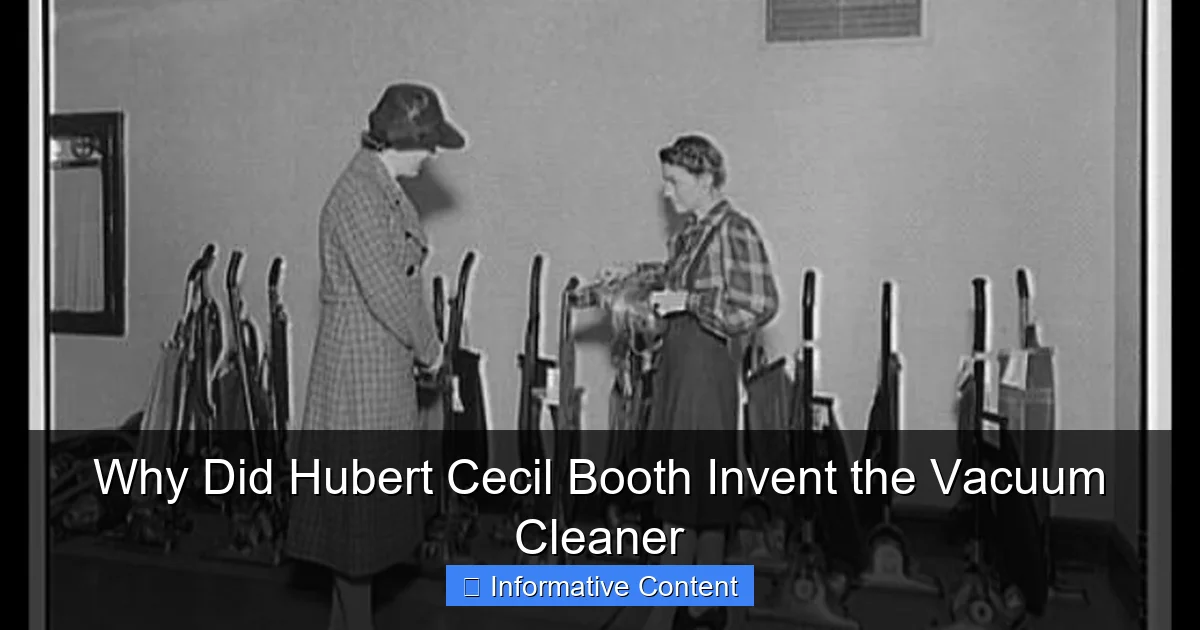
Visual guide about Why Did Hubert Cecil Booth Invent the Vacuum Cleaner
Image source: th-thumbnailer.cdn-si-edu.com
The pivotal moment that led Hubert Cecil Booth to invent the vacuum cleaner is a story of observation, critical thinking, and a stroke of genius. It was 1901, and Booth, a civil engineer by profession, attended a demonstration of a new American cleaning machine at St. Pancras Station in London. This machine was designed to clean railway carriages.
The Blowing Machine’s Flaw
The American machine’s approach to cleaning was quite novel for the time: it used compressed air to *blow* dust and dirt out of the carpets and upholstery. While the demonstrator proudly showed off the effectiveness of this powerful blast of air, clearing visible debris, Booth immediately saw a significant flaw. He noticed that as the machine blew dust *out* of the carpets, it simply propelled it *into the air* within the carriage. The dust wasn’t being removed; it was merely being displaced, creating a swirling cloud that would inevitably settle back down or be inhaled by passengers and workers.
Booth, ever the engineer, understood the principles of air pressure and particulate matter. He realized that blowing dust around was fundamentally inefficient and ultimately unhealthy. It didn’t solve the core problem of dust accumulation; it just moved the problem from one location to another.
Booth’s Eureka Moment
It was in this moment that Booth experienced his “eureka.” As he pondered the shortcomings of the blowing machine, a simple yet profound question formed in his mind: “Why not suck instead of blow?” He reasoned that if one could create a strong enough suction, the dust could be drawn *into* a container, rather than being dispersed into the atmosphere. This wasn’t just a minor tweak; it was a complete inversion of the prevailing cleaning philosophy.
Legend has it that to test his theory, Booth placed his handkerchief over the plush velvet seat of a restaurant chair and tried to suck the dust onto it with his mouth. Though a rather unhygienic experiment, it confirmed his intuition: dust could indeed be drawn through a filter by suction. This simple act of observation and imaginative reversal of a flawed concept directly led to why Hubert Cecil Booth would invent the vacuum cleaner. He envisioned a machine that would actively extract the dirt, trapping it, and thereby truly cleaning the environment. This foundational insight was the genesis of modern vacuum cleaning.
From Idea to Invention: The “Puffing Billy”
With his “sucking not blowing” revelation firmly in mind, Hubert Cecil Booth wasted no time turning his theoretical insight into a tangible invention. He dedicated himself to designing a machine that could generate sufficient suction to effectively remove dust and dirt, a task far more complex than it might initially seem.
Early Prototypes and Principles
Booth’s first experimental devices were quite rudimentary. He focused on creating a powerful air pump that could generate a significant vacuum. The challenge was to achieve this without creating an excessively bulky or inefficient machine. His designs centered on a motor-driven pump that would draw air through a filter system, capturing the dust particles. The principle was elegantly simple: create a partial vacuum, and atmospheric pressure would push air (and suspended dust) towards the area of lower pressure, through a nozzle, and into a collecting chamber.
He experimented with various types of filters to ensure that the dust was effectively trapped and not simply blown out the other side. This filtration system was crucial to the success of his invention, as it ensured that the collected dust truly remained out of the environment.
The Challenge of Scale and Power
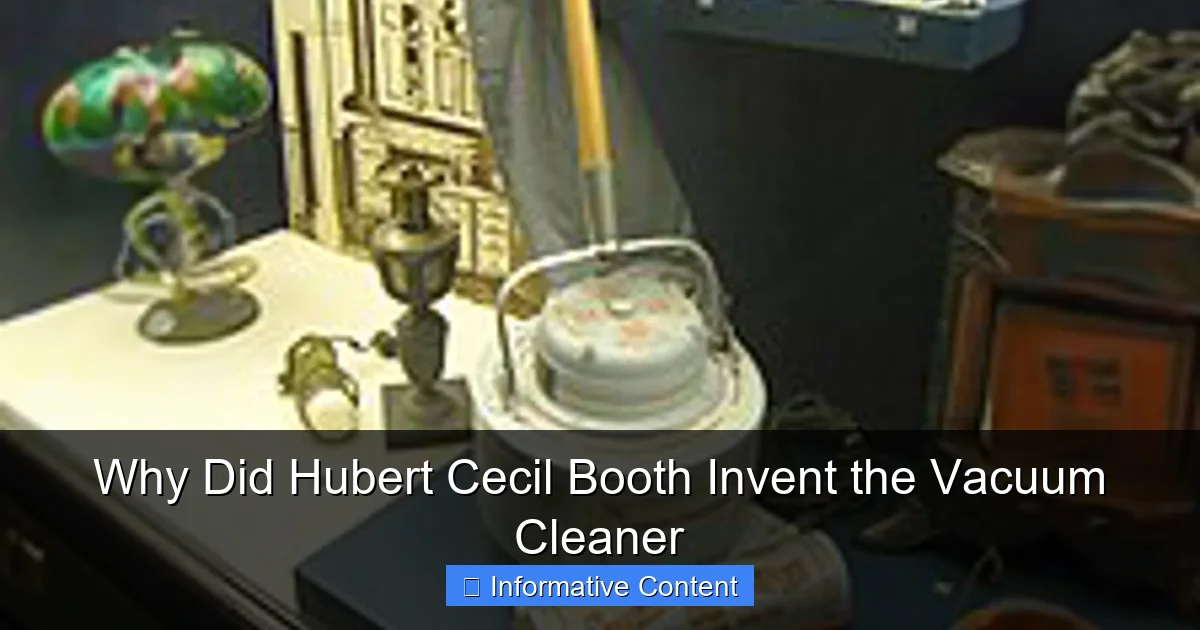
The result of Booth’s initial efforts to invent the vacuum cleaner was not the sleek, portable machine we know today. His first working prototype, patented in 1901, was a truly massive contraption, soon nicknamed “Puffing Billy” by the public due to its noisy, chugging engine. This behemoth was powered by a petrol engine, requiring significant horsepower to create the necessary suction. It was so large, in fact, that it couldn’t simply be carried into a house.
Instead, Booth’s “Puffing Billy” was mounted on a horse-drawn cart. The cart would be parked outside a building, and long hoses, sometimes several hundred feet long, would be fed through windows and doors to reach the interior. Operators would then move these nozzles across carpets and upholstery, watching in amazement as dirt and dust were visibly sucked away, disappearing into the machine’s large collection bags. While cumbersome, it demonstrated undeniably that his principle of suction cleaning worked, and worked remarkably well, providing a level of cleanliness previously unimaginable. It was a clear demonstration of why Hubert Cecil Booth invented the vacuum cleaner – to genuinely remove dirt.
Bringing Cleanliness to the Masses (and Royalty)
Hubert Cecil Booth wasn’t just an inventor; he was also a shrewd entrepreneur. Recognizing that his initial vacuum cleaner was far too large and expensive for individual households to purchase, he devised an innovative business model.
The British Vacuum Cleaner Company
Instead of selling his massive “Puffing Billy” machines directly, Booth founded the British Vacuum Cleaner Company (BVCC) in 1903. This company offered a cleaning *service*. The horse-drawn vacuum cleaner would arrive at a customer’s home or business, park outside, and a team of operators would unroll the lengthy hoses, bringing the powerful suction capability directly into the building. Customers could hire the BVCC to perform thorough, deep cleaning of their carpets, upholstery, and even walls.
This service model was a stroke of genius. It allowed people to experience the transformative power of Booth’s invention without the immense upfront cost or the logistical challenge of owning such a large machine. The novelty of the “vacuum cleaner van” arriving in the street, with its team of uniformed operators, quickly captured public attention and imagination. It was a spectacle, and more importantly, it delivered unprecedented cleanliness.
Royal Approval and Public Fascination
The effectiveness of Booth’s vacuum cleaner quickly gained renown. Its ability to extract embedded dirt and dust was far superior to any existing method. Soon, the British Vacuum Cleaner Company was employed to clean prestigious venues. One notable early achievement was the cleaning of Westminster Abbey for King Edward VII’s coronation in 1902. The machine impressively removed vast quantities of dust that had accumulated over years, earning royal commendation and a significant boost in credibility.
The Royal Mint, Buckingham Palace, and even the Palace of Westminster also availed themselves of Booth’s unique cleaning service. This royal endorsement cemented the status of Booth’s invention as a truly revolutionary device. The public, witnessing these high-profile cleanings and experiencing the benefits in their own homes, became increasingly fascinated. The phrase “vacuum cleaner” became synonymous with thorough, hygienic cleaning. This growing demand and undeniable proof of efficacy further validated why Hubert Cecil Booth invented the vacuum cleaner, proving its profound impact on society. The public’s desire for cleaner, healthier homes was finally being met, thanks to Booth’s ingenious suction system.
The Enduring Legacy of Hubert Cecil Booth
The vision of Hubert Cecil Booth to invent the vacuum cleaner wasn’t just about creating a new gadget; it was about fundamentally transforming the way we live and maintain our environments. His invention had a profound and lasting impact that extends far beyond domestic chores.
Transforming Domestic Life
Booth’s vacuum cleaner dramatically improved household hygiene. For the first time, people could truly remove dust, dirt, and allergens from their homes, leading to cleaner air and healthier living conditions. The laborious task of carpet beating became obsolete, freeing up significant time and effort, especially for women and domestic staff.
Over time, as technology advanced, Booth’s massive, petrol-powered vacuum cleaners began to shrink. Smaller electric motors became available, allowing for the development of more compact, portable vacuum cleaners that could be brought indoors and operated by individuals. These domestic models, inspired directly by Booth’s suction principle, made deep cleaning accessible to millions of households, making daily life easier and homes demonstrably cleaner. The shift from a service to an individual appliance empowered homeowners to maintain cleanliness on their own terms, ushering in an era of unprecedented domestic convenience.
The Evolution of Vacuum Technology
Every vacuum cleaner you see today, from the upright models to canister vacuums, robotic cleaners, and handheld devices, owes its fundamental design principle to Hubert Cecil Booth. His insight that “sucking is better than blowing” remains the core tenet of all vacuum technology. While the power sources, filtration systems, and designs have evolved dramatically, the basic mechanism of creating a vacuum to draw in airborne particles and trap them in a filter is a direct descendant of Booth’s original concept.
Modern vacuum cleaners are more efficient, quieter, and come with a myriad of attachments for specialized cleaning tasks. They incorporate HEPA filters to trap even microscopic allergens, smart technology for autonomous cleaning, and ergonomic designs for ease of use. Yet, none of these advancements would have been possible without the foundational work of Booth. He wasn’t just building a machine; he was laying the groundwork for an entire industry and a new standard of cleanliness. His legacy is a testament to the power of observation, innovation, and a commitment to solving a practical problem with an elegant, effective solution. Why did Hubert Cecil Booth invent the vacuum cleaner? Because he saw a better, healthier way to clean, and he had the genius to bring that vision to life.
Conclusion
The story of why Hubert Cecil Booth invented the vacuum cleaner is a compelling narrative of ingenuity born from a simple observation. In an era plagued by dust, grime, and the inefficiency of traditional cleaning methods, Booth saw a profound flaw in the prevalent approach to cleaning. His revolutionary insight – that true cleanliness required *suction*, not merely displacement of dirt – led to an invention that would change domestic life forever.
From the unwieldy, horse-drawn “Puffing Billy” to the sleek, smart devices in our homes today, every vacuum cleaner carries the DNA of Booth’s original concept. He didn’t just create a machine; he sparked a revolution in hygiene, public health, and household convenience. His legacy reminds us that sometimes, the most transformative ideas come from simply asking “What if we did the opposite?” Hubert Cecil Booth’s enduring contribution ensures that our homes remain cleaner, our air fresher, and our lives just a little bit easier, all thanks to his pivotal invention.
🎥 Related Video: Hubert Cecil Booth invented the first successful vacuum cleaner #shorts #facts #inventions
📺 Lil Professor Brah
In 1901, Hubert Cecil Booth revolutionized cleaning with the first successful vacuum cleaner, a behemoth so colossal it required …
Frequently Asked Questions
How did people clean before Hubert Cecil Booth invented the vacuum cleaner?
Before Booth’s invention, cleaning primarily involved brooms, brushes, and dusters for surfaces, and taking carpets outside to beat them manually. These methods largely displaced dust rather than removing it, often stirring up allergens and dirt into the air.
What was wrong with the earlier “blowing” cleaning machines?
The “blowing” machines, like the one Booth observed, used compressed air to blast dust and dirt out of surfaces. The problem was that this only scattered the dust into the surrounding air, where it would eventually settle again, making the cleaning ineffective and unhealthy.
How did Hubert Cecil Booth test his idea for a suction cleaner?
Legend has it that Booth first tested his idea by placing a handkerchief over a plush velvet restaurant chair and trying to suck the dust through it with his mouth, confirming that suction could indeed draw dust through a filter.
Why was the “Puffing Billy” so large?
Booth’s initial “Puffing Billy” vacuum cleaner was large because it required a powerful petrol engine to generate enough suction to be effective. The technology for smaller, more efficient electric motors wasn’t readily available or powerful enough at that time.
How did the British Vacuum Cleaner Company operate?
The British Vacuum Cleaner Company provided cleaning services. Their large, horse-drawn vacuum cleaners would arrive at a customer’s location, and long hoses would be fed into the building to perform thorough cleaning of carpets and upholstery.
What is Hubert Cecil Booth’s lasting legacy in terms of cleaning technology?
Hubert Cecil Booth’s lasting legacy is the foundational principle of suction-based cleaning. Every modern vacuum cleaner, regardless of its size or advanced features, operates on the core concept of creating a vacuum to draw in dust and dirt, a direct evolution of Booth’s original invention.