Why Is Jupiter Called the Vacuum Cleaner
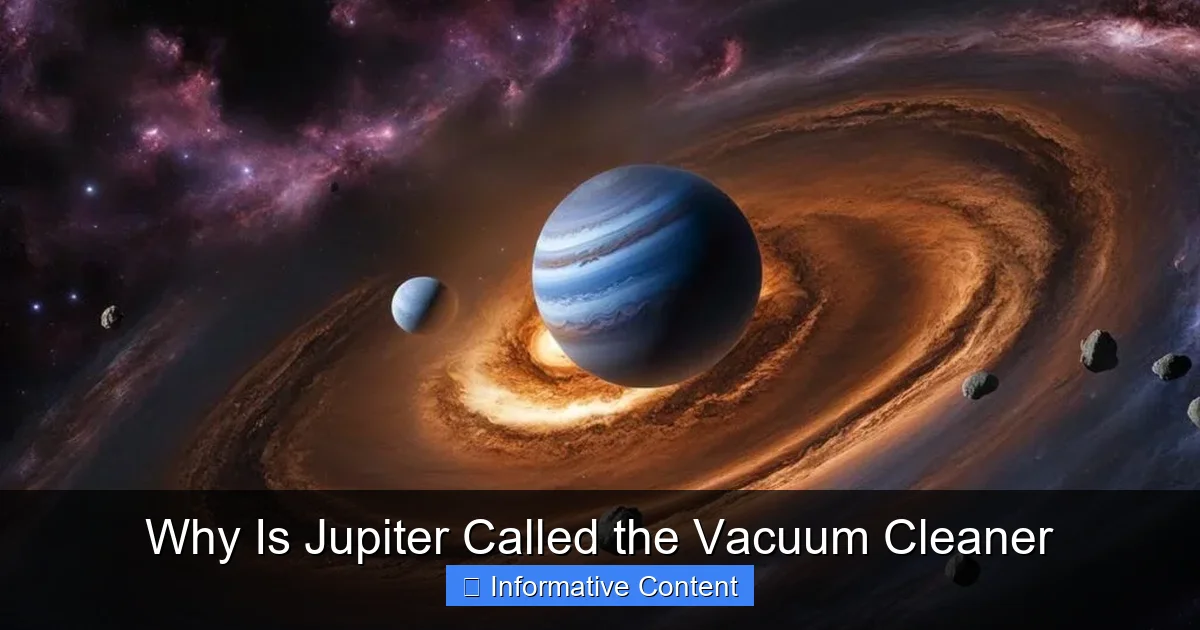
Jupiter, our solar system’s largest planet, has earned the nickname “the vacuum cleaner” due to its immense gravitational pull. This powerful force acts like a cosmic magnet, deflecting or capturing countless asteroids and comets that might otherwise pose a threat to the inner planets, including Earth. Its protective role has been crucial in shaping our solar system and maintaining a relatively safe environment for life to thrive.
Why Is Jupiter Called the Vacuum Cleaner
Imagine a colossal, swirling giant, larger than all other planets combined, silently patrolling our solar system. This isn’t just a scene from a science fiction movie; it’s a description of Jupiter, the magnificent gas giant that stands as the fifth planet from our Sun. But Jupiter is more than just a pretty face in the night sky. It’s often referred to as “the vacuum cleaner” of the solar system, a nickname that hints at its vital and awe-inspiring role in maintaining the cosmic order.
This intriguing moniker isn’t just a whimsical fancy; it’s a testament to Jupiter’s incredible gravitational power. For billions of years, this planetary behemoth has been diligently sweeping up or deflecting countless space rocks, comets, and other debris that hurtle through space. Think about it: without Jupiter’s immense influence, our inner solar system, including our very own Earth, might be a much more dangerous place, constantly bombarded by celestial projectiles. So, let’s embark on a journey to understand why is Jupiter called the vacuum cleaner and delve into the fascinating science behind this cosmic cleanup crew.
In the following sections, we’ll explore Jupiter’s mind-boggling size and gravitational pull, examine concrete examples of its “cleaning” activities, and understand how its presence has fundamentally shaped our solar system from its very beginnings. We’ll also touch upon the nuances of this analogy, discussing how this powerful protector sometimes also plays a more complex role. By the end, you’ll have a profound appreciation for why Jupiter is called the vacuum cleaner and the silent, essential work it performs for all of us.
Key Takeaways
- Immense Gravity: Jupiter’s colossal size and mass generate an incredibly powerful gravitational field, making it the most dominant gravitational force in our solar system after the Sun.
- Protective Shield: This immense gravity acts like a cosmic shield, deflecting or capturing dangerous asteroids and comets, significantly reducing the frequency of impacts on Earth and other inner planets.
- Evidence from Impacts: The spectacular collision of Comet Shoemaker-Levy 9 with Jupiter in 1994 provided dramatic visual evidence of its “vacuum cleaner” role, demonstrating its ability to intercept celestial bodies.
- Solar System Sculptor: Beyond just protection, Jupiter’s gravity played a crucial role in shaping the early solar system, influencing the formation of the asteroid belt and the orbits of other planets.
- Dual Role: While primarily a protector, Jupiter’s gravity can sometimes also perturb objects, occasionally flinging them towards the inner solar system, highlighting its complex and dynamic influence.
- Stabilizing Influence: By clearing out or stabilizing various objects, Jupiter contributes significantly to the overall stability and long-term evolution of our planetary system.
Quick Answers to Common Questions
What is the main reason why Jupiter is called the vacuum cleaner?
Jupiter is called the vacuum cleaner primarily because its immense gravitational pull acts like a cosmic magnet, deflecting or absorbing countless asteroids and comets that might otherwise impact the inner planets, including Earth.
Did Jupiter literally “clean up” the early solar system?
Yes, in a way. Jupiter’s gravity prevented material in the asteroid belt from coalescing into a fifth rocky planet, instead scattering and preventing accretion, thus “cleaning” that region of planet formation.
What was the Shoemaker-Levy 9 impact?
The Shoemaker-Levy 9 impact was a spectacular event in 1994 when fragments of a comet, intercepted by Jupiter’s gravity, collided with the giant planet, leaving massive scars in its atmosphere and demonstrating its protective role.
Does Jupiter ever send objects towards Earth?
While Jupiter primarily deflects objects away, its complex gravitational interactions can, on rare occasions, also perturb objects into orbits that could eventually lead them towards the inner solar system. However, its net effect is overwhelmingly protective.
How does Jupiter’s gravity affect the asteroid belt?
Jupiter’s gravity strongly influences the asteroid belt, creating “Kirkwood gaps” where asteroids are cleared out due to orbital resonances, and trapping other asteroids in stable “Trojan” points, effectively sculpting the belt’s structure.
📑 Table of Contents
- The Giant Among Planets: Understanding Jupiter’s Scale
- Sweeping Up the Cosmic Dust: How Jupiter Cleans the Solar System
- More Than Just a Cleaner: Jupiter’s Role in Early Solar System Formation
- The Mechanics Behind the Might: Jupiter’s Gravitational Prowess Explained
- The “Vacuum Cleaner” Analogy: Is it Perfect?
- Conclusion
The Giant Among Planets: Understanding Jupiter’s Scale
To truly grasp why Jupiter is called the vacuum cleaner, we first need to appreciate its sheer scale. Jupiter is not just big; it’s unimaginably massive. It truly lives up to its “giant” designation, dominating our solar system in a way no other planet does.
Unfathomable Size and Mass
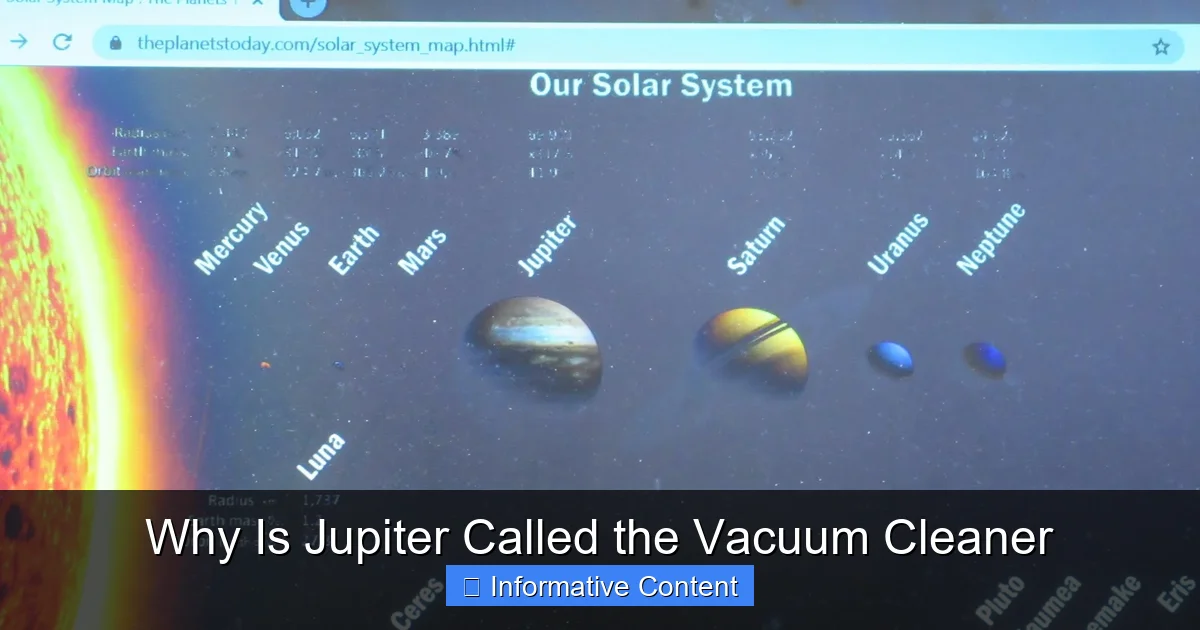
Let’s put Jupiter’s size into perspective. If you were to gather all the other planets in our solar system – Mars, Earth, Venus, Mercury, Saturn, Uranus, and Neptune – and somehow combine them into one massive sphere, Jupiter would *still* be more than twice as massive. It’s so big that over 1,300 Earths could fit inside it! This isn’t just a matter of volume; it’s about mass. Jupiter contains approximately 70% of the total planetary mass in our solar system. Imagine that!
This colossal mass is the fundamental reason behind its nickname “Jupiter, the vacuum cleaner.” It’s not just a big ball of gas; it’s a gravitational powerhouse. Its enormous bulk translates directly into an immense gravitational field, a field that extends far beyond its immediate atmosphere and influences objects millions of miles away.
A Powerful Gravitational Pull
Gravity, as we know from Isaac Newton, is directly proportional to mass. The more massive an object, the stronger its gravitational pull. Since Jupiter is so incredibly massive, its gravitational force is likewise phenomenal. If you could stand on Jupiter (which you can’t, as it’s a gas giant with no solid surface), you’d weigh about 2.5 times what you do on Earth. This isn’t just a fun fact; it’s the core principle explaining why Jupiter is called the vacuum cleaner.
This powerful gravitational pull acts like an invisible, planet-sized magnet, reaching out into the far stretches of the solar system. It grabs hold of smaller objects—asteroids, comets, and other bits of cosmic debris—and either pulls them in for a spectacular impact or slingshots them away onto entirely new trajectories, often out of the inner solar system altogether. This constant interaction is why Jupiter is called the vacuum cleaner, diligently tidying up our cosmic neighborhood.
Sweeping Up the Cosmic Dust: How Jupiter Cleans the Solar System
Visual guide about Why Is Jupiter Called the Vacuum Cleaner
Image source: 1.bp.blogspot.com
Now that we understand Jupiter’s immense power, let’s look at the concrete ways it acts as the solar system’s cleanup crew. The actions of Jupiter, the vacuum cleaner, are not just theoretical; they are observed phenomena that have dramatic consequences for other planets.
Gravitational Shielding
The primary way Jupiter functions as a vacuum cleaner is through gravitational shielding. Picture this: thousands, even millions, of asteroids and comets constantly whiz through space. Many of these originated in the asteroid belt between Mars and Jupiter, or further out in the Kuiper Belt and the distant Oort Cloud. These objects can be nudged by gravitational interactions or collisions, sending them hurtling on paths that could intersect with the inner planets.
Enter Jupiter. As these potentially dangerous objects approach the inner solar system, Jupiter’s massive gravity often intercepts them. It either pulls them directly into itself, leading to an impact, or, more commonly, it redirects their paths. This redirection can send them flying out of the solar system entirely, into the Sun, or into stable orbits that no longer pose a threat to Earth. This constant gravitational influence effectively creates a protective barrier, reducing the frequency of catastrophic impacts on our home planet. This is the essence of why Jupiter is called the vacuum cleaner.
The Shoemaker-Levy 9 Impact: A Famous Example
Perhaps the most dramatic and widely observed proof of Jupiter’s role as a vacuum cleaner occurred in July 1994. Comet Shoemaker-Levy 9, a fragmented comet, spectacularly slammed into Jupiter’s atmosphere over several days. This wasn’t just a small impact; the fragments created massive scars in Jupiter’s cloud tops, some larger than Earth itself, that were visible for months.
This event was a stark reminder of what could happen if such an object were to hit Earth. Scientists estimate that if Shoemaker-Levy 9 had been on an Earth-bound trajectory, the resulting impacts would have been catastrophic, potentially wiping out entire species. The fact that Jupiter intercepted it underscores its critical role. It literally took a bullet for the inner solar system, dramatically illustrating why Jupiter is called the vacuum cleaner. It was a firsthand demonstration of its active role in protecting us.
Reshaping Orbital Paths
Beyond direct interception, Jupiter’s gravity constantly perturbs the orbits of countless smaller bodies. It doesn’t just “clean” by consuming; it also cleans by reorganizing. Its enormous mass creates gravitational resonances that can either stabilize certain asteroid orbits or, conversely, destabilize them, pushing objects towards either the inner or outer solar system.
For instance, the Kirkwood gaps within the asteroid belt are regions where Jupiter’s gravity has cleared out asteroids due to orbital resonance. In these areas, an asteroid’s orbital period would be a simple fraction (e.g., 1/2, 1/3) of Jupiter’s, leading to repeated gravitational nudges that eventually eject the asteroid from that orbit. This active shaping of the asteroid belt further illustrates why Jupiter is called the vacuum cleaner – it’s not just catching things, it’s also tidying up the entire cosmic neighborhood.
More Than Just a Cleaner: Jupiter’s Role in Early Solar System Formation
Jupiter’s influence as a vacuum cleaner isn’t just a present-day phenomenon; it has been a dominant force since the very dawn of our solar system, playing a pivotal role in shaping its architecture.
Sculpting the Asteroid Belt
One of the most profound examples of Jupiter’s early influence is its role in the formation of the asteroid belt. Many scientists believe that without Jupiter, there might have been a fifth rocky planet forming in that region. However, Jupiter’s massive gravitational pull, even in the early stages of its formation, continuously stirred up the material in the proto-asteroid belt. It prevented planetesimals (small, nascent planetary bodies) from accreting into a larger planet.
Instead, Jupiter’s gravity kept these rocky bodies on chaotic, highly eccentric orbits, causing them to collide at high velocities. These collisions typically led to fragmentation rather than accretion, resulting in the millions of smaller rocks we see today in the asteroid belt. So, while it didn’t literally “vacuum” them all up, it certainly “cleaned” the area of potential planet formation, ensuring it remained a belt of debris. This historical influence is a core reason why Jupiter is called the vacuum cleaner.
Influence on Kuiper Belt Objects and Oort Cloud
Jupiter’s gravitational reach extends far beyond the asteroid belt, influencing the icy realms of the Kuiper Belt (beyond Neptune) and even the distant Oort Cloud. Its early gravitational interactions with other gas giants, particularly Saturn, are thought to have caused significant migrations of these planets. This “Grand Tack” hypothesis suggests that Jupiter initially migrated inward towards the Sun before migrating back out to its current position.
During these migrations, Jupiter would have scattered countless icy bodies from the inner solar system outwards, contributing material to the Kuiper Belt and Oort Cloud. Conversely, it also perturbed objects *within* these regions, sending some on paths that might eventually bring them closer to the Sun or even fling them out of the solar system entirely. These massive, long-range effects further solidify the understanding of why Jupiter is called the vacuum cleaner, as it continually reshapes the outer boundaries of our planetary neighborhood.
A Planetary Protector or a Menace?
While we mostly focus on Jupiter’s protective role, it’s important to acknowledge that its immense gravity is a double-edged sword. While it typically deflects objects away from the inner solar system, its powerful gravitational influence can occasionally sling objects *inward* as well. Imagine a cosmic game of billiards, where Jupiter is the cue ball. Sometimes it clears the table, but other times, it can inadvertently send a ball towards the pockets you’re trying to protect.
However, the overwhelming consensus among scientists is that Jupiter’s net effect has been profoundly protective. The number of potentially hazardous objects it intercepts or flings out of the inner solar system far outweighs the number it nudges towards us. Its presence is considered a crucial factor in the relatively low impact rate on Earth over geological timescales, allowing for the stable conditions necessary for life to evolve. This powerful balance is why Jupiter is called the vacuum cleaner, performing a complex and essential dance.
The Mechanics Behind the Might: Jupiter’s Gravitational Prowess Explained
To really understand why Jupiter is called the vacuum cleaner, a brief dive into the physics of its power is helpful. It’s all about gravity, but on a truly immense scale.
Newton’s Law of Universal Gravitation
At its heart, Jupiter’s vacuum-cleaner action is governed by Isaac Newton’s Law of Universal Gravitation. This law states that every particle of matter in the universe attracts every other particle with a force that is directly proportional to the product of their masses and inversely proportional to the square of the distance between their centers.
In simpler terms: Big things pull harder than small things, and things pull harder when they’re closer. Jupiter’s mass is absolutely enormous, making the “product of their masses” part of the equation very large indeed when it interacts with an asteroid or comet. Even though these smaller objects might be far away, Jupiter’s sheer mass ensures that its gravitational pull remains significant enough to alter their trajectories. This fundamental law is the bedrock of why Jupiter is called the vacuum cleaner.
The Jupiter-Sun Dance
Jupiter isn’t just sitting still, passively waiting for things to come its way. It’s in constant, dynamic motion, orbiting the Sun every 11.8 Earth years. This orbit itself, combined with its mass, makes it a gravitational powerhouse that affects the Sun itself. Jupiter’s gravity is so strong that it causes the Sun to “wobble” slightly around a point that is just outside the Sun’s surface, rather than the Sun’s exact center.
This dynamic interplay means that Jupiter is constantly moving through different regions of space, effectively sweeping a vast volume. As it moves, its gravitational field acts as a constantly shifting net, scooping up or deflecting objects from a wide range of orbital paths. It’s not a stationary target; it’s an active, moving force field, which adds another layer to why Jupiter is called the vacuum cleaner.
Resonance and Orbital Harmony
Beyond direct pull, Jupiter’s gravity also creates “orbital resonances.” These occur when two orbiting bodies exert regular, periodic gravitational influence on each other, usually because their orbital periods are related by a simple ratio (e.g., 2:1, 3:2). These resonances can have profound effects, either stabilizing orbits or destabilizing them over long periods.
In some parts of the asteroid belt, Jupiter’s resonance has created the Kirkwood gaps, as mentioned earlier, essentially clearing those zones of asteroids. In other regions, like the Trojan asteroids, Jupiter’s resonance has created stable pockets of gravity (Lagrange points) where thousands of asteroids happily co-orbit with Jupiter, trapped by its powerful influence. These complex gravitational interactions demonstrate the nuanced but incredibly powerful way Jupiter, the vacuum cleaner, shapes its environment.
The “Vacuum Cleaner” Analogy: Is it Perfect?
The nickname “the vacuum cleaner” is incredibly evocative and largely accurate, but like any analogy, it has its limits. It helps us understand a complex concept, but it’s important to appreciate the full picture.
A Net Protector
When we say why Jupiter is called the vacuum cleaner, we’re primarily highlighting its role as a protector. The overall effect of Jupiter’s gravity on the inner solar system has been to significantly reduce the bombardment of comets and asteroids. Without Jupiter, models suggest that Earth would have experienced far more catastrophic impacts throughout its history, potentially making the long-term stability required for complex life much less likely. So, yes, in its overall action, it largely “cleans up” by removing threats. It acts as a shield, deflecting the majority of potentially dangerous objects.
Not Always a Gentle Sweep
A vacuum cleaner typically sucks things up and keeps them. Jupiter’s interaction is more dynamic. While it does absorb some objects (like Shoemaker-Levy 9), it also frequently acts as a gravitational “slingshot.” It can accelerate objects, sending them into new, sometimes faster, trajectories. Most of these new paths lead objects away from the inner solar system, but some can, theoretically, send objects inward.
However, the statistical probability favors the protective role. The objects it flings inward are a smaller fraction compared to those it diverts outward or absorbs. This nuance is important to remember when we discuss why Jupiter is called the vacuum cleaner; it’s a powerful gravitational sculptor, not just a passive collector.
A Cosmic Balancing Act
Ultimately, Jupiter’s presence represents a cosmic balancing act. Its immense gravity is a double-edged sword that has shaped our solar system in profound ways. It prevented the formation of a planet in the asteroid belt, influenced the migration of other gas giants, and continues to manage the flow of cosmic debris. This complex interplay of forces means that while it’s a powerful “cleaner,” it’s also an active participant in the ongoing evolution of our celestial neighborhood. The moniker “Jupiter, the vacuum cleaner” captures the essence of its beneficial, protective role for inner planets like Earth, making it one of the most vital planets in our solar system.
Conclusion
So, why is Jupiter called the vacuum cleaner? The answer lies in its overwhelming mass and the colossal gravitational field it generates. This isn’t just a quaint nickname; it’s a scientific acknowledgment of Jupiter’s indispensable role in safeguarding the inner solar system from the constant barrage of asteroids and comets. From the dramatic impact of Shoemaker-Levy 9 to its subtle shaping of the asteroid belt and beyond, Jupiter has consistently acted as our solar system’s vigilant guardian.
This gas giant not only cleans up stray cosmic debris but also profoundly influenced the very architecture of our planetary system from its earliest days. Its gravitational prowess prevents chaos, maintaining a relative stability that has allowed life on Earth to flourish over billions of years. When you gaze up at the night sky and spot that bright beacon, remember Jupiter, the vacuum cleaner, diligently performing its cosmic chores, ensuring our little corner of the universe remains a safer, more stable home. It’s a truly remarkable testament to the powerful, unseen forces at play in the grand tapestry of space.
🎥 Related Video: Jupiter: The Cosmic Vacuum
📺 Ultra Space Balls
it from asteroids—Jupiter and the Moon! 🛡️ Jupiter, the “vacuum cleaner” of the solar system, uses its massive gravity to …
Frequently Asked Questions
Why is Jupiter considered a protector of Earth?
Jupiter is considered a protector of Earth because its enormous gravitational field acts as a cosmic shield. It intercepts or diverts many asteroids and comets that would otherwise be on a collision course with our planet, significantly reducing impact risks.
How big is Jupiter compared to Earth?
Jupiter is colossal; it’s so large that over 1,300 Earths could fit inside it. Its mass is more than twice the mass of all the other planets in our solar system combined, which explains its powerful gravitational influence.
What would happen if Jupiter didn’t exist?
If Jupiter didn’t exist, the inner solar system would likely be a much more dangerous place. Earth would face a significantly higher risk of impacts from asteroids and comets, potentially preventing the long-term stable conditions necessary for life to evolve.
Is the “vacuum cleaner” analogy scientifically accurate?
The “vacuum cleaner” analogy is largely accurate in describing Jupiter’s dominant gravitational role in clearing and deflecting cosmic debris. While it doesn’t simply “suck up” everything, its overall effect is one of protection and shaping the solar system.
Does Jupiter have any other significant roles in the solar system?
Beyond being the “vacuum cleaner,” Jupiter played a crucial role in the early solar system’s formation, influencing the asteroid belt and the migration of other gas giants. It also has a profound effect on the Sun’s motion and the stability of the entire planetary system.
What kind of objects does Jupiter “vacuum up”?
Jupiter primarily “vacuums up” (or deflects) comets originating from the outer solar system (like the Kuiper Belt and Oort Cloud) and asteroids from the main asteroid belt. These are typically icy or rocky bodies of varying sizes.