How Dyson Vacuum Cleaner Works
Dyson vacuum cleaners revolutionized cleaning with their unique cyclonic technology, eliminating bags and maintaining powerful, constant suction. Instead of relying on bags that clog and reduce airflow, Dyson machines spin dust and debris out of the airstream using centrifugal force. This innovative approach, combined with advanced digital motors and multi-stage filtration, ensures superior dirt pick-up and expels cleaner air, making them highly effective for tackling various messes around your home.
Ever wondered what makes a Dyson vacuum cleaner tick? You’re not alone! These machines have become synonymous with powerful cleaning and innovative design. When you pick up a Dyson, you’re not just getting a vacuum; you’re getting a piece of engineering marvel that completely reimagined how we tackle dirt and dust in our homes.
Before Dyson came along, vacuum cleaners were, for the most part, pretty simple: a motor created suction, and a bag collected the dirt. The problem? As the bag filled up, it also clogged, dramatically reducing suction power. It was frustrating, inefficient, and meant you were constantly losing cleaning effectiveness. James Dyson, the brilliant mind behind the brand, experienced this frustration firsthand, leading him on a quest to invent a better way to clean. His journey, fueled by over 5,000 prototypes, resulted in the groundbreaking cyclonic technology that defines every Dyson vacuum cleaner today.
So, how exactly does a Dyson vacuum cleaner work its magic, separating it from its predecessors and competitors? It all comes down to a clever combination of physics, advanced motor technology, and meticulous design that focuses on airflow rather than just raw suction power. Let’s pull back the curtain and explore the fascinating science and engineering inside these iconic machines.
Key Takeaways
- Cyclonic Separation: Dyson vacuum cleaners utilize centrifugal force within cyclones to separate dust and debris from the air, removing the need for traditional bags that can clog and reduce suction.
- Constant Suction Power: Unlike conventional bagged vacuums, Dyson’s cyclonic technology prevents filters from clogging quickly, ensuring consistent and powerful suction throughout the cleaning process.
- Advanced Digital Motors: Modern Dyson models are powered by compact, high-speed digital motors, which are significantly more efficient and powerful than older brush-based motors, contributing to their impressive performance.
- Multi-Stage Filtration: Beyond cyclonic separation, Dyson vacuums incorporate advanced HEPA-grade filtration systems to capture microscopic particles, allergens, and pollutants, expelling cleaner air back into your home.
- Airflow is Key: While motor power is important, Dyson’s engineering focuses heavily on optimizing airflow paths, ensuring efficient movement of air and debris from the floorhead to the dust bin.
- Beyond Suction: Many Dyson models include intelligent features like laser dust detection, piezo sensors for particle counting, and optimized brush bars to enhance cleaning efficacy on various floor types.
Quick Answers to Common Questions
How do Dyson vacuums maintain constant suction?
Dyson vacuums maintain constant suction through their multi-stage cyclonic technology, which spins dust and debris out of the air before it reaches the filters. This prevents the filters from clogging quickly, allowing consistent airflow and maintaining strong suction power.
Are Dyson vacuums good for allergies?
Yes, Dyson vacuums are generally excellent for allergies. They feature fully sealed filtration systems, including HEPA-grade post-motor filters, which capture microscopic allergens, pollen, and pet dander as small as 0.3 microns, expelling cleaner air back into your home.
What is a Dyson digital motor?
A Dyson digital motor is a compact, high-speed, brushless DC motor that is electronically commutated. It’s incredibly powerful and efficient, spinning at very high RPMs (up to 125,000 RPM) to generate strong suction while being lightweight and durable, especially in cordless models.
How often should I clean my Dyson’s filter?
Most Dyson models with washable pre-motor filters recommend cleaning them once a month under cold water. It’s crucial to let the filter air dry completely for at least 24 hours before reinserting it to prevent damage to the motor. Some advanced Dyson models with Cinetic technology do not require filter cleaning.
What is the difference between air watts and motor watts?
Motor watts measure the electrical power consumed by the vacuum’s motor, while air watts represent the effective cleaning power, combining airflow and suction. Air watts are a more accurate indicator of a vacuum’s ability to pick up dirt, as they reflect how efficiently the motor’s power is converted into cleaning action.
📑 Table of Contents
The Core Innovation: Cyclonic Technology
The heart of every Dyson vacuum cleaner lies in its revolutionary cyclonic technology. This is what sets it apart from traditional bagged vacuums and even many bagless alternatives. Instead of collecting dust in a porous bag, Dyson vacuums use centrifugal force to spin dirt and dust out of the air. Think of it like a mini tornado inside your vacuum.
The Problem with Bags and Filters
Traditional bagged vacuums work by pulling air, dirt, and dust into a bag. The bag acts as a filter, allowing air to pass through while trapping the larger particles. However, as the bag fills, its pores become blocked with fine dust. This clogging restricts airflow, forcing the motor to work harder and significantly reducing suction power. Eventually, the vacuum loses much of its ability to pick up dirt effectively.
Even early bagless vacuums often relied on simple filters that would clog quickly, requiring frequent cleaning or replacement, and still leading to a drop in performance. James Dyson’s eureka moment came from observing a saw mill, where a large industrial cyclone was used to separate sawdust from the air efficiently and continuously, without clogging.
How Cyclonic Separation Works in a Dyson
A Dyson vacuum cleaner works by drawing air and debris into a conical chamber called a cyclone. The air is spun at incredibly high speeds, creating a powerful vortex. Because dust and dirt particles are heavier than air, the centrifugal force generated by this spinning action pushes them against the outer wall of the cone. As they hit the wall, they lose momentum and fall downwards into a clear collection bin, while the cleaner air continues upwards, ready for further filtration.
This process is highly efficient and, crucially, doesn’t rely on a filter to do the primary separation. This means that the main airflow path remains clear, and suction power doesn’t diminish as the bin fills up. This is the cornerstone of why a Dyson vacuum cleaner maintains constant, strong suction.
Inside a Dyson: Components and Airflow Path
Understanding the individual components and how air flows through them helps explain how a Dyson vacuum cleaner works so effectively. It’s a carefully orchestrated journey for dirt from your floor to the dust bin.
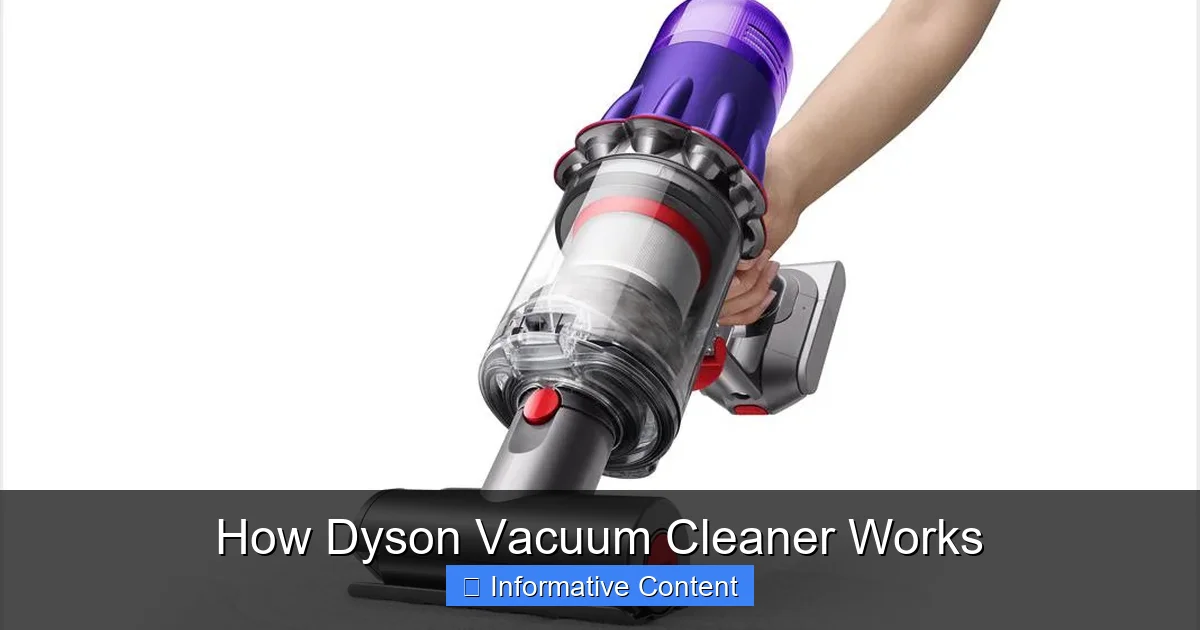
Visual guide about How Dyson Vacuum Cleaner Works
Image source: dyson-h.assetsadobe2.com
The Inlet and Brush Bar: First Contact
The cleaning process begins at the floorhead. Dyson vacuums often feature advanced brush bars, either motorized or air-driven. These brush bars rotate at high speeds, agitating carpets to dislodge embedded dirt and sweeping hard floors to gather surface debris. This initial mechanical action is crucial for lifting dirt and preparing it to be sucked into the vacuum’s system.
Different Dyson models come with specialized brush bars optimized for various floor types. For instance, soft roller cleaner heads are designed for hard floors, gently picking up fine dust and larger debris without scratching. High-torque cleaner heads, on the other hand, often have stiff nylon bristles for deep carpet cleaning and anti-tangle technology for pet hair.
The Motor: Powering the Vortex
Once debris is agitated, it’s drawn into the vacuum by the powerful motor. Modern Dyson vacuum cleaners, especially the cordless models, feature lightweight, high-speed digital motors. These motors are incredibly efficient, spinning at up to 125,000 RPM – significantly faster than a Formula 1 engine. This immense speed creates the necessary vacuum pressure and airflow to power the cyclonic separation process.
The motor pulls air through the system, creating the low-pressure zone needed for suction. The efficiency of Dyson’s digital motors means they can generate immense power in a small, lightweight package, which is essential for ergonomic cordless designs.
The Cyclone Assembly: Multi-tier Separation
After passing through the motor (in some designs) and entering the main body, the dirty air hits the primary cyclone, which separates the larger debris. But Dyson doesn’t stop there. Most modern Dyson vacuum cleaner models incorporate multiple, smaller cyclones – sometimes hundreds of them – working in parallel. This is known as Radial Root Cyclone™ or Cinetic Cyclone™ technology.
- Radial Root Cyclone™ Technology: This design uses multiple cones, arranged radially, to generate even greater centrifugal forces. The narrower the cyclone, the faster the air spins, and the finer the particles it can separate. Each stage of cyclones captures progressively smaller particles, ensuring even microscopic dust and allergens are spun out of the airflow.
- Cinetic Cyclone™ Technology: Found in some upright and canister models, this takes it a step further. These cyclones are so small and operate at such high frequencies that they oscillate. This oscillation prevents microscopic dust from sticking to the cyclone’s mesh, effectively making the system self-cleaning. Vacuums with Cinetic technology are so efficient at separation that they don’t even require washable pre-motor filters, making maintenance even easier.
All separated dirt and dust fall into the transparent bin, which can be easily emptied with a push of a button, avoiding contact with the debris.
Filtration System: Capturing Microscopic Particles
Even after multiple stages of cyclonic separation, some extremely fine particles might still remain in the air. This is where Dyson’s advanced filtration comes in. The air, now largely free of larger debris, passes through a series of filters, typically a washable pre-motor filter and a sealed HEPA-grade post-motor filter.
These filters capture microscopic allergens, pollen, bacteria, and even mold spores as tiny as 0.3 microns. Dyson’s fully sealed filtration systems ensure that these particles are trapped within the machine and not expelled back into your home. This is particularly beneficial for allergy sufferers, as the Dyson vacuum cleaner works not just to clean your floors but also to purify the air it expels.
The Clean Air Exhaust
Finally, the now thoroughly cleaned air is expelled from the vacuum. Because of the multi-stage cyclonic separation and advanced filtration, the air leaving a Dyson vacuum cleaner is often cleaner than the air it initially took in. This complete sealed system ensures that all the dirt and allergens picked up are contained.
The Science of Suction and Airflow
When discussing how a Dyson vacuum cleaner works, it’s crucial to understand the difference between raw motor power and effective cleaning power. Dyson focuses on the latter, emphasizing optimized airflow.
Constant Suction Power Explained
As mentioned, the primary advantage of cyclonic technology is maintaining constant suction. In traditional vacuums, as bags or filters clog, the motor struggles, and suction drops. With Dyson, the dirt is continuously spun out of the air and into the bin, meaning the airflow path remains relatively clear. This ensures that the vacuum performs at its peak from the moment you start cleaning until the bin is full.
Think of it like this: if you have a powerful engine, but a blocked exhaust pipe, you won’t get much performance. Dyson ensures the “exhaust pipe” (the airflow path) stays clear, allowing its powerful digital motor to operate at maximum efficiency.
Air Watts vs. Motor Watts
When looking at vacuum cleaner specifications, you might see “motor watts” (the power consumed by the motor) and “air watts” (a measure of the effective power of a vacuum cleaner, combining airflow and suction). While motor watts can indicate raw power, air watts are a more accurate reflection of a vacuum’s actual cleaning ability. A Dyson vacuum cleaner, with its optimized airflow and efficient cyclonic separation, often achieves very high air watt ratings relative to its motor wattage, showcasing its efficiency.
It’s not just about how strong the motor pulls, but how effectively that pull translates into moving dirt from the floor into the bin. Dyson’s engineering excels at this conversion.
Advanced Dyson Technologies
Dyson continually innovates, adding new technologies to enhance how a Dyson vacuum cleaner works and performs.
Digital Motors (V-series)
Dyson’s V-series digital motors are compact, powerful, and energy-efficient. These brushless DC motors are electronically commutated, meaning they don’t have brushes that wear out, leading to longer lifespans and higher rotational speeds. This technological leap allows for lightweight, cordless machines that still deliver impressive suction comparable to much larger, corded vacuums.
Each generation of V-series motor (e.g., V6, V7, V8, V10, V11, V15) brings improvements in power, efficiency, and run time, constantly pushing the boundaries of what a cordless Dyson vacuum cleaner can achieve.
Laser Detect™ and Piezo Sensors
Some of Dyson’s latest models, like the V15 Detect, incorporate truly innovative features:
- Laser Detect™: A precisely angled green laser integrated into the Fluffy Optic™ cleaner head illuminates microscopic dust particles on hard floors that are invisible to the naked eye. This helps users see exactly where to clean, ensuring a thorough job and leaving no speck of dust behind. It dramatically enhances the perception of how a Dyson vacuum cleaner works to reveal hidden dirt.
- Piezo Sensor: This clever sensor, located at the dust inlet, continuously counts and measures the size of dust particles passing into the bin. It dynamically adjusts the motor’s suction power based on the amount and size of dirt detected, optimizing performance and battery life. It also provides real-time cleaning proof on an LCD screen, showing you the quantity of different-sized particles collected, giving a satisfying insight into how much your Dyson vacuum cleaner works to deep clean.
De-tangling Technology
Pet hair and long human hair are common problems for vacuum cleaner brush bars. Dyson has introduced technologies like hair screw tools and anti-tangle conical brush bars that automatically clear hair from the brush as it cleans. These innovations prevent hair from wrapping around the bar, maintaining optimal cleaning performance and reducing the need for manual brush bar maintenance.
Different Dyson Models and Their Specifics
While the core cyclonic technology remains consistent, how a Dyson vacuum cleaner works in practice can vary slightly depending on the model and its intended use.
Cordless Stick Vacuums (e.g., V15 Detect, Outsize)
These are Dyson’s most popular and versatile models. They combine powerful digital motors with lightweight designs, offering incredible maneuverability and often long battery life. They are perfect for daily clean-ups, reaching high places, and tackling various floor types with interchangeable cleaner heads. Many come with an array of attachments for different cleaning tasks.
Their modular design allows them to transform into handheld units for car cleaning or upholstery, showcasing their adaptability and how effectively a Dyson vacuum cleaner works in multiple scenarios.
Upright/Canister Vacuums (e.g., Ball Animal)
Dyson’s traditional upright and canister vacuums (like the Ball™ series) are designed for larger homes and deep cleaning. They often feature larger dust bins, wider cleaning paths, and continuous power from a cord. The “Ball™” technology allows them to pivot smoothly around furniture with just a turn of the wrist, making them surprisingly agile for their size. These models often utilize Radial Root Cyclone™ or even Cinetic Cyclone™ technology for robust performance and superior filtration.
Handheld Models
Compact and powerful, Dyson handheld vacuums are perfect for quick spills, car interiors, and small, tricky areas. They use scaled-down versions of the digital motor and cyclonic technology to deliver impressive suction in a truly portable form factor. While not designed for whole-house cleaning, they are invaluable for specific tasks where a full-size vacuum is impractical.
Maintenance and Optimizing Performance
To ensure your Dyson vacuum cleaner works at its best for years to come, a little maintenance goes a long way. The beauty of the bagless design is simplified upkeep.
Bin Emptying
Empty the clear bin frequently, preferably after each significant use. Overfilling the bin can lead to some fine dust being re-entrained into the cyclones, potentially reducing efficiency. Dyson’s “point and shoot” emptying mechanisms make this a hygienic, hands-free process.
Filter Care
Most Dyson models have washable pre-motor filters. Refer to your manual, but typically these should be washed with cold water once a month and allowed to air dry completely for at least 24 hours before reinserting. A clean filter is crucial for maintaining constant suction and ensuring the expelled air remains clean. Cinetic models, as discussed, usually don’t require filter washing.
Brush Bar Cleaning
Periodically check the brush bar for tangled hair or debris. While many newer Dyson models have anti-tangle technology, older models or high-usage scenarios might still require occasional manual removal of wrapped hair. This ensures the brush bar can agitate and sweep effectively.
Clearing Blockages
If you notice a sudden drop in suction, check for blockages in the cleaner head, wand, or hose. Dyson’s transparent designs often make it easy to spot obstructions. Promptly clearing any blockages restores full power and ensures your Dyson vacuum cleaner works efficiently.
Conclusion
The journey of understanding how a Dyson vacuum cleaner works reveals a sophisticated blend of physics and engineering. From James Dyson’s initial frustration with clogging bags to today’s laser-guided, digitally motored machines, the core principle remains the same: efficient cyclonic separation for constant, powerful suction.
Dyson vacuums don’t just suck up dirt; they meticulously separate it from the airflow, trap microscopic allergens, and expel cleaner air, all while maintaining peak performance. Their innovative approach, continuous development of digital motors, and integration of smart technologies like laser detection and piezo sensors have cemented their reputation as leaders in home cleaning. So, the next time you power up your Dyson, you’ll know there’s a whirlwind of clever engineering happening inside, making your home a cleaner, healthier place.
Frequently Asked Questions
How does Dyson’s cyclonic technology differ from traditional bagged vacuums?
Dyson’s cyclonic technology differs fundamentally by separating dirt and dust from the airflow using centrifugal force, rather than relying on a porous bag. This means the vacuum doesn’t lose suction as dirt accumulates, unlike traditional bagged vacuums where the bag’s pores clog, reducing airflow and power.
Do Dyson vacuums ever lose suction over time?
While the core cyclonic technology is designed to prevent suction loss due to a full bin, factors like a clogged filter, a blocked airway (e.g., in the brush bar or wand), or a severely depleted battery in cordless models can temporarily reduce suction. Regular maintenance, such as washing filters and clearing blockages, is key to maintaining optimal performance.
What does the laser on some Dyson vacuums do?
The laser on some Dyson vacuums, like the V15 Detect, illuminates microscopic dust particles on hard floors that are otherwise invisible to the naked eye. This green laser is precisely angled to highlight hidden dirt, helping users ensure a more thorough clean and leaving no dust untouched.
Can Dyson vacuums handle pet hair effectively?
Yes, Dyson vacuums are highly effective at handling pet hair. Many models feature specialized cleaner heads and tools designed to pick up pet hair efficiently from carpets and upholstery, often incorporating anti-tangle technology to prevent hair from wrapping around the brush bar, ensuring consistent performance.
Are Dyson cordless vacuums as powerful as their corded counterparts?
Modern Dyson cordless vacuums, especially the latest generations, are remarkably powerful and can offer cleaning performance comparable to many corded models, particularly for everyday cleaning tasks. Their advanced digital motors and optimized airflow allow them to generate significant suction in a lightweight, convenient package, though corded models might still offer an edge for continuous, heavy-duty cleaning over very large areas.
Why do some Dyson vacuums have multiple cyclones?
Dyson vacuums use multiple, smaller cyclones to increase their efficiency in separating progressively finer particles. The narrower the cyclone, the faster the air spins, and the greater the centrifugal force. This multi-stage approach ensures that even microscopic dust, allergens, and pollutants are spun out of the airflow, leaving cleaner air and preventing filter clogging.