How Does a Vacuum Cleaner Motor Work
Every time you vacuum, a small but mighty motor is at work. This vacuum cleaner motor converts electrical energy into mechanical energy, spinning an impeller at incredibly high speeds. This rapid rotation creates a powerful airflow and a pressure differential, which is the magic behind your vacuum cleaner’s ability to suck up dirt and debris. Understanding its core components—like the stator, rotor, and brushes—reveals the ingenious engineering that keeps our homes clean.
There’s a quiet hero humming away in your closet, ready to spring into action at a moment’s notice. It’s your vacuum cleaner, and while you might appreciate the clean floors it leaves behind, have you ever stopped to think about how it actually *works*? It seems like magic, doesn’t it? One moment, there’s a pile of crumbs, and the next, poof! Gone.
The secret to this everyday magic lies deep within the machine, specifically in its powerful engine: the vacuum cleaner motor. This isn’t just any motor; it’s a marvel of engineering designed to create the incredible suction force that makes short work of dirt, dust, and pet hair. Understanding how this vital component functions not only satisfies our curiosity but also helps us appreciate the clever technology we often take for granted. So, grab a cup of coffee, and let’s pull back the curtain on the fascinating world inside your vacuum cleaner.
Key Takeaways
- Electrical to Mechanical Energy: A vacuum cleaner motor’s fundamental job is to convert electrical power from your wall outlet into mechanical rotational force.
- Core Components: Key parts include the stator (stationary electromagnet), rotor/armature (spinning electromagnet), commutator (reverses current), carbon brushes (transfer current), and the fan/impeller (generates airflow).
- Electromagnetic Principle: The motor operates on the principle of electromagnetism, where opposing magnetic poles created by the stator and rotor constantly repel and attract, causing continuous rotation.
- Suction Mechanism: The spinning impeller blades create a low-pressure area inside the vacuum, which draws in higher-pressure air (and dirt) from outside, resulting in suction.
- Universal Motor Dominance: Most household vacuum cleaners use a “universal motor” because it can run on both AC and DC current, offers high speed in a compact size, and provides excellent power for suction.
- Maintenance Matters: Regular maintenance, such as cleaning filters and checking for blockages, is crucial for preventing motor overheating and extending the lifespan of your vacuum cleaner motor.
Quick Answers to Common Questions
What type of motor is typically found in household vacuum cleaners?
Most household vacuum cleaners use a “universal motor” because it can operate on both AC and DC current, is compact, and delivers high RPM for strong suction.
What is the main function of the impeller in a vacuum cleaner motor?
The impeller, a fan-like component attached to the motor shaft, is responsible for creating a high-speed airflow that generates the low-pressure area (suction) inside the vacuum.
Why are carbon brushes important in a vacuum cleaner motor?
Carbon brushes are critical because they provide the electrical connection, transferring current from the stationary power source to the spinning commutator and rotor coils, enabling continuous rotation.
What is the difference between a thru-flow and a bypass motor?
In a thru-flow motor, dirty air passes directly through the motor for cooling, while in a bypass motor, the dirty air is routed around the motor, protecting the motor from debris and extending its lifespan.
What is the most common reason a vacuum cleaner motor overheats?
The most common reason for a vacuum cleaner motor to overheat is restricted airflow, typically caused by clogged filters, an overfull dirt bin/bag, or blockages in the hose or nozzle.
📑 Table of Contents
- The Heart of the Matter: What a Motor Does in Your Vacuum
- Anatomy of a Vacuum Cleaner Motor: Key Components
- The Magic of Suction: How the Motor Creates Airflow
- Motor Types in Vacuum Cleaners: A Quick Look
- Keeping Your Vacuum Cleaner Motor Happy: Maintenance Tips
- Conclusion: The Unsung Hero of Cleanliness
The Heart of the Matter: What a Motor Does in Your Vacuum
At its core, a vacuum cleaner motor has one primary job: to convert electrical energy into mechanical energy. Think of it like a tiny, extremely efficient engine. When you plug your vacuum into an outlet and flip the switch, electricity flows into the motor. This electricity then powers a series of components that work in harmony to spin a fan at incredibly high speeds. It’s this high-speed spinning that generates the airflow and pressure differential necessary for suction.
From Electricity to Motion: The Universal Motor
Most household vacuum cleaners rely on what’s known as a “universal motor.” Why “universal”? Because it can operate effectively on both alternating current (AC), which is what comes out of your wall sockets, and direct current (DC). This versatility, combined with its ability to achieve very high RPM (revolutions per minute) in a relatively compact size, makes it the perfect choice for vacuum cleaners.
The magic of the universal motor lies in electromagnetism. You might remember from school that electricity and magnetism are two sides of the same coin. When electricity flows through a wire, it creates a magnetic field. Our motor harnesses this principle to create continuous rotational movement.
Anatomy of a Vacuum Cleaner Motor: Key Components
To truly understand how a vacuum cleaner motor works, we need to break it down into its essential parts. Each component plays a critical role in transforming electrical energy into the powerful spin needed for suction.
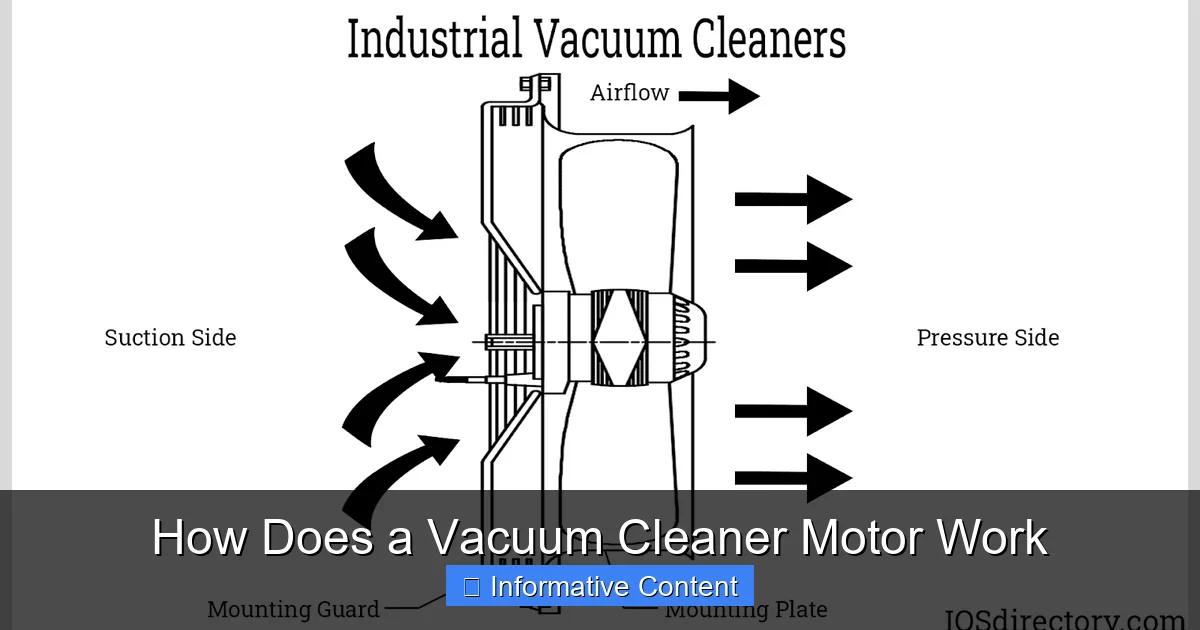
Visual guide about How Does a Vacuum Cleaner Motor Work
Image source: iqsdirectory.com
The Stator: The Stationary Magnet
Imagine the outer casing of the motor – that’s roughly where the stator is located. The stator is the stationary part of the motor. It consists of electromagnets, which are essentially coils of wire wrapped around a metal core. When electricity flows through these coils, they become temporary magnets, creating a magnetic field that remains fixed in space.
The Rotor (or Armature): The Spinning Heart
Inside the stator, you’ll find the rotor, also known as the armature. This is the part that spins. The rotor is also made up of coils of wire wrapped around an iron core, and it’s mounted on a shaft. When electricity flows through the rotor’s coils, it too becomes an electromagnet. Crucially, the magnetic field of the rotor is designed to constantly interact with the magnetic field of the stator.
The Commutator: The Current Reverser
Here’s where things get clever. For the rotor to keep spinning in one direction, its magnetic poles need to constantly switch. This is the job of the commutator. The commutator is a segmented copper ring attached to one end of the rotor shaft. As the rotor spins, different segments of the commutator come into contact with the carbon brushes, which we’ll discuss next. This continuous contact allows the electrical current to be fed into the rotor coils in such a way that the polarity of its magnetic field is reversed at just the right moment.
Carbon Brushes: The Electrical Connectors
Think of carbon brushes as the “bridges” that transfer electricity from the stationary power source to the spinning commutator and, by extension, the rotor coils. These small blocks of carbon are held in place by springs, pressing firmly against the commutator segments. As the commutator spins, the carbon brushes maintain electrical contact, allowing the current to flow. Over time, these brushes wear down due to friction, which is why they sometimes need to be replaced in older motors.
The Fan (or Impeller): The Suction Creator
Attached to the same shaft as the rotor is the fan, often called an impeller. This is the component directly responsible for creating the suction. The impeller is essentially a set of blades, much like those you’d find in a jet engine or a turbine, but designed to move air very efficiently. When the motor spins the rotor, the impeller spins along with it, creating the powerful airflow needed for cleaning.
Bearings: Keeping Things Smooth
All these fast-moving parts need to spin smoothly without excessive friction. That’s where bearings come in. Usually, ball bearings are used to support the rotor shaft, allowing it to rotate freely and minimize wear. Good bearings contribute to a quieter, more efficient, and longer-lasting motor.
The Magic of Suction: How the Motor Creates Airflow
Now that we know the parts, let’s put it all together and see how the vacuum cleaner motor actually generates the force we call “suction.”
The Electromagnetic Dance
When you switch on your vacuum, electricity flows from the outlet to the carbon brushes, then through the commutator to the rotor coils. Simultaneously, the stator coils also become magnetized. The magnetic field of the stator interacts with the magnetic field of the rotor. Like poles repel, and opposite poles attract. This push-and-pull action causes the rotor to spin.
As the rotor spins, the commutator continuously reverses the direction of the current in the rotor coils. This ensures that the rotor’s magnetic poles are always repelling the stator’s poles ahead of them and attracting the stator’s poles behind them, creating a continuous, powerful rotation in one direction.
The Impeller’s Role: Creating Pressure Differential
The real suction magic happens when the impeller, attached to the spinning rotor shaft, gets up to speed. The blades of the impeller are shaped to rapidly push air outwards from the center of the fan housing. Imagine a mini tornado being created inside the vacuum’s motor housing.
As air is expelled outwards, it creates a region of very low air pressure directly in front of the impeller. At the same time, the air outside the vacuum cleaner (and surrounding your dirt and dust) is at a higher atmospheric pressure. Nature abhors a vacuum, literally! Air naturally moves from areas of high pressure to areas of low pressure to equalize the difference.
This pressure differential is what drives the suction. The higher-pressure air from your floor, along with any dirt, dust, and debris, is forced into the vacuum cleaner’s nozzle, through the hose, and into the low-pressure area created by the impeller. The air then passes through the filters, which trap the dirt, and is eventually expelled, usually from the back of the vacuum, as cleaner air.
Motor Types in Vacuum Cleaners: A Quick Look
While the universal motor is predominant, it’s worth noting there are slight variations in how the airflow is managed around the motor itself. These are primarily categorized as “thru-flow” and “bypass” motors.
Thru-Flow Motors
In a thru-flow motor, the air that gets sucked up (along with the dirt) passes directly through the motor itself before being exhausted. This design is simpler and often used in upright vacuums or older models. A significant drawback is that fine dust particles passing through the motor can cause wear and tear on components like the carbon brushes and bearings, potentially shortening the motor’s life. However, they are generally more compact.
Bypass Motors
Bypass motors are designed to keep the dirty airflow separate from the motor’s internal workings. In this configuration, the dirty air is drawn in by the impeller and routed around the motor, through a separate path, and then exhausted. A separate, clean air stream is typically drawn in from a different inlet (often a small vent) to cool the motor. This design protects the motor from dirt and debris, leading to a longer lifespan. Most modern canister vacuums and wet/dry vacuums utilize bypass motors because of their enhanced durability, especially when dealing with moisture.
Keeping Your Vacuum Cleaner Motor Happy: Maintenance Tips
A well-maintained vacuum cleaner motor can last for many years, providing reliable cleaning power. Here are some practical tips to ensure its longevity and efficiency:
Regular Filter Cleaning and Replacement
This is perhaps the most crucial tip. Clogged filters are the number one enemy of a vacuum cleaner motor. When filters are dirty, the motor has to work much harder to pull air through, leading to overheating. Overheating can burn out motor windings, melt insulation, and significantly reduce the motor’s lifespan. Always check and clean or replace your filters according to your vacuum cleaner’s manual.
Empty the Dirt Bin/Bag Frequently
Similar to clogged filters, an overfull dirt bin or bag restricts airflow. This forces the motor to strain, leading to the same overheating issues. Emptying your vacuum frequently not only maintains strong suction but also protects the motor.
Clear Blockages Promptly
Hoses, nozzles, and brush rolls can become clogged with debris like socks, toys, or large wads of hair. A blockage creates immense resistance to airflow, causing the motor to work excessively hard. If you notice a sudden drop in suction, check for blockages immediately and clear them out.
Avoid Wet Messes with a Dry Vacuum
Unless you have a specialized wet/dry vacuum, never attempt to suck up liquids. Water can cause immediate and catastrophic damage to a dry vacuum cleaner motor by short-circuiting its electrical components. This is a quick way to destroy your machine.
Listen to Your Vacuum
Pay attention to the sounds your vacuum makes. A sudden change in pitch, a loud grinding noise, or an unusually high-pitched whine can indicate a problem. It might be worn carbon brushes, failing bearings, or an impending motor issue. Addressing these early can prevent more expensive repairs down the line.
Conclusion: The Unsung Hero of Cleanliness
The next time you glide your vacuum cleaner across the carpet, take a moment to appreciate the sophisticated engineering humming beneath its surface. The vacuum cleaner motor, with its intricate dance of electromagnetism, spinning impellers, and precisely timed current reversals, is truly the unsung hero of domestic cleanliness. It converts invisible electrical energy into tangible suction power, effortlessly removing the dirt and dust that accumulates in our daily lives.
Understanding how this vital component works not only deepens our appreciation for everyday technology but also empowers us to be better caretakers of our appliances. By performing simple maintenance and understanding the basic principles, you can ensure your vacuum cleaner motor continues to spin efficiently, keeping your home spotless for years to come. It’s a powerful reminder that even the simplest chores are often made possible by incredibly clever and efficient design.
Frequently Asked Questions
How does a vacuum cleaner motor create suction?
The motor spins an impeller at very high speeds. This action creates a low-pressure area inside the vacuum, while the air outside remains at higher atmospheric pressure. The difference in pressure forces air (and dirt) into the vacuum’s nozzle to equalize the pressure.
Can I replace the motor in my vacuum cleaner?
Yes, it is often possible to replace a vacuum cleaner motor, especially in higher-quality or commercial models. However, it can be a complex task requiring specific tools and technical knowledge, so many people opt for professional repair or replacement if their motor fails.
What are the signs of a failing vacuum cleaner motor?
Common signs of a failing motor include a burning smell, excessive noise (grinding, screaming, or a sudden change in pitch), intermittent power, reduced suction power, or the vacuum simply not turning on. These symptoms often indicate worn carbon brushes, bad bearings, or burnt-out windings.
Why do carbon brushes wear out in a vacuum cleaner motor?
Carbon brushes wear out due to constant friction with the spinning commutator. They are designed to be sacrificial components, gradually eroding over time. When they wear down too much, they lose electrical contact, and the motor will stop working.
How can I extend the life of my vacuum cleaner motor?
To extend the life of your vacuum cleaner motor, regularly clean or replace filters, empty the dirt bin/bag frequently, clear any blockages promptly, and avoid vacuuming liquids with a dry vacuum. These practices ensure the motor doesn’t have to work harder than necessary.
Is it bad if my vacuum cleaner motor gets hot?
A vacuum cleaner motor naturally generates some heat during operation, which is normal. However, if the motor becomes excessively hot to the touch, or you smell burning, it’s a sign of overheating. This often indicates restricted airflow or a failing component and should be addressed immediately to prevent damage.