
How Does a Vacuum Cleaner Create Suction
Ever wondered how your vacuum cleaner magically lifts dirt? It all comes down to basic physics! A vacuum cleaner creates suction by using a powerful motor to spin a fan, which rapidly moves air out of the vacuum’s body. This action lowers the air pressure inside the machine, causing the higher atmospheric pressure outside to push dust and debris into the nozzle. It’s a clever dance between high and low pressure that makes cleaning possible!
Think about your vacuum cleaner for a moment. It’s a marvel of modern convenience, effortlessly gobbling up dust, crumbs, and pet hair from your floors. You plug it in, flip a switch, and *whoosh!* – the mess disappears. But have you ever paused to wonder about the hidden magic at play? How does this seemingly simple appliance generate such impressive force, making dirt and debris vanish as if by an invisible hand?
It’s a question many of us ponder, perhaps while wrestling with a particularly stubborn patch of dirt. The answer, surprisingly, lies in the fundamental principles of physics, specifically air pressure. Your vacuum cleaner doesn’t actually “suck” in the way you might imagine a straw does. Instead, it ingeniously manipulates air pressure to create a powerful current that carries dirt along for the ride. Understanding this process not only satisfies your curiosity but can also help you appreciate the engineering behind this everyday household hero and even improve its performance.
In this deep dive, we’re going to pull back the curtain and explore precisely how a vacuum cleaner creates suction. We’ll break down the components, the physics, and the clever design choices that make these machines so effective. Get ready to understand the unseen forces that keep your home sparkling clean!
Key Takeaways
- Pressure Differential is Key: A vacuum cleaner creates suction by establishing a difference in air pressure between the inside of the machine (low pressure) and the surrounding room (higher atmospheric pressure).
- The Fan is the Workhorse: An electric motor spins a fan (impeller) at high speeds, which rapidly pushes air out of the vacuum’s exhaust, thereby reducing the air density and pressure within the sealed system.
- Atmospheric Pressure Does the Pushing: It’s not the vacuum “pulling” dirt, but rather the higher external air pressure “pushing” dust and debris from the cleaning surface into the lower-pressure environment inside the vacuum.
- Airflow and Suction Power: Suction power is determined by both airflow (how much air moves) and static pressure (the intensity of the pressure difference), often measured in CFM and water lift.
- Filtration is Crucial: Before exhausted, the air passes through filters (bags, cyclones, HEPA) to trap dirt and allergens, preventing them from being expelled back into your home.
- Maintenance Matters: Keeping filters clean, emptying dust bins, and checking for blockages are vital steps to ensure your vacuum cleaner maintains optimal suction power.
Quick Answers to Common Questions
What is the main principle behind how a vacuum cleaner creates suction?
The main principle is creating a pressure differential. The vacuum cleaner generates a low-pressure zone inside its body compared to the higher atmospheric pressure outside, causing air to rush in and carry debris with it.
What is the role of the fan in a vacuum cleaner?
The fan, or impeller, is spun at high speeds by the motor. Its angled blades push air out of the vacuum’s exhaust, thereby reducing the air pressure inside the sealed system and creating the low-pressure zone.
Does a vacuum cleaner “pull” or “push” dirt?
Technically, a vacuum cleaner “pushes” dirt. The higher external atmospheric pressure pushes dirt and debris into the lower-pressure environment created inside the vacuum cleaner.
What are “air watts” and why are they important?
Air watts measure the power a vacuum cleaner actually uses to move a volume of air, combining airflow and static pressure. It’s a more accurate indicator of real-world cleaning performance than just the motor’s electrical wattage.
How does a full dust bag or clogged filter affect suction?
A full dust bag or clogged filter restricts the airflow. This makes it harder for the fan to expel air, weakening the pressure differential and significantly reducing the vacuum cleaner’s suction power.
📑 Table of Contents
- The Core Principle: Air Pressure and the Magic of Low Pressure
- The Heart of the Machine: The Motor and Fan Assembly
- The Path of Air: From Inlet to Exhaust
- Factors Influencing Suction Power
- Different Types of Vacuum Cleaners and Their Suction Mechanisms
- Maintaining Optimal Suction: Tips for a Powerful Clean
- Conclusion: The Everyday Marvel of Physics
The Core Principle: Air Pressure and the Magic of Low Pressure
At the heart of how a vacuum cleaner creates suction is a concept called a “pressure differential.” This might sound complicated, but it’s really quite simple. Imagine a busy nightclub. If the bouncer lets people out much faster than they come in, the club quickly empties. In the world of air, if you rapidly remove air from a sealed space, the pressure inside that space drops.
Understanding Atmospheric Pressure
First, let’s talk about the air all around us. We’re constantly submerged in an “ocean of air,” and this air has weight. This weight exerts pressure on everything – including you, your furniture, and the floor you’re about to vacuum. We call this “atmospheric pressure.” It’s surprisingly strong, usually around 14.7 pounds per square inch at sea level. You don’t feel it because this pressure is exerted equally from all directions, balancing itself out.
Creating a Pressure Differential
Your vacuum cleaner works by creating an area of *lower* air pressure inside its sealed body compared to the *higher* atmospheric pressure outside. Think of it like this: the air outside the vacuum is “pushing” with more force than the air inside the vacuum. When you open a pathway (the vacuum nozzle) between these two pressure zones, the higher outside pressure rushes in to equalize with the lower inside pressure, much like water flowing from a high point to a low point. This rushing air is what we perceive as “suction.” It’s this powerful stream of air that carries dirt and debris into the vacuum cleaner.
The Heart of the Machine: The Motor and Fan Assembly

Visual guide about How Does a Vacuum Cleaner Create Suction
Image source: vacuuminfo.com
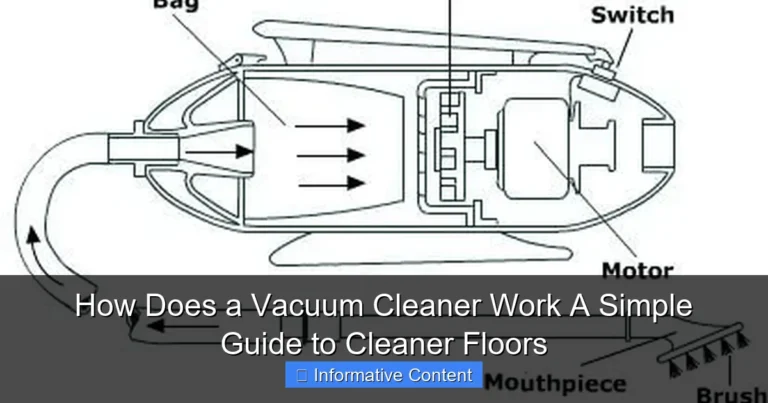
So, what creates this crucial pressure differential? The answer lies in the vacuum cleaner’s engine room: the electric motor and the fan assembly. These two components work in perfect harmony to generate the necessary airflow.
The Electric Motor’s Role
Every vacuum cleaner, whether it’s an upright, canister, or robotic model, relies on an electric motor. This motor is typically a universal motor, meaning it can run on both alternating current (AC) and direct current (DC), though in most homes, it’s powered by AC from your wall outlet. The motor’s primary job is simple: to spin the fan. The more powerful the motor, generally, the faster it can spin the fan, and the greater the potential for strong suction. However, motor wattage alone doesn’t always tell the whole story of a vacuum’s suction power, as we’ll discuss later.
The Impeller Fan: The Real Workhorse
Attached directly to the motor’s shaft is the impeller fan, often just called the “fan.” This is the true workhorse when it comes to how a vacuum cleaner creates suction. The fan is specifically designed with a series of angled blades, much like an airplane propeller or a turbine. When the motor spins the fan at extremely high speeds – often tens of thousands of revolutions per minute – these blades act like tiny paddles, pushing air rapidly in one direction.
From Fan Blades to Airflow
As the fan blades spin, they forcibly expel air out of the vacuum cleaner’s exhaust port. This rapid expulsion of air has a significant effect: it reduces the volume of air inside the vacuum’s sealed internal chamber. With less air inside, the air molecules become more spread out, leading to a drop in air density and, consequently, a drop in air pressure. This is precisely how the low-pressure zone is created. The continuous spinning of the fan maintains this low-pressure state, ensuring a constant flow of air into the vacuum’s nozzle, effectively creating the continuous suction we rely on for cleaning.
The Path of Air: From Inlet to Exhaust
Understanding the motor and fan is key, but the journey of the air through the vacuum cleaner is equally important. The design of this path dictates how efficiently the vacuum can collect dirt and how clean the expelled air will be.
The Nozzle and Air Inlet
The adventure of dirt and air begins at the nozzle – the part of the vacuum cleaner that makes direct contact with your floor or other surfaces. The nozzle is designed to create a tight seal with the cleaning surface, which is crucial for maximizing the pressure differential. Any significant gaps or leaks here will reduce the effectiveness of the suction. As the higher outside atmospheric pressure pushes air and dirt towards the low-pressure zone, they enter through this nozzle. Many nozzles also feature rotating brushes, which aren’t directly involved in creating suction but help to agitate dirt and lift it from the carpet fibers, making it easier for the airflow to carry it away.
The Dust Collection System (Bag/Canister)
Once the air and debris enter the vacuum, they immediately encounter the dust collection system. This is where the dirt is separated from the air.
* Bagged Vacuums: In older or simpler models, the air and dirt go directly into a disposable bag. The bag is made of a porous material that allows air to pass through but traps dirt and dust particles.
* Bagless (Canister) Vacuums: More common today, bagless vacuums use cyclonic separation. As the air enters the canister, it’s spun rapidly in a vortex. Centrifugal force pushes heavier dirt and dust particles against the walls of the canister, where they lose momentum and fall into a collection bin, while the lighter air continues its journey. This method is efficient because it prevents the filters from clogging as quickly.
Filtration: Keeping the Air Clean
After passing through the initial dust collection stage, the air is still not perfectly clean. It may contain very fine dust, allergens, and microscopic particles. This is where the filtration system comes in. Filters are absolutely critical to ensure that the air being expelled back into your home is free from these contaminants.
* Pre-Motor Filters: These are often foam or pleated filters placed before the motor to protect it from larger particles that might escape the primary collection system.
* Post-Motor Filters (Exhaust Filters): These are usually denser and designed to capture even finer particles before the air leaves the vacuum. High-efficiency particulate air (HEPA) filters are a popular type of post-motor filter, capable of trapping 99.97% of airborne particles 0.3 micrometers in diameter, including pollen, pet dander, dust mites, and smoke. This is particularly important for people with allergies or asthma.
The Exhaust Port
Finally, after passing through all the filtration stages, the now-cleaned air exits the vacuum cleaner through the exhaust port. This is where the air that was initially pushed out by the fan blades leaves the machine, completing the cycle and maintaining the continuous flow necessary for the vacuum cleaner to create suction effectively.
Factors Influencing Suction Power
When you shop for a vacuum, you’ll see various specifications. Not all of them directly tell you about the “suction power” in a straightforward way. Let’s break down what truly influences how effectively a vacuum cleaner creates suction.
Motor Power (Air Watts vs. Electrical Watts)
Many people look at the electrical wattage (e.g., 1200W) of a vacuum’s motor, assuming higher watts always mean better suction. However, electrical watts only tell you how much electricity the motor consumes, not how efficiently that power is converted into airflow and suction. A more accurate measure of a vacuum’s cleaning ability is “air watts.” Air watts represent the amount of power a vacuum cleaner actually uses to move a volume of air through an opening. It’s a combination of airflow and water lift (static pressure), providing a much better indication of real-world cleaning performance.
Airflow (CFM)
Airflow, often measured in Cubic Feet per Minute (CFM), tells you how much air the vacuum can move. Higher CFM means the vacuum can pull in more air and, consequently, more dirt over a given time. This is particularly important for picking up lighter, bulkier debris like pet hair or crumbs. A high CFM allows for efficient cleaning of larger areas and better pickup on hard floors or low-pile carpets.
Static Pressure (Water Lift)
Static pressure, also known as “sealed suction” or “water lift,” is measured in inches of water. It indicates how intensely the vacuum can create that pressure differential. High water lift means the vacuum can “pull” very strongly against a sealed surface, making it excellent for deep cleaning carpets, extracting embedded dirt, or tasks like wet pickup where a strong pull is needed to lift liquid.
Sealed Suction vs. Working Suction
It’s important to differentiate between “sealed suction” and “working suction.” Sealed suction is measured at the end of the hose or nozzle when it’s completely blocked – essentially the maximum possible pressure differential. Working suction, however, is the actual suction power generated *while* the vacuum is cleaning, with air flowing freely through the nozzle and attachments. A good vacuum needs a balance of both: enough airflow to pick up debris, and enough static pressure to lift it effectively.
Design and Air Leaks
The overall design of the vacuum, the quality of its seals, and the condition of its filters greatly impact its effective suction. A poorly designed hose connection, a cracked housing, or an improperly seated filter can all lead to air leaks. When air leaks out or in from unintended places, the pressure differential weakens, and the vacuum cleaner’s ability to create suction is significantly reduced. This is why maintaining your vacuum is so crucial!
Different Types of Vacuum Cleaners and Their Suction Mechanisms
While the fundamental principles of how a vacuum cleaner creates suction remain the same, different types of vacuums are designed with specific tasks and environments in mind, leading to variations in their airflow pathways and features.
Upright Vacuums
These are classic household workhorses, often favored for carpets. Uprights typically have the motor and fan assembly located in the main body, close to the brush roll. This direct path can allow for powerful airflow and strong brush agitation, making them very effective for deep cleaning carpets. Their design usually emphasizes high airflow for moving carpet fibers and dirt.
Canister Vacuums
Canister vacuums separate the motor and dust bin into a main unit, connected by a flexible hose to the cleaning head. This design offers greater maneuverability and versatility for cleaning various surfaces, including hard floors, upholstery, and stairs. The long hose can sometimes slightly reduce the effective suction compared to a direct-air upright, but modern canister vacuums are engineered to minimize this loss. They often have excellent sealed suction for focused cleaning.
Robot Vacuums
These autonomous cleaners are designed for daily maintenance. They feature compact motors and smaller fans to create suction. Due to their size and battery power limitations, their suction power (both airflow and static pressure) is generally less than full-sized upright or canister models. However, their consistent, frequent cleaning makes them effective at preventing dirt buildup. Their low-profile design is key to reaching under furniture.
Handheld Vacuums
Handhelds are small, portable units perfect for quick clean-ups and tight spaces. Their motors and fans are scaled down to fit their compact form factor, meaning they provide less overall suction than their larger counterparts. However, for their intended purpose – small spills, car interiors, or crumbs – they create sufficient suction by bringing the intake nozzle very close to the debris.
Wet/Dry Vacuums
Also known as shop vacs, these robust machines are built for heavy-duty tasks, including picking up liquids. They feature powerful motors and larger, more durable fan assemblies to handle both wet and dry debris. Their internal design is often simpler, with fewer intricate filters (at least for wet pickup), to maintain strong airflow and static pressure even when dealing with challenging materials. The ability to create very strong suction is vital for picking up heavy liquids.
Maintaining Optimal Suction: Tips for a Powerful Clean
Understanding how a vacuum cleaner creates suction also empowers you to keep it working at its best. Regular maintenance isn’t just about prolonging the life of your appliance; it’s about ensuring you get the most efficient clean every time.
Emptying the Dust Bin or Bag Regularly
This is perhaps the most fundamental tip. As your dust bin or bag fills up, the air has to work harder to pass through the accumulated debris. This creates resistance, reduces airflow, and ultimately weakens the pressure differential, meaning less effective suction. Empty your bag or bin when it’s about two-thirds full, or even sooner for fine dust.
Cleaning or Replacing Filters
Filters are your vacuum’s lungs. Over time, they become clogged with fine dust particles, restricting airflow significantly. If air can’t pass through the filters easily, the fan can’t efficiently push it out, and the pressure inside the vacuum won’t drop as much. Check your manual for filter cleaning instructions; some are washable, while others need to be replaced periodically. Clean filters are crucial for maintaining that strong, consistent pull.
Checking for Blockages
A blockage in the hose, nozzle, or wand is a direct impediment to airflow. Whether it’s a sock, a toy, or a clump of pet hair, anything that obstructs the path of air will dramatically reduce suction. If you notice a sudden drop in power, always check these areas first. Disconnect parts and visually inspect them, or use a broom handle (carefully!) to dislodge obstructions.
Sealing and Gaskets
Over time, the rubber seals and gaskets around the dust bin, filters, or various connection points can wear out or become damaged. Even small cracks or tears can allow air to leak in or out, weakening the pressure differential the vacuum is trying to create. Periodically inspect these seals and replace them if necessary. A well-sealed system ensures all the fan’s effort goes into creating that powerful suction at the nozzle.
Conclusion: The Everyday Marvel of Physics
So there you have it! The next time you power up your vacuum cleaner, you’ll know that it’s not some mystical force at work. Instead, you’re witnessing an ingenious application of basic physics. The simple interplay of a motor, a spinning fan, and the resulting air pressure differential is precisely how a vacuum cleaner creates suction, transforming a messy floor into a clean one.
It’s a powerful reminder that even the most mundane household appliances are often sophisticated pieces of engineering. By understanding this process, you not only gain a new appreciation for your vacuum but also know how to keep it running at its peak performance, ensuring your home stays spick and span, one powerful whoosh at a time. Happy vacuuming!
Frequently Asked Questions
How often should I clean my vacuum’s filters?
It depends on your vacuum model and usage. Many manufacturers recommend cleaning washable filters monthly and replacing disposable ones every 6-12 months. However, if you have pets or allergies, or use your vacuum frequently, you might need to clean or replace them more often to maintain optimal suction.
Can a vacuum cleaner lose suction over time?
Yes, a vacuum cleaner can definitely lose suction over time. This is often due to blockages in the hose or nozzle, full dust bins or bags, clogged filters, or worn-out seals. Regular maintenance is key to preventing this decline in performance.
Is higher motor wattage always better for suction?
Not necessarily. While a powerful motor is important, electrical wattage only indicates power consumption. “Air watts” is a better measure as it accounts for how efficiently the motor’s power is converted into actual airflow and suction, giving a more accurate picture of cleaning ability.
What’s the difference between sealed suction and working suction?
Sealed suction is the maximum suction measured when the nozzle is completely blocked, indicating the strongest possible pressure differential. Working suction is the actual suction power achieved during active cleaning, with air flowing freely, which is more relevant to real-world performance.
Why do some vacuum cleaners have brush rolls?
Brush rolls, particularly on upright and carpet-specific vacuums, are designed to agitate carpet fibers. They help dislodge embedded dirt, dust, and pet hair, making it easier for the vacuum’s airflow and suction to pick up the loosened debris.
Can I improve my vacuum’s suction without buying a new one?
Absolutely! The most effective ways to improve your vacuum’s suction are to regularly empty the dust bin or bag, clean or replace all filters (pre-motor and post-motor), check for and clear any blockages in the hose or nozzle, and inspect seals for wear or damage. These simple steps can restore much of your vacuum’s original power.