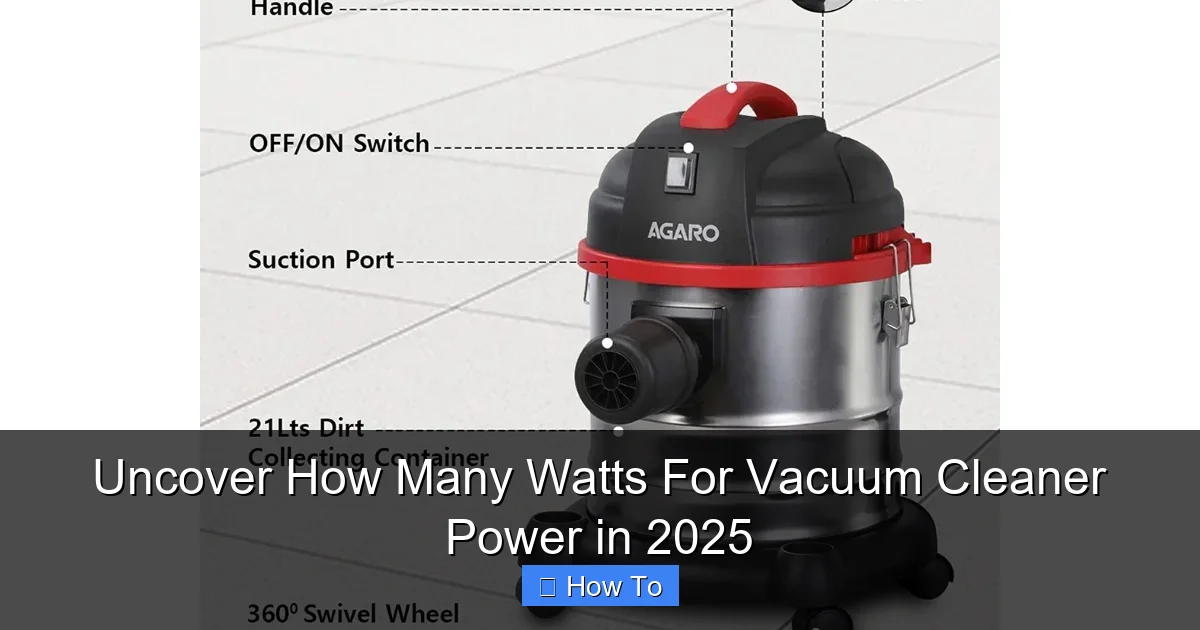
Uncover How Many Watts For Vacuum Cleaner Power in 2025
Understanding how many watts for a vacuum cleaner is key to efficient cleaning, but it’s not the only factor. This guide reveals that while wattage indicates power consumption, a vacuum’s actual suction and cleaning ability depend on a complex interplay of motor design, airflow, and nozzle efficiency. Learn to distinguish between watts and true performance to make an informed purchase in 2025.
Uncover How Many Watts For Vacuum Cleaner Power in 2025
Welcome to the definitive guide on understanding vacuum cleaner wattage in 2025! Choosing the right vacuum can feel like a maze, especially with all the numbers and technical jargon. One of the most common questions people ask is: “How many watts for vacuum cleaner do I really need?” It’s a fantastic question, and one that often leads to misunderstandings. Many believe that higher watts always equals better cleaning power. While there’s a kernel of truth to that, the full picture is far more nuanced, especially with the advanced technology available today.
In this comprehensive guide, we’ll demystify vacuum cleaner wattage, explain what those numbers truly mean for your cleaning routine, and help you make an informed decision for your home. We’ll break down the difference between electrical input and actual cleaning power, explore how different vacuum types consume power, and give you practical tips to ensure your next vacuum is the perfect blend of power, efficiency, and performance. By the end, you’ll be an expert, ready to tackle any mess with confidence, knowing exactly how many watts for vacuum cleaner power are right for you in 2025.
Key Takeaways
- Watts indicate power consumption, not necessarily suction power: A higher wattage vacuum cleaner might use more electricity, but it doesn’t automatically mean better cleaning. Efficiency and design play crucial roles.
- Motor watts vs. Air watts are different metrics: Motor watts show electrical input, while air watts measure actual cleaning power at the nozzle – a more relevant metric for suction.
- Optimal wattage varies by vacuum type and cleaning needs: Stick vacuums often have lower watts (100-300W) for quick cleans, while uprights and canisters (500-1500W+) offer more robust power for deep cleaning carpets.
- Consider floor types and common debris: Hard floors generally require less power than thick carpets, and pet hair demands stronger suction and specialized attachments, often correlating with higher effective wattage.
- Energy efficiency is a growing concern in 2025: Many modern vacuums are designed to deliver excellent cleaning performance with lower wattage, thanks to improved motor design and airflow technology, saving on electricity bills.
- Check for manufacturer’s claims and reviews: Don’t rely solely on wattage numbers. Look for air watt ratings, independent reviews, and demonstrations to assess real-world cleaning effectiveness.
- Battery-powered vacuums measure power differently: Cordless models use battery voltage and run time as key indicators, with their “watts” typically referring to motor power rather than direct wall plug consumption.
Quick Answers to Common Questions
What’s the ideal wattage for a small apartment?
For a small apartment with mostly hard floors, a cordless stick vacuum with a motor wattage of 150-250W (or 700-800W for a corded stick) offering good air watts, is often ideal. It provides sufficient power for daily dust and crumbs without being overkill.
Does higher wattage always mean louder vacuum?
Not necessarily. While very high wattage motors *can* be louder, modern vacuum design incorporates noise reduction technologies. An older, less efficient 1000W vacuum might be louder than a newer, more efficient 800W model that converts power into suction more effectively.
Are vacuums with lower watts less effective?
Not if they’re well-designed. Thanks to advancements in motor efficiency, airflow dynamics, and nozzle design, many lower-wattage vacuums in 2025 can outperform older, higher-wattage models in terms of actual cleaning effectiveness, while using less energy.
How do I know if my vacuum is energy efficient?
Look for energy efficiency labels or certifications on the product or packaging. Many regions have regulations encouraging lower power consumption. Also, check for reviews that highlight performance with lower wattage.
Should I worry about vacuum watts tripping my circuit breaker?
Most household vacuums (even high wattage ones) are designed to operate safely on standard circuits. However, if you run multiple high-power appliances simultaneously on the same circuit (e.g., vacuum and microwave), it could potentially overload it. Check your home’s circuit capacity if you frequently experience tripping.
Step 1: Understand What “Watts” Truly Mean for a Vacuum Cleaner
Before we dive into numbers, let’s clarify what “watts” represent when it comes to your vacuum cleaner. In simple terms, watts measure the electrical power consumed by the vacuum’s motor. It’s the input power – how much electricity the appliance draws from the wall socket to operate its motor and other components.
H3: Differentiating Watts from Suction Power
This is a critical distinction! Many people assume that a 2000-watt vacuum will automatically have twice the suction of a 1000-watt model. This isn’t necessarily true. While wattage indicates how much energy the motor uses, it doesn’t directly tell you how efficiently that energy is converted into actual suction at the nozzle, or how effectively it lifts dirt from your floors.
Think of it this way: a powerful car engine (high watts) doesn’t always mean a fast car. The car’s design, weight, and aerodynamics also play a huge role in its speed and efficiency. Similarly, a vacuum’s motor design, airflow pathways, filter system, and even the design of its brush roll and nozzle significantly impact its actual cleaning performance, regardless of the raw wattage number. Modern vacuum cleaners are incredibly efficient, often delivering superior cleaning with fewer watts than older models.
H3: Introducing “Air Watts” – A Better Metric for Suction
If “motor watts” (the number you usually see) isn’t the whole story, what is? Enter “air watts.” Air watts are a much better indicator of actual cleaning power because they measure the amount of power a vacuum generates at the nozzle – the point where cleaning happens. It’s a combination of airflow (how much air the vacuum moves) and suction (how strongly it pulls).
Unfortunately, not all manufacturers consistently list air watts, and there’s no universally standardized way to measure them across all brands. However, if you see an air watt rating, it’s a more reliable indicator of suction strength than motor watts alone. Generally, a good quality household vacuum might have anywhere from 100 to 300+ air watts. For those seeking to know how many watts for vacuum cleaner cleaning power they need, looking for an air watt rating is a smart move.
Step 2: Identify Your Cleaning Needs and Home Environment
The ideal wattage for your vacuum cleaner depends heavily on your specific cleaning challenges. A small apartment with hardwood floors has very different requirements than a large house with wall-to-wall shag carpet and three shedding pets.
H3: Consider Your Floor Types
* Hard Floors (Wood, Tile, Laminate): These typically require less raw power. A vacuum with moderate suction and a good brush bar (often with softer bristles) for picking up fine dust and debris is sufficient. Lower wattage stick or robot vacuums often perform excellently here.
* Low-Pile Carpets and Rugs: Mid-range suction is usually adequate. A vacuum with a decent brush roll will help agitate the fibers and lift dirt.
* Medium to High-Pile Carpets and Shag Rugs: These demand stronger suction and a powerful, adjustable brush roll to penetrate deep into the fibers and extract embedded dirt and allergens. This is where higher effective watts (or air watts) become more beneficial.
* Mixed Floor Types: Many homes have a mix. Look for vacuums with adjustable power settings or specialized attachments for different surfaces.
H3: Evaluate the Amount and Type of Debris
* Everyday Dust and Crumbs: Most standard vacuums, even those with lower motor watts, can handle this with ease, especially if they are efficient.
* Pet Hair: This is a big one! Pet hair can be notoriously difficult to pick up, requiring strong suction and often specialized pet hair tools or tangle-free brush rolls. If you have pets, you’ll likely want a vacuum with robust cleaning power, which often correlates with higher efficiency in converting electrical watts into effective suction.
* Allergens and Fine Dust: For allergy sufferers, a vacuum with excellent filtration (like HEPA) is crucial, alongside strong suction to capture microscopic particles. The efficiency of the vacuum in creating airflow for filtration can be more important than just raw motor watts.
* Heavy Dirt and Sand: If you track in a lot of dirt, perhaps from gardening or active lifestyles, you’ll benefit from a more powerful vacuum designed for deep cleaning.
H3: How Often Do You Vacuum?
* Daily Quick Clean-ups: A lightweight, lower-wattage stick or handheld vacuum might be perfect for convenience.
* Weekly Deep Cleans: A more powerful upright or canister vacuum, designed for thorough cleaning, would be ideal. These often have higher motor watts, reflecting their robust cleaning capabilities.
Step 3: Explore Typical Wattage Ranges for Different Vacuum Types
The number of watts for vacuum cleaner models varies significantly based on their design and intended use. Here’s a general breakdown you’ll encounter in 2025:
H3: Corded Vacuum Cleaners
* Upright Vacuums: These traditional workhorses often range from 700 watts to 1500 watts or even higher for commercial-grade models. They’re built for powerful, deep cleaning, especially on carpets. Many manufacturers have reduced wattage to meet energy regulations but maintained cleaning power through improved design.
* Canister Vacuums: Similar to uprights, canister vacuums usually fall into the 700 watts to 1400 watts range. Their design often allows for excellent versatility and powerful suction, making them great for mixed floor types and detailed cleaning.
* Stick Vacuums (Corded): These lighter, more compact vacuums typically range from 300 watts to 800 watts. They offer a good balance of power and maneuverability for quick clean-ups on hard floors and low-pile carpets.
* Handheld Vacuums (Corded): For spot cleaning, these are usually on the lower end, from 200 watts to 600 watts, focusing on portability over sustained deep cleaning power.
H3: Cordless (Battery-Powered) Vacuum Cleaners
Cordless vacuums measure power differently. Instead of directly stating “watts” for continuous power draw from an outlet, their performance is often described by battery voltage (e.g., 18V, 22V, 25.2V), motor wattage (internal to the vacuum, often lower than corded models, e.g., 100W-300W for the motor itself), and run time.
* Cordless Stick Vacuums: These are extremely popular for their convenience. Their internal motor watts can range from 100W to 400W. What’s more important here is their suction power (often measured in air watts, like 50-250 AW) and battery life. Advanced models in 2025 are exceptionally powerful and efficient, rivalling many corded options for everyday cleaning.
* Cordless Handheld Vacuums: These typically have lower motor watts (e.g., 50W-150W) and are designed for quick, small messes. Their battery life is usually shorter but sufficient for their purpose.
H3: Robot Vacuums
Robot vacuums are designed for automated, maintenance cleaning. Their power consumption is generally very low during operation (often between 20 watts and 60 watts) as they prioritize efficiency and long run times. Their cleaning efficacy comes from sophisticated navigation, brush design, and consistent daily operation rather than sheer brute force suction, though high-end models can have surprisingly strong suction for their size.
Step 4: Locate Your Vacuum Cleaner’s Wattage Information
So, you’re wondering how many watts for vacuum cleaner you currently own or are considering buying? Here’s where to look:
H3: Check the Product Label or Nameplate
Every electrical appliance, including vacuum cleaners, has a rating label. This is usually a sticker located on the main body of the vacuum (often on the bottom, back, or side). Look for terms like “Power,” “Input,” “Watts (W),” or “Voltage (V)” and “Amperage (A).” If it lists voltage and amperage, you can multiply them (V x A = W) to get the wattage.
H3: Consult the Owner’s Manual
The instruction manual that came with your vacuum cleaner will always contain detailed specifications, including the power consumption in watts.
H3: Search Online
If you no longer have the manual or can’t find the label, a quick online search for your vacuum’s make and model number will usually yield its specifications on the manufacturer’s website or retailer product pages.
Step 5: Choose the Right Wattage (and Performance) for Your Home in 2025
Now that you understand the nuances, how do you actually decide how many watts for vacuum cleaner you need?
H3: Prioritize Air Watts When Possible
If a manufacturer provides an “air watt” rating, use that as your primary indicator for suction power, especially when comparing similar vacuum types. Higher air watts generally mean better cleaning performance.
H3: Match to Your Floor Types and Debris
* Mostly Hard Floors / Light Cleaning: You can comfortably opt for lower motor wattage (e.g., 300-800W for corded, or an efficient cordless stick with good air watts) and still get excellent results.
* Mixed Floors / General Cleaning: A mid-range corded upright or canister (700-1200W) or a powerful cordless stick vacuum (e.g., 150-250+ air watts) will be a versatile choice.
* Heavy Carpets / Pet Hair / Deep Cleaning: Look for corded models in the higher wattage range (1000W-1500W+) with strong brush rolls, or high-end cordless models known for their deep-cleaning power and air watt ratings (250+ AW).
H3: Don’t Overlook Design and Features
Even with a perfect understanding of how many watts for vacuum cleaner are suitable, remember that other features are crucial:
* Brush Roll: A good brush roll (especially with adjustable height or on/off function) is vital for carpet cleaning and preventing scratches on hard floors.
* Filtration System: HEPA filters are essential for allergy sufferers, trapping fine dust and allergens.
* Attachments: Crevice tools, upholstery brushes, and pet hair tools enhance versatility.
* Weight and Maneuverability: Consider how easy the vacuum is to push, carry, and store.
* Noise Level: Some powerful vacuums can be quite loud. Check decibel ratings if noise is a concern.
* Bagged vs. Bagless: Bagged vacuums offer better dust containment, while bagless are more convenient but can release dust during emptying.
H3: Consider Energy Efficiency
In 2025, energy efficiency is more important than ever. Many countries have regulations limiting the maximum motor wattage for new vacuum cleaners to encourage more efficient designs. This means manufacturers are innovating to deliver powerful cleaning with lower electricity consumption. A vacuum with a lower motor wattage that still boasts excellent cleaning reviews and high air watts is a win-win: powerful cleaning and lower energy bills. Don’t assume higher watts always equals better, especially with modern engineering.
Troubleshooting: My Vacuum Feels Underpowered!
If your vacuum cleaner isn’t performing as expected, even if you thought you picked the right wattage, don’t immediately blame the motor watts. Here are common culprits and solutions:
H3: Check for Clogs
Blockages in the hose, wand, or nozzle are the most frequent cause of reduced suction. Disconnect parts and check for debris.
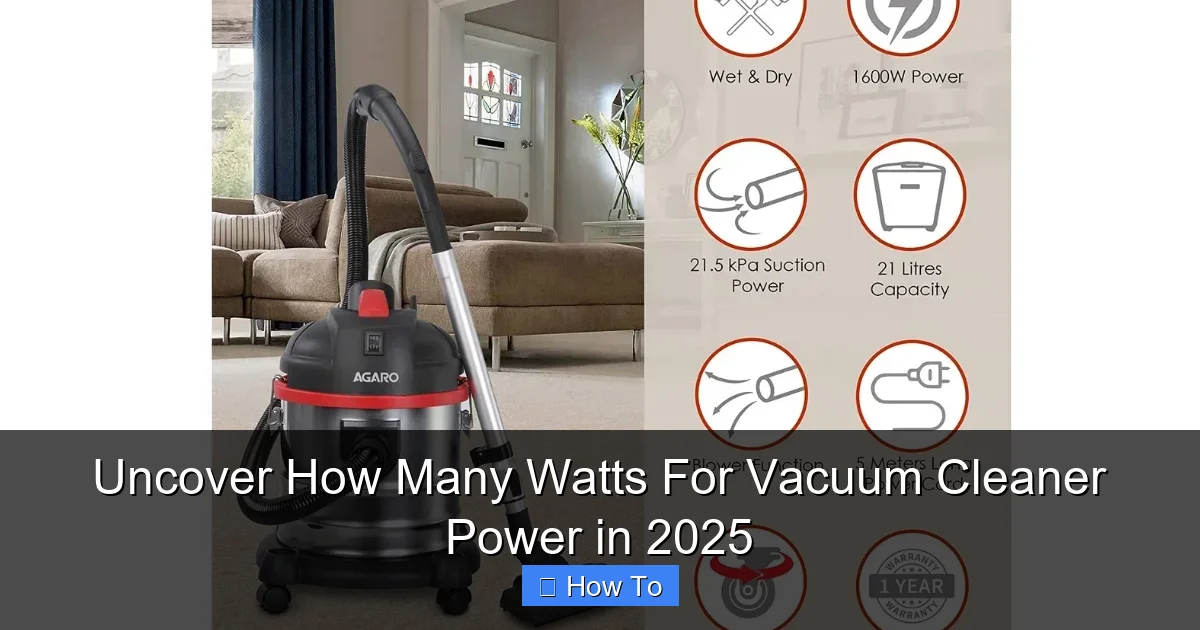
Visual guide about Uncover How Many Watts For Vacuum Cleaner Power in 2025
Image source: drowdry.com
H3: Empty the Dustbin or Change the Bag
A full dustbin or bag severely restricts airflow, drastically reducing suction power. Empty or replace it regularly.
H3: Clean or Replace Filters
Clogged filters (pre-motor and post-motor/HEPA) impede airflow. Most filters are washable or replaceable; consult your manual.
H3: Inspect the Brush Roll
Hair and fibers can wrap around the brush roll, preventing it from spinning effectively. Clean it regularly.
H3: Check for Leaks in the System
Cracks in the hose or loose connections can cause suction loss. Ensure all attachments are securely fitted.
H3: Adjust Height Settings (for uprights)
If your upright vacuum has height adjustments, ensure it’s set correctly for your carpet pile. Too high, and it won’t agitate; too low, and it seals off suction.
Conclusion: Powering Your Clean in 2025
Understanding “how many watts for vacuum cleaner” is a crucial first step in choosing the right appliance, but it’s just one piece of the puzzle. In 2025, modern vacuum technology allows for incredible cleaning power with increasingly efficient motors. Instead of fixating solely on high motor wattage, focus on the overall design, air watt ratings (if available), and features that cater to your specific home and cleaning habits.
By considering your floor types, the types of debris you typically clean, and balancing performance with energy efficiency, you can select a vacuum cleaner that not only has the right amount of power but also delivers an exceptional cleaning experience. Armed with this knowledge, you’re now ready to confidently choose a vacuum that will keep your home sparkling clean for years to come!
🎥 Related Video: 4 Vacuum Buying Rules Homeowners MUST Know!
📺 Vacuum Nerds
Here are the 4 Rules that everyone breaks when buying a vacuum. This one is just my experience. Canister vacuum …