How a Wet Dry Vacuum Cleaner Works in 2025 Unveiled
A wet dry vacuum cleaner is a powerhouse cleaning machine engineered to tackle both solid debris and liquid spills effortlessly. It operates using a robust motor to generate immense suction, directing messes into specialized collection tanks. Understanding the core mechanics, from its sophisticated airflow management and dual filtration systems to the crucial float ball safety mechanism, empowers users to maximize the utility and longevity of their wet dry vac, especially as technology advances in 2025.
How a Wet Dry Vacuum Cleaner Works in 2025 Unveiled
Welcome to the ultimate guide on understanding the impressive technology behind one of the most versatile cleaning tools around: the wet dry vacuum cleaner. In a world increasingly focused on efficiency and adaptability, the wet dry vac stands out as an indispensable helper for homes, workshops, and job sites alike. But how exactly does this marvel of engineering manage to suck up sawdust one minute and a bucket of spilled water the next?
By 2025, while the fundamental principles remain the same, modern advancements have made these machines smarter, more powerful, and easier to use than ever before. If you’ve ever been curious about the inner workings of your trusty wet dry vac, or if you’re considering investing in one, you’re in the right place. We’re going to pull back the curtain and explain, in simple terms, every step of how a wet dry vacuum cleaner operates, what makes it so unique, and what exciting innovations you can expect from today’s models. Get ready to understand your cleaning powerhouse like never before!
Key Takeaways
- Dual Functionality: A wet dry vacuum cleaner is uniquely designed to handle both dry debris (dust, dirt, wood shavings) and liquid spills (water, mud, oil) with equal efficiency, unlike standard household vacuums.
- Powerful Suction Mechanism: At its core, a strong motor drives a fan to create a high-velocity airflow, generating the vacuum suction necessary to lift heavy debris and liquids.
- Specialized Filtration: These versatile vacuums utilize different filtration methods for wet versus dry tasks. Dry vacuuming employs cartridge filters, while wet vacuuming often uses a foam sleeve, protecting the motor from moisture.
- Collection Tanks: All collected material, whether solid or liquid, is deposited into a large, durable collection tank, which needs to be emptied regularly for optimal performance.
- Float Ball Safety Feature: During wet vacuuming, a crucial float ball rises with the water level, automatically shutting off suction when the tank is full to prevent liquid from reaching and damaging the motor.
- Blower Functionality: Many modern wet dry vacuum cleaners also offer a powerful blower mode, allowing them to clear debris from workshops, driveways, or even dry wet surfaces.
- 2025 Innovations: Expect advanced battery technology, smart features (like sensor-based cleaning or app integration), enhanced filtration for fine particles, and quieter operation to be prominent in newer models.
Quick Answers to Common Questions
What’s the best way to clean a clogged filter?
For dry cartridge filters, carefully remove them and tap them against a hard surface (like a trash can) to dislodge loose debris. For deeply embedded dirt, some filters can be rinsed with water, but always check your manual first and ensure they are *completely* dry before reinstallation to avoid motor damage.
Can I use my wet dry vac without a filter?
Never operate your wet dry vacuum cleaner without the appropriate filter. For dry vacuuming, a cartridge filter protects the motor from dust. For wet vacuuming, a foam sleeve or wet filter is essential to prevent splashing water from reaching and damaging the motor. Running it without a filter will void your warranty and likely destroy the motor.
How do I know if the float ball is working correctly?
To test the float ball, fill the tank with water to near capacity while the vacuum is off. The ball should float freely to the top. Then, with the vac running, observe if the suction cuts off as the water level approaches the motor’s intake. If it doesn’t, the float ball might be stuck or damaged and needs attention.
What’s the difference between a shop vac and a wet dry vac?
The terms “shop vac” and “wet dry vac” are often used interchangeably. “Shop-Vac” is actually a popular brand name, similar to how “Kleenex” is used for tissues. Functionally, a shop vac is a type of wet dry vacuum cleaner, meaning it has the capability to handle both wet and dry messes.
My wet dry vac smells bad after wet use. What should I do?
A bad smell usually indicates that liquid debris, especially dirty water or organic matter, was left in the tank too long. To fix this, empty the tank completely, rinse it thoroughly with clean water, and clean any foam filters. You can also use a mild detergent solution to clean the tank, then rinse well and let all components air dry completely before reassembling and storing.
The Core Principle: Generating Powerful Suction
At the heart of every wet dry vacuum cleaner is a simple yet powerful concept: creating a strong vacuum. This isn’t just any vacuum; it’s one designed to handle significant challenges.
The Motor and Fan: The Engine of Suction
The main component responsible for the magic is the electric motor, which powers a high-speed fan, often called an impeller. When you switch on your wet dry vac, the motor spins this fan rapidly. This spinning action does two critical things simultaneously:
- Creates Low Pressure: As the fan blades spin, they push air out through an exhaust port. This rapid expulsion of air creates an area of lower air pressure inside the collection tank and the connected hose.
- Draws in Air: Nature abhors a vacuum! Because the pressure inside the hose is now lower than the atmospheric pressure outside, the higher external pressure pushes air—and whatever debris or liquid is in its path—into the hose and towards the collection tank. This is the essence of suction.
The stronger the motor and the more efficiently the fan is designed, the more powerful the suction force generated by the wet dry vacuum cleaner. This raw power is what allows it to lift heavy dirt and substantial volumes of liquid.
The Dry Vacuuming Process: Tackling Solid Messes
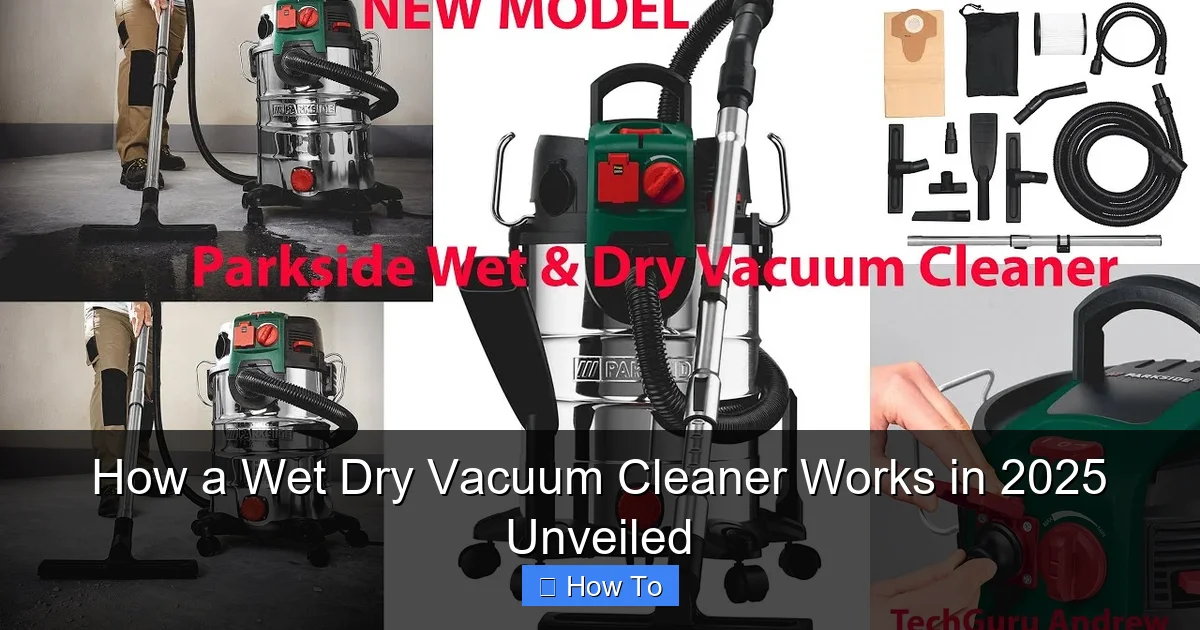
Visual guide about How a Wet Dry Vacuum Cleaner Works in 2025 Unveiled
Image source: i.ytimg.com
When you’re cleaning up wood chips, drywall dust, or general workshop debris, your wet dry vacuum cleaner employs a specific set of internal mechanisms to ensure efficient collection and motor protection.
Step 1: Intake of Debris and Air
The process begins when the powerful suction draws air, along with any dry debris, through the nozzle and into the hose. This mixture then travels down the hose towards the main collection tank.
Step 2: Entering the Collection Tank
Upon reaching the collection tank, the air and debris mixture slows down slightly. The design of the tank often encourages a cyclonic action or simply a drop in velocity, allowing heavier particles to fall to the bottom of the tank.
Step 3: Critical Dry Filtration
This is where a crucial distinction for a wet dry vacuum cleaner comes into play. To protect the motor from fine dust and debris, a specialized filter is installed.
- The Cartridge Filter: Most wet dry vacs use a large, pleated cartridge filter, similar to an air filter in a car. This filter is designed to trap minuscule dry particles while allowing clean air to pass through. It typically covers the intake path to the motor.
- Why it’s Essential: Without this filter, fine dust would be sucked directly into the motor, leading to rapid wear and tear, overheating, and ultimately, motor failure. The clean air then exits through the exhaust port of the wet dry vacuum cleaner.
It’s vital to ensure the correct filter is in place and properly seated for dry vacuuming.
Step 4: Collection of Dry Debris
The filtered dry debris settles at the bottom of the collection tank, ready to be disposed of once your cleaning task is complete. The tank’s capacity dictates how much debris can be collected before it needs emptying.
The Wet Vacuuming Process: Conquering Liquid Spills
Switching from dry to wet tasks requires a different internal setup for your wet dry vacuum cleaner, primarily concerning filtration and safety mechanisms. This is where its true versatility shines.
Step 1: Preparing for Liquids – Filter Change
Before tackling any liquids, you *must* remove the dry cartridge filter. Sucking water through a dry paper filter will ruin the filter and severely restrict airflow, potentially damaging your wet dry vac.
- The Foam Sleeve: Instead of a pleated cartridge filter, a foam sleeve or a specialized wet filter is typically used. This foam sleeve allows air and liquid to pass through freely while preventing larger debris from potentially harming the motor. It acts as a primary barrier against splashes.
- Proper Installation: Ensure the foam filter is securely placed according to your model’s instructions.
Step 2: Intake of Liquid and Air
Similar to dry vacuuming, the powerful suction draws in the liquid and some air through the nozzle and hose. The key difference is the density of what’s being pulled in.
Step 3: Liquid Enters the Collection Tank
The liquid, often accompanied by some air, enters the main collection tank. Because liquids are much denser than air and dry debris, they immediately begin to settle at the bottom of the tank.
Step 4: The Crucial Float Ball Safety System
This is perhaps the most ingenious safety feature of a wet dry vacuum cleaner. Located within the collection tank, directly beneath the motor housing, is a float ball mechanism.
- How it Works: As the liquid level in the tank rises, the buoyant float ball rises with it.
- Automatic Shut-off: When the tank is nearly full, the float ball reaches the top of its chamber and seals off the intake port to the motor. This immediately stops the airflow and the suction, producing a distinct change in the sound of the wet dry vac or a complete cut-off of suction. This is a critical warning sign that the tank needs to be emptied.
- Motor Protection: This mechanism is vital. It prevents liquid from ever reaching the motor, which would cause an electrical short circuit, significant damage, and pose a safety hazard. Never override or ignore the float ball’s activation.
Step 5: Collection of Liquid
The liquid collects at the bottom of the tank, ready for disposal. The capacity of the tank is especially important for wet vacuuming, as liquids can quickly fill it up.
More Than Just Suction: The Blower Function
Many modern wet dry vacuum cleaners offer an additional, highly useful feature: a blower function. This effectively turns your vacuum into a powerful leaf blower or air mover.
How the Blower Works
Instead of drawing air into the hose, the blower function redirects the powerful airflow generated by the motor and fan *out* through a dedicated exhaust port.
- Reversing the Flow (conceptually): While not literally reversing the fan, the design allows the air that would normally be exhausted from the motor chamber to be channeled into an output hose.
- Practical Uses: This is incredibly handy for clearing debris from driveways, blowing leaves, drying wet floors or car interiors, or even inflating air mattresses (with the right attachment). It adds another layer of versatility to your wet dry vacuum cleaner.
Inside the Shell: Key Components of Your Wet Dry Vac
Beyond the motor, fan, and filters, several other components work in harmony to make a wet dry vacuum cleaner effective.
The Collection Tank (Drum)
This durable container, typically made of plastic or stainless steel, is where all the collected dry debris or liquids are stored. Tank sizes vary widely, from small 2-gallon models for quick clean-ups to large 20-gallon beasts for commercial applications.
Hose and Attachments
The flexible hose connects to the intake port and directs the debris/liquid. A variety of attachments are available:
- Utility Nozzle: A wide, flat nozzle for general purpose cleaning.
- Crevice Tool: For tight spaces and corners.
- Wet Nozzle: Often with squeegee blades for efficient liquid pick-up.
- Floor Brush: For larger dry surfaces.
These attachments make the wet dry vacuum cleaner adaptable to countless scenarios.
Power Source
Traditionally, wet dry vacs are corded, offering continuous power. However, with advancements in 2025, powerful cordless wet dry vacuum cleaner models are becoming increasingly popular, offering unparalleled portability thanks to improved battery technology.
Wet Dry Vacs in 2025: What’s New?
While the fundamental principles remain tried and true, the year 2025 brings exciting enhancements to the wet dry vacuum cleaner landscape.
Enhanced Battery Technology
Cordless wet dry vacs are no longer just for light-duty tasks. Advancements in lithium-ion battery technology mean longer run times, quicker charging, and more consistent power output, making cordless models viable for extended, heavy-duty use. Expect swappable battery packs and smart charging solutions to be standard.
Smart Features and Connectivity
Some high-end wet dry vacuum cleaner models are beginning to integrate smart technology. This could include:
- Sensor-Based Operation: Sensors that detect the type of debris (wet or dry) and automatically adjust suction power or even suggest filter changes.
- App Integration: Monitoring battery life, filter status, or even scheduling maintenance alerts via a smartphone app.
- Voice Assistant Compatibility: Basic controls through smart home ecosystems.
Advanced Filtration Systems
Beyond standard cartridge filters, 2025 models are pushing for even better air quality. HEPA-rated wet dry vacuum cleaner filters are becoming more common, designed to capture microscopic particles like allergens, mold spores, and very fine dust, making them ideal for sensitive environments. Multi-stage filtration is also evolving to trap different particle sizes more effectively.
Noise Reduction Technology
Older wet dry vacs were notoriously loud. Modern engineering is focusing on quieter motors, redesigned fan housings, and sound-dampening materials to significantly reduce operational noise, making them much more pleasant to use indoors.
Increased Durability and Eco-Friendliness
Manufacturers are focusing on more robust materials that can withstand harsh environments and prolonged use. Furthermore, there’s a growing trend towards more energy-efficient motors and the use of recycled materials in construction, reflecting a broader commitment to sustainability.
Keeping Your Wet Dry Vac Happy: Maintenance Tips
To ensure your wet dry vacuum cleaner continues to perform optimally for years to come, regular maintenance is key.
1. Empty the Tank Regularly
Don’t wait until it’s overflowing. For wet tasks, empty the liquid promptly to prevent stagnation and odors. For dry tasks, empty when about two-thirds full to maintain suction efficiency.
2. Clean or Replace Filters
- Dry Filters: Tap them clean or rinse them if they’re washable (check your manual). Replace them when they become too clogged or damaged. A clean filter is crucial for strong suction and motor longevity.
- Foam Filters: Rinse foam sleeves thoroughly after wet use and let them air dry completely before storing or reusing.
3. Check the Hose and Attachments
Periodically inspect for blockages, cracks, or damage. Clear any obstructions that might reduce suction.
4. Keep the Float Ball Clean
Ensure the float ball and its cage are free of debris or grime that could prevent it from rising properly during wet vacuuming.
5. Store Properly
Store your wet dry vacuum cleaner in a clean, dry place. If it’s a cordless model, follow battery storage guidelines (e.g., store at a partial charge).
“Help! My Wet Dry Vac Isn’t Working Right”: Troubleshooting Common Issues
Even with the best wet dry vacuum cleaner, you might encounter issues. Here are quick fixes for common problems.
No Suction or Weak Suction
- Check for Blockages: The most common culprit. Inspect the hose, nozzle, and intake port for clogs.
- Check Filters: A dirty or clogged dry filter will drastically reduce suction. Clean or replace it. Ensure the correct filter (dry or foam) is installed for the task.
- Tank Full: For wet vacuuming, the float ball might have engaged. Empty the tank.
- Lid Seal: Ensure the motor head is securely latched onto the collection tank. Any air leak will reduce suction.
Motor Cuts Out During Wet Use
- Float Ball Activated: This is normal! The tank is full. Empty the tank and restart.
- Overheating: The motor might be overheating due to a blockage or prolonged heavy use. Turn it off, let it cool down, and check for obstructions.
Leaking from the Tank
- Improper Lid Seal: Re-secure the motor head.
- Damaged Tank/Gasket: Inspect the tank for cracks or the seal gasket for damage.
- Overfilling: If the float ball is stuck or faulty, liquid might overflow. Address the float ball issue.
Conclusion
The wet dry vacuum cleaner is a testament to practical engineering, combining powerful suction with ingenious safety features to handle the toughest cleaning challenges. From the humble motor and fan creating that essential vacuum to the sophisticated filtration systems and the life-saving float ball, every component plays a vital role in its operation.
As we move further into 2025, these versatile machines continue to evolve, offering smarter features, improved battery life, enhanced filtration, and quieter performance. Understanding how your wet dry vac works empowers you not only to use it more effectively but also to perform necessary maintenance and troubleshooting, ensuring it remains a reliable workhorse for years to come. So next time you fire up your wet dry vacuum cleaner, you’ll know precisely the intricate dance of physics and engineering happening inside, making quick work of any mess, wet or dry.
🎥 Related Video: The BEST Vacuum!?
📺 RYOBI TOOLS USA